
- Posts: 464
- Thank you received: 0
Seattle Times: "The truth about global warming"
- garyabrill
-

- User
-

Less
More
19 years 11 months ago #175900
by garyabrill
Only crazy if you think that the climate some 200 million years ago was strictly controlled by CO2. Your next door neighbors in Africa and Eurasia at the time might have had a bit of insight into the effects land masses have on climate.
As to bears, whether they will adapt or not based on bears that are fed fish and anti-biotics in a zoo might be a bit of a stretch. I assume you realize polar bears are now cannibalizing one another for the first time in recorded history because (apparently) of starvation.
Replied by garyabrill on topic Re: Seattle Times: "The truth about global warming"
My point is, bears adapt and will survive.... Just because they hunt a certain way now does not mean they cannot adapt to change. The zoo thing I just threw in there to be a smart axe.
BTW, I thought the north american continent was once tropical (tropical fossils found, etc) .....do I remember this correctly, or am I crazy?
Only crazy if you think that the climate some 200 million years ago was strictly controlled by CO2. Your next door neighbors in Africa and Eurasia at the time might have had a bit of insight into the effects land masses have on climate.
As to bears, whether they will adapt or not based on bears that are fed fish and anti-biotics in a zoo might be a bit of a stretch. I assume you realize polar bears are now cannibalizing one another for the first time in recorded history because (apparently) of starvation.
Please Log in or Create an account to join the conversation.
- Randonnee
-
- User
-
Less
More
- Posts: 170
- Thank you received: 0
19 years 11 months ago #175942
by Randonnee
Replied by Randonnee on topic Re: Seattle Times: "The truth about global warming
Greenland's glaciers have been shrinking for 100 years: study
Aug 21 3:18 PM US/Eastern
Greenland's glaciers have been shrinking for the past century, according to a Danish study, suggesting that the ice melt is not a recent phenomenon caused by global warming...
Using maps from the 19th century and current satellite observations, the scientists were able to conclude that "70 percent of the glaciers have been shrinking regularly since the end of the 1880s at a rate of around eight meters per year," Yde said...
"A three-to-four degree increase of the temperature on Greenland from 1920 to 1930, and the increase recorded since 1995 has sped up the ice melt," he said...
www.breitbart.com/news/2006/08/21/060821191826.o0mynclv.html
Aug 21 3:18 PM US/Eastern
Greenland's glaciers have been shrinking for the past century, according to a Danish study, suggesting that the ice melt is not a recent phenomenon caused by global warming...
Using maps from the 19th century and current satellite observations, the scientists were able to conclude that "70 percent of the glaciers have been shrinking regularly since the end of the 1880s at a rate of around eight meters per year," Yde said...
"A three-to-four degree increase of the temperature on Greenland from 1920 to 1930, and the increase recorded since 1995 has sped up the ice melt," he said...
www.breitbart.com/news/2006/08/21/060821191826.o0mynclv.html
Please Log in or Create an account to join the conversation.
- garyabrill
-
- User
-
Less
More
- Posts: 464
- Thank you received: 0
19 years 11 months ago #175994
by garyabrill
Now, now now...so if glacier melt is not "caused by global warming"; just what is causing glacier melt? Cooling? Reindeer? Santa Claus? Glacier stagnation can be only caused in two ways: warming or lack of snowfall. Glacier melting can have only one cause: melting....No?
In any case, it is the rate of glacier melt that is disconcerting. If glaciers in Washington, for instance, were disappearing at the rate they have been doing so then no marginal glaciers would exist in Washington - the same marginal glaciers that have existed for hundreds or thousands of years. All that could be left would be about 1-2 dozen of the very largest Washington glaciers. Europe has seen even more dramatic melt, as has the Himalyan Peruvian Glaciers and Sw'ern Canadian glaciers to name a few. You should see the Manatee and Remora glaciers near Pemberton if you want examples. Or read a paper ... google "disappearance of Peyto Glacier" in the Rockies.
On hurricanes, try googling "SST and tropical storm formation" and "effects of wind shear on hurricane development". You should be able to find some very good scientific papers.
Replied by garyabrill on topic Re: Seattle Times: "The truth about global warming
Greenland's glaciers have been shrinking for 100 years: study
Aug 21 3:18 PM US/Eastern
Greenland's glaciers have been shrinking for the past century, according to a Danish study, suggesting that the ice melt is not a recent phenomenon caused by global warming...
Using maps from the 19th century and current satellite observations, the scientists were able to conclude that "70 percent of the glaciers have been shrinking regularly since the end of the 1880s at a rate of around eight meters per year," Yde said...
"A three-to-four degree increase of the temperature on Greenland from 1920 to 1930, and the increase recorded since 1995 has sped up the ice melt," he said...
www.breitbart.com/news/2006/08/21/060821191826.o0mynclv.html
Now, now now...so if glacier melt is not "caused by global warming"; just what is causing glacier melt? Cooling? Reindeer? Santa Claus? Glacier stagnation can be only caused in two ways: warming or lack of snowfall. Glacier melting can have only one cause: melting....No?
In any case, it is the rate of glacier melt that is disconcerting. If glaciers in Washington, for instance, were disappearing at the rate they have been doing so then no marginal glaciers would exist in Washington - the same marginal glaciers that have existed for hundreds or thousands of years. All that could be left would be about 1-2 dozen of the very largest Washington glaciers. Europe has seen even more dramatic melt, as has the Himalyan Peruvian Glaciers and Sw'ern Canadian glaciers to name a few. You should see the Manatee and Remora glaciers near Pemberton if you want examples. Or read a paper ... google "disappearance of Peyto Glacier" in the Rockies.
On hurricanes, try googling "SST and tropical storm formation" and "effects of wind shear on hurricane development". You should be able to find some very good scientific papers.
Please Log in or Create an account to join the conversation.
- hyak.net
-
- User
-
Less
More
- Posts: 601
- Thank you received: 0
19 years 11 months ago #175995
by hyak.net
Replied by hyak.net on topic Re: Seattle Times: "The truth about global warming
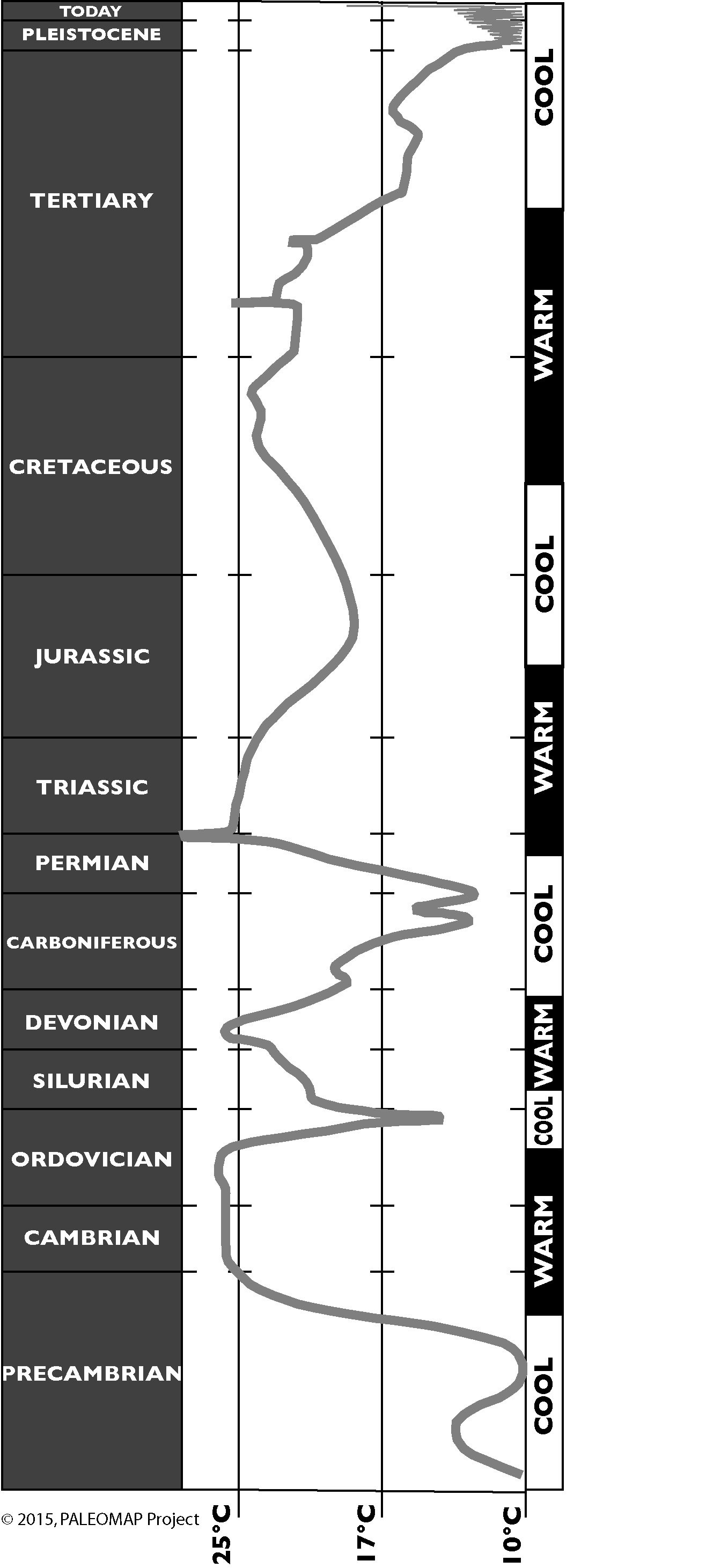
Follow this chart of Earth Climate History. You will notice a trend and we humans have no way to control this. As you can see, we have a long bit of warming to go just to reach the average earth temprature over the duration of its existance. Its a natural phenomenon we do not control.
Please Log in or Create an account to join the conversation.
- philfort
-
- User
-
Less
More
- Posts: 259
- Thank you received: 0
19 years 11 months ago #175997
by philfort
Replied by philfort on topic Re: Seattle Times: "The truth about global warming"
As has been repeated over and over and over again, it isn't the absolute temperature that is of concern, but the (apparently) unprecedented rate of change and how it will affect us in the next few decades/centuries. Your graph covers billions of years, so it isn't really relevant to the discussion (other than to show it will probably get colder again at some time in the future) - humans will probably just be a blip on the graph anyway (that doesn't imply "we humans have no way to control this" though).
Please Log in or Create an account to join the conversation.
- Randonnee
-
- User
-
Less
More
- Posts: 170
- Thank you received: 0
19 years 11 months ago - 19 years 11 months ago #175998
by Randonnee
Replied by Randonnee on topic Re: Seattle Times: "The truth about global warming
From the National Academy of Sciences:
"...Because of larger uncertainties in temperature reconstructions for decades and individual years, and because not all proxies record temperatures for such short timescales, even less confidence can be placed in the Mann team's conclusions about the 1990s, and 1998 in particular..."
"...The reconstructions show relatively warm conditions centered around the year 1000, and a relatively cold period, or "Little Ice Age," from roughly 1500 to 1850. " Perhaps this explains the advance and then the recent shrinking of glaciers.
My point here is that significant uncertainty remains even in the information that is weighed heavily toward GW enthusiasts' doom and gloom. There are modeling on top of modeling, proxy evidence, suppositons, and rushing to conclusions with emotional zeal. In trying to read the various positions, it appears to me that it always balances out to:
It is warmer recently, and greenhouse gasses may contribute. Yea, so.
Even at my (low) level of use of (review of data and studies) science in patient care I do not see a comparable clear and proven conclusion to the popular GW enthusiast view. The doom and gloom and alarmist whining is just that. Dismissing the whole concept per the GW enthusiasts would likewise be foolish. But it is just not conclusive as many want to say. To frame it another way, if such (GW enthusiast doom gloom acceptance based on studies)"conclusive" evidence suits your "scientific" standard, then a drug rep with a few studies could sell you a lot of widely unproven drugs....
See the NAS press release below:
Date: June 22, 2006
Contacts: Bill Kearney, Director of Media Relations
Megan Petty, Media Relations Assistant
Office of News and Public Information
202-334-2138; e-mail <news@nas.edu>
FOR IMMEDIATE RELEASE
'High Confidence' That Planet Is Warmest in 400 Years;
Less Confidence in Temperature Reconstructions Prior to 1600
WASHINGTON -- There is sufficient evidence from tree rings, boreholes, retreating glaciers, and other "proxies" of past surface temperatures to say with a high level of confidence that the last few decades of the 20th century were warmer than any comparable period in the last 400 years, according to a new report from the National Research Council. Less confidence can be placed in proxy-based reconstructions of surface temperatures for A.D. 900 to 1600, said the committee that wrote the report, although the available proxy evidence does indicate that many locations were warmer during the past 25 years than during any other 25-year period since 900. Very little confidence can be placed in statements about average global surface temperatures prior to A.D. 900 because the proxy data for that time frame are sparse, the committee added.
Scientists rely on proxies to reconstruct paleoclimatic surface temperatures because geographically widespread records of temperatures measured with instruments date back only about 150 years. Other proxies include corals, ocean and lake sediments, ice cores, cave deposits, and documentary sources, such as historic drawings of glaciers. The globally averaged warming of about 1 degree Fahrenheit (0.6 degrees Celsius) that instruments have recorded during the last century is also reflected in proxy data for that time period, the committee noted.
The report was requested by Congress after a controversy arose last year over surface temperature reconstructions published by climatologist Michael Mann and his colleagues in the late 1990s. The researchers concluded that the warming of the Northern Hemisphere in the last decades of the 20th century was unprecedented in the past thousand years. In particular, they concluded that the 1990s were the warmest decade, and 1998 the warmest year. Their graph depicting a rise in temperatures at the end of a long era became known as the "hockey stick."
The Research Council committee found the Mann team's conclusion that warming in the last few decades of the 20th century was unprecedented over the last thousand years to be plausible, but it had less confidence that the warming was unprecedented prior to 1600; fewer proxies -- in fewer locations -- provide temperatures for periods before then. Because of larger uncertainties in temperature reconstructions for decades and individual years, and because not all proxies record temperatures for such short timescales, even less confidence can be placed in the Mann team's conclusions about the 1990s, and 1998 in particular.
The committee noted that scientists' reconstructions of Northern Hemisphere surface temperatures for the past thousand years are generally consistent. The reconstructions show relatively warm conditions centered around the year 1000, and a relatively cold period, or "Little Ice Age," from roughly 1500 to 1850. The exact timing of warm episodes in the medieval period may have varied by region, and the magnitude and geographical extent of the warmth is uncertain, the committee said. None of the reconstructions indicates that temperatures were warmer during medieval times than during the past few decades, the committee added.
The scarcity of precisely dated proxy evidence for temperatures before 1600, especially in the Southern Hemisphere, is the main reason there is less confidence in global reconstructions dating back further than that. Other factors that limit confidence include the short length of the instrumental record, which is used to calibrate and validate reconstructions, and the possibility that the relationship between proxy data and local surface temperatures may have varied over time. It also is difficult to estimate a mean global temperature using data from a limited number of sites. On the other hand, confidence in large-scale reconstructions is boosted by the fact that the proxies on which they are based generally exhibit strong correlations with local environmental conditions. Confidence increases further when multiple independent lines of evidence point to the same general phenomenon, such as the Little Ice Age.
Collecting additional proxy data, especially for years before 1600 and for areas where the current data are relatively sparse, would increase our understanding of temperature variations over the last 2,000 years, the report says. In addition, improving access to data on which published temperature reconstructions are based would boost confidence in the results. The report also notes that new analytical methods, or more careful use of existing methods, might help circumvent some of the current limitations associated with large-scale reconstructions.
The committee pointed out that surface temperature reconstructions for periods before the Industrial Revolution -- when levels of atmospheric greenhouse gases were much lower -- are only one of multiple lines of evidence supporting the conclusion that current warming is occurring in response to human activities, and they are not the primary evidence.
The National Research Council is the principal operating arm of the National Academy of Sciences and the National Academy of Engineering. It is a private, nonprofit institution that provides science and technology advice under a congressional charter. A committee roster follows.
Copies of Surface Temperature Reconstructions for the Last 2,000 Years will be available from the National Academies Press; tel. 202-334-3313 or 1-800-624-6242 or on the Internet at www.nap.edu . Reporters may obtain a pre-publication copy from the Office of News and Public Information (contacts listed above).
[ This news release and report are available at national-academies.org ]
NATIONAL RESEARCH COUNCIL
Division on Earth and Life Studies
Board on Atmospheric Sciences and Climate
Committee on Surface Temperature Reconstructions for the Last 2,000 Years
Gerald R. North (chair)
Distinguished Professor of Meteorology and Oceanography and
Harold J. Haynes Endowed Chair in Geosciences
Texas A&M University
College Station
Franco Biondi
Associate Professor of Physical Geography
University of Nevada
Reno
Peter Bloomfield
Professor of Statistics and of Financial Mathematics
North Carolina State University
Raleigh
John R. Christy
Professor of Atmospheric Science, and
Director
Earth System Science Center
University of Alabama
Huntsville
Kurt M. Cuffey
Professor of Geography
University of California
Berkeley
Robert E. Dickinson1,2
Professor
School of Earth and Atmospheric Sciences
Georgia Institute of Technology
Atlanta
Ellen R.M. Druffel
Professor of Earth System Science
University of California
Irvine
Douglas Nychka
Senior Scientist
National Center for Atmospheric Research
Boulder, Colo.
Bette Otto-Bliesner
Scientist
Climate and Global Dynamics Division;
Head
Paleoclimate Group; and
Deputy Head
Climate Change Research Section
National Center for Atmospheric Research
Boulder, Colo.
Neil Roberts
Head
School of Geography
University of Plymouth
Plymouth, United Kingdom
Karl K. Turekian1
Sterling Professor of Geology and Geophysics
Yale University
New Haven, Conn.
John M. Wallace1
Professor of Atmospheric Sciences, and
Director
Joint Institute for the Study of the Atmosphere and Ocean
University of Washington
Seattle
RESEARCH COUNCIL STAFF
Ian Kraucunas
Study Director
1 Member, National Academy of Sciences
2 Member, National Academy of Engineering
"...Because of larger uncertainties in temperature reconstructions for decades and individual years, and because not all proxies record temperatures for such short timescales, even less confidence can be placed in the Mann team's conclusions about the 1990s, and 1998 in particular..."
"...The reconstructions show relatively warm conditions centered around the year 1000, and a relatively cold period, or "Little Ice Age," from roughly 1500 to 1850. " Perhaps this explains the advance and then the recent shrinking of glaciers.
My point here is that significant uncertainty remains even in the information that is weighed heavily toward GW enthusiasts' doom and gloom. There are modeling on top of modeling, proxy evidence, suppositons, and rushing to conclusions with emotional zeal. In trying to read the various positions, it appears to me that it always balances out to:
It is warmer recently, and greenhouse gasses may contribute. Yea, so.
Even at my (low) level of use of (review of data and studies) science in patient care I do not see a comparable clear and proven conclusion to the popular GW enthusiast view. The doom and gloom and alarmist whining is just that. Dismissing the whole concept per the GW enthusiasts would likewise be foolish. But it is just not conclusive as many want to say. To frame it another way, if such (GW enthusiast doom gloom acceptance based on studies)"conclusive" evidence suits your "scientific" standard, then a drug rep with a few studies could sell you a lot of widely unproven drugs....
See the NAS press release below:
Date: June 22, 2006
Contacts: Bill Kearney, Director of Media Relations
Megan Petty, Media Relations Assistant
Office of News and Public Information
202-334-2138; e-mail <news@nas.edu>
FOR IMMEDIATE RELEASE
'High Confidence' That Planet Is Warmest in 400 Years;
Less Confidence in Temperature Reconstructions Prior to 1600
WASHINGTON -- There is sufficient evidence from tree rings, boreholes, retreating glaciers, and other "proxies" of past surface temperatures to say with a high level of confidence that the last few decades of the 20th century were warmer than any comparable period in the last 400 years, according to a new report from the National Research Council. Less confidence can be placed in proxy-based reconstructions of surface temperatures for A.D. 900 to 1600, said the committee that wrote the report, although the available proxy evidence does indicate that many locations were warmer during the past 25 years than during any other 25-year period since 900. Very little confidence can be placed in statements about average global surface temperatures prior to A.D. 900 because the proxy data for that time frame are sparse, the committee added.
Scientists rely on proxies to reconstruct paleoclimatic surface temperatures because geographically widespread records of temperatures measured with instruments date back only about 150 years. Other proxies include corals, ocean and lake sediments, ice cores, cave deposits, and documentary sources, such as historic drawings of glaciers. The globally averaged warming of about 1 degree Fahrenheit (0.6 degrees Celsius) that instruments have recorded during the last century is also reflected in proxy data for that time period, the committee noted.
The report was requested by Congress after a controversy arose last year over surface temperature reconstructions published by climatologist Michael Mann and his colleagues in the late 1990s. The researchers concluded that the warming of the Northern Hemisphere in the last decades of the 20th century was unprecedented in the past thousand years. In particular, they concluded that the 1990s were the warmest decade, and 1998 the warmest year. Their graph depicting a rise in temperatures at the end of a long era became known as the "hockey stick."
The Research Council committee found the Mann team's conclusion that warming in the last few decades of the 20th century was unprecedented over the last thousand years to be plausible, but it had less confidence that the warming was unprecedented prior to 1600; fewer proxies -- in fewer locations -- provide temperatures for periods before then. Because of larger uncertainties in temperature reconstructions for decades and individual years, and because not all proxies record temperatures for such short timescales, even less confidence can be placed in the Mann team's conclusions about the 1990s, and 1998 in particular.
The committee noted that scientists' reconstructions of Northern Hemisphere surface temperatures for the past thousand years are generally consistent. The reconstructions show relatively warm conditions centered around the year 1000, and a relatively cold period, or "Little Ice Age," from roughly 1500 to 1850. The exact timing of warm episodes in the medieval period may have varied by region, and the magnitude and geographical extent of the warmth is uncertain, the committee said. None of the reconstructions indicates that temperatures were warmer during medieval times than during the past few decades, the committee added.
The scarcity of precisely dated proxy evidence for temperatures before 1600, especially in the Southern Hemisphere, is the main reason there is less confidence in global reconstructions dating back further than that. Other factors that limit confidence include the short length of the instrumental record, which is used to calibrate and validate reconstructions, and the possibility that the relationship between proxy data and local surface temperatures may have varied over time. It also is difficult to estimate a mean global temperature using data from a limited number of sites. On the other hand, confidence in large-scale reconstructions is boosted by the fact that the proxies on which they are based generally exhibit strong correlations with local environmental conditions. Confidence increases further when multiple independent lines of evidence point to the same general phenomenon, such as the Little Ice Age.
Collecting additional proxy data, especially for years before 1600 and for areas where the current data are relatively sparse, would increase our understanding of temperature variations over the last 2,000 years, the report says. In addition, improving access to data on which published temperature reconstructions are based would boost confidence in the results. The report also notes that new analytical methods, or more careful use of existing methods, might help circumvent some of the current limitations associated with large-scale reconstructions.
The committee pointed out that surface temperature reconstructions for periods before the Industrial Revolution -- when levels of atmospheric greenhouse gases were much lower -- are only one of multiple lines of evidence supporting the conclusion that current warming is occurring in response to human activities, and they are not the primary evidence.
The National Research Council is the principal operating arm of the National Academy of Sciences and the National Academy of Engineering. It is a private, nonprofit institution that provides science and technology advice under a congressional charter. A committee roster follows.
Copies of Surface Temperature Reconstructions for the Last 2,000 Years will be available from the National Academies Press; tel. 202-334-3313 or 1-800-624-6242 or on the Internet at www.nap.edu . Reporters may obtain a pre-publication copy from the Office of News and Public Information (contacts listed above).
[ This news release and report are available at national-academies.org ]
NATIONAL RESEARCH COUNCIL
Division on Earth and Life Studies
Board on Atmospheric Sciences and Climate
Committee on Surface Temperature Reconstructions for the Last 2,000 Years
Gerald R. North (chair)
Distinguished Professor of Meteorology and Oceanography and
Harold J. Haynes Endowed Chair in Geosciences
Texas A&M University
College Station
Franco Biondi
Associate Professor of Physical Geography
University of Nevada
Reno
Peter Bloomfield
Professor of Statistics and of Financial Mathematics
North Carolina State University
Raleigh
John R. Christy
Professor of Atmospheric Science, and
Director
Earth System Science Center
University of Alabama
Huntsville
Kurt M. Cuffey
Professor of Geography
University of California
Berkeley
Robert E. Dickinson1,2
Professor
School of Earth and Atmospheric Sciences
Georgia Institute of Technology
Atlanta
Ellen R.M. Druffel
Professor of Earth System Science
University of California
Irvine
Douglas Nychka
Senior Scientist
National Center for Atmospheric Research
Boulder, Colo.
Bette Otto-Bliesner
Scientist
Climate and Global Dynamics Division;
Head
Paleoclimate Group; and
Deputy Head
Climate Change Research Section
National Center for Atmospheric Research
Boulder, Colo.
Neil Roberts
Head
School of Geography
University of Plymouth
Plymouth, United Kingdom
Karl K. Turekian1
Sterling Professor of Geology and Geophysics
Yale University
New Haven, Conn.
John M. Wallace1
Professor of Atmospheric Sciences, and
Director
Joint Institute for the Study of the Atmosphere and Ocean
University of Washington
Seattle
RESEARCH COUNCIL STAFF
Ian Kraucunas
Study Director
1 Member, National Academy of Sciences
2 Member, National Academy of Engineering
Please Log in or Create an account to join the conversation.