
- Posts: 49
- Thank you received: 0
Managing hazards when skiing
- hop
-

- User
-

Less
More
12 years 1 week ago - 12 years 1 week ago #222391
by hop
I'm not sure if I completely understand the Kanaroo reference but with regards to your last barometer for risk: going solo I basically stick to the meadow-skippiest terrain possible because my margin for error is tiny - I must be able to ski out of or self-rescue from ANY/EVERY incident I put myself in. With a partner, you have an added safety net: someone to belay you, someone to bounce ideas off of, a 2nd opinion, and worse case scenario someone to dig you out/stabilize/rescue you.
Of course, others may think differently and that's fine too.
Jason4: I may sell myself short, who knows. I do sometimes think I should man up and ski bigger lines, the ones that lots of other people go up and come down all the time. And someday I might get more comfortable with that again (I was much bolder - or more likely more naive - when I was younger), but definitely not with certain people in the party.
Replied by hop on topic Re: Managing hazards when skiing
flash mobs with go-pros and a popular public format to post. The 'social proof ' heuristic is a strong driving force within us humans which is why it creates decision making traps in potentially hazardous situations with sometimes tragic results. Look what was done to our Grand- daddy Kanaroo over here. I just assume that they knew that no one was below them when they triggered all those wet slides. One barometer for risk that I use is to ask, would I take this risk if I was going solo? If not, why would I take that risk with the camera rolling?
I'm not sure if I completely understand the Kanaroo reference but with regards to your last barometer for risk: going solo I basically stick to the meadow-skippiest terrain possible because my margin for error is tiny - I must be able to ski out of or self-rescue from ANY/EVERY incident I put myself in. With a partner, you have an added safety net: someone to belay you, someone to bounce ideas off of, a 2nd opinion, and worse case scenario someone to dig you out/stabilize/rescue you.
Of course, others may think differently and that's fine too.
Jason4: I may sell myself short, who knows. I do sometimes think I should man up and ski bigger lines, the ones that lots of other people go up and come down all the time. And someday I might get more comfortable with that again (I was much bolder - or more likely more naive - when I was younger), but definitely not with certain people in the party.
Please Log in or Create an account to join the conversation.
- Jason4
-
Topic Author
- User
-
Less
More
- Posts: 178
- Thank you received: 0
12 years 1 week ago #222394
by Jason4
Replied by Jason4 on topic Re: Managing hazards when skiing
When you get back from your whale hunt we should get out again. I feel like I'm more interested in seeing new places than I am skiing crazy lines. Krissy has declared next year to be the year of the coulior so I'm not sure what that will bring but I'm always happy to make hippy turns.
Please Log in or Create an account to join the conversation.
- Shred
-
- User
-
Less
More
- Posts: 78
- Thank you received: 0
12 years 1 week ago #222395
by Shred
Replied by Shred on topic Re: Managing hazards when skiing
I'm not sure if I completely understand the Kanaroo reference
thesnowtroopers.com/2014/washington-pass...aroo-hunting-take-1/
I believe freeski is referencing this tour.
Some really dangerous stuff going on...
Please Log in or Create an account to join the conversation.
- hop
-
- User
-
Less
More
- Posts: 49
- Thank you received: 0
12 years 1 week ago #222396
by hop
One thing's for sure - if I had been falling for that social proof trap I would have a lot more "classic" steep gnar descents under my belt by now. Most of my friends that frequent the steep, gnarly, and exposed don't bother inviting me anymore since 99% of the time my response is "thanks but no thanks, you guys have fun".
Replied by hop on topic Re: Managing hazards when skiing
[quote author=hop link=topic=31855.msg134073#msg134073 date=1402341764 I do sometimes think I should man up and ski bigger lines, the ones that lots of other people go up and come down all the time. And someday I might get more comfortable with that again (I was much bolder - or more likely more naive - when I was younger), but definitely not with certain people in the party.
the 'social proof' heuristic trap comes into play when we base our decision making on what other people are doing. This introduces a thinking bias and important cues required for hazard analysis can be misinterpreted or even missed altogether resulting in an increased probability for an accident. Just because someone else is taking a high risk does not mean you have to. Many don't make it back.
One thing's for sure - if I had been falling for that social proof trap I would have a lot more "classic" steep gnar descents under my belt by now. Most of my friends that frequent the steep, gnarly, and exposed don't bother inviting me anymore since 99% of the time my response is "thanks but no thanks, you guys have fun".
Please Log in or Create an account to join the conversation.
- Lowell_Skoog
-
- User
-
Less
More
- Posts: 1460
- Thank you received: 16
12 years 1 week ago #222398
by Lowell_Skoog
In ski mountaineering I think belays are more likely to be used for protecting against a fall on hard snow/ice rather than protection against avalanche hazard. At least, that's when I would most likely want to use one.
Using the Park Headwall as an example, if I wanted to belay somebody so they could check out the face from above, I'd probably bury a picket in a T-trench and sit on the flat summit area to belay them. I think a buried picket would be strong enough. The snow/ice on the summit is typically too soft for ice screws but too hard to use skis as an anchor.
Replied by Lowell_Skoog on topic Re: Managing hazards when skiing
Since I've never skied on belay or belayed a skier I've never experienced the force that it takes to keep someone from getting swept away if the slope does pop. I know that's a common technique for ski patrol so someone here must have felt it, how secure of a stance does the belayer need?
In ski mountaineering I think belays are more likely to be used for protecting against a fall on hard snow/ice rather than protection against avalanche hazard. At least, that's when I would most likely want to use one.
Using the Park Headwall as an example, if I wanted to belay somebody so they could check out the face from above, I'd probably bury a picket in a T-trench and sit on the flat summit area to belay them. I think a buried picket would be strong enough. The snow/ice on the summit is typically too soft for ice screws but too hard to use skis as an anchor.
Please Log in or Create an account to join the conversation.
- ron j
-
- User
-
Less
More
- Posts: 1091
- Thank you received: 0
12 years 1 week ago #222401
by ron j
Interesting.
Didn't ever have one, but years ago I saw something similar which also had a spring expanding ball about a foot in diameter that was attached to a avalanche cord like that and was designed to be attached to one's pack an deployed with a rip cord.
I have also heard of old timers tying plastic beach bottles to their avy cords, presumably to give them better flotation in an avy.
Obviously pre-beacon technology, eh?
Replied by ron j on topic Re: Managing hazards when skiing
Makes sense to me.
Did you ever own one of these?
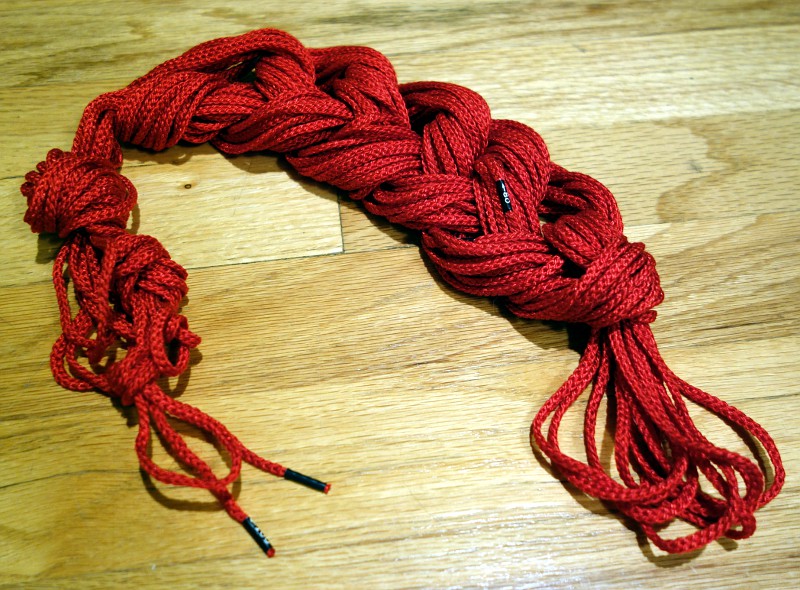
Add length markers to your rope and you could market a hot new product. Call it an avalanche cord.
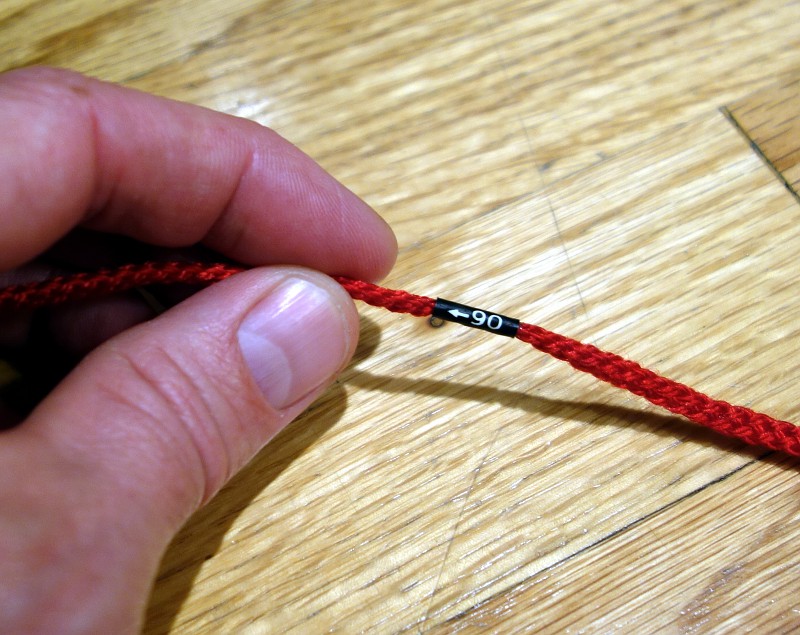
The picture shows an avalanche cord I bought at REI in the 1970s. The cord is 100 feet long with markers every 10 feet. The markers have an arrow pointing to the end where you tie in.
I don't think I ever used it, but I'm glad I never threw it away. It's a cool old relic.
Interesting.
Didn't ever have one, but years ago I saw something similar which also had a spring expanding ball about a foot in diameter that was attached to a avalanche cord like that and was designed to be attached to one's pack an deployed with a rip cord.
I have also heard of old timers tying plastic beach bottles to their avy cords, presumably to give them better flotation in an avy.
Obviously pre-beacon technology, eh?
Please Log in or Create an account to join the conversation.