
- Posts: 224
- Thank you received: 0
Expansion of North Cascades National Park
- Telemon
-

- User
-

Less
More
16 years 2 months ago #192200
by Telemon
Replied by Telemon on topic Re: Expansion of North Cascades National Park
I have been following this debate with some interest and I thought that I would chime in with my assessment of U.S. national park management. I am a Canadian who has visited quite a number of these parks. In fact, I recently returned home from a road trip that included 5 national parks and 3 monuments. My perception was that they cater to an ever increasing aged and unfit clientele. All outdoor activity information is directed to the lowest common denominator. Most trail descriptions are over exaggerated, even on the "Disneyized" paved paths. A ranger had my wife almost in tears about the risks of going on a cliff dwelling tour by using the routine summer heat speech, (while snow flurried around us). She declined the walk and missed out on something that she could have easily done. However, the topper was the trail description handout given by staff at the Capital Reef National Park visitor center.
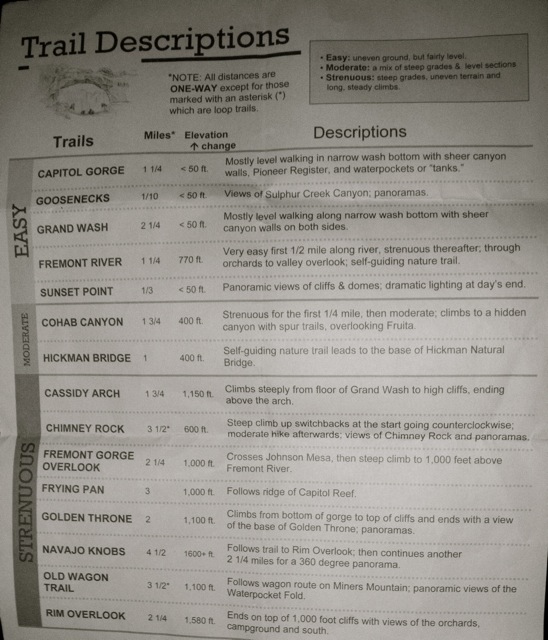
The first red flag (knowing what I have experienced in other national parks) should have been finding that a trail (Fremont River) with an elevation change of 770vf over 1 1/4 miles had been placed in the Easy category. My altimeter registered 490vf when I did this quick climb above the campsite; a park topo map confirmed this figure when I checked later. Even so, using the dumbed down criteria that national parks all seem to use, this would appear to be a "Moderate" hike. I wanted to take my wife along on a hike to Cassidy Arch, but she refused based on the handout stating that the trail would rise steeply up 1,150vf in just over 1 3/4 miles. So once again I went on my own. I noted that the large stone marker at the beginning of the trail said that the arch was 950' above. Well, my altimeter told me that it was actually 660'...not even close! I had failed to measure the first trail (Hickman Bridge) that we walked, but I kind of doubt that it is the 400vf on the handout.
I stopped in the bakery/museum before we left the park. The volunteer worker told me that most of the measurements on the handout were incorrect and that the park staff was aware of this fact. A uniformed person at the visitor center acknowledged that they had the correct data, but couldn't explain why they gave out misinformation to hikers. While I was writing a form letter to express my displeasure, the park's General Manager appeared. He couldn't explain either why their information wasn't even close to being right and why they continued to dispense it when they had the correct measurements at the desk. He said that I was the first person to complain. Maybe that is true, but I have to wonder what the rangers who walk those trails think. Could they be that incompetent,too?
Perhaps you think that my little rant is silly, but I was less than impressed with how national parks manage something fairly straightforward. It is very unlikely that I will ever be in the financial position to afford heli-skiing, but I rather like the North Cascades the way it is now.
The first red flag (knowing what I have experienced in other national parks) should have been finding that a trail (Fremont River) with an elevation change of 770vf over 1 1/4 miles had been placed in the Easy category. My altimeter registered 490vf when I did this quick climb above the campsite; a park topo map confirmed this figure when I checked later. Even so, using the dumbed down criteria that national parks all seem to use, this would appear to be a "Moderate" hike. I wanted to take my wife along on a hike to Cassidy Arch, but she refused based on the handout stating that the trail would rise steeply up 1,150vf in just over 1 3/4 miles. So once again I went on my own. I noted that the large stone marker at the beginning of the trail said that the arch was 950' above. Well, my altimeter told me that it was actually 660'...not even close! I had failed to measure the first trail (Hickman Bridge) that we walked, but I kind of doubt that it is the 400vf on the handout.
I stopped in the bakery/museum before we left the park. The volunteer worker told me that most of the measurements on the handout were incorrect and that the park staff was aware of this fact. A uniformed person at the visitor center acknowledged that they had the correct data, but couldn't explain why they gave out misinformation to hikers. While I was writing a form letter to express my displeasure, the park's General Manager appeared. He couldn't explain either why their information wasn't even close to being right and why they continued to dispense it when they had the correct measurements at the desk. He said that I was the first person to complain. Maybe that is true, but I have to wonder what the rangers who walk those trails think. Could they be that incompetent,too?
Perhaps you think that my little rant is silly, but I was less than impressed with how national parks manage something fairly straightforward. It is very unlikely that I will ever be in the financial position to afford heli-skiing, but I rather like the North Cascades the way it is now.
Please Log in or Create an account to join the conversation.
- Telemon
-
- User
-
Less
More
- Posts: 224
- Thank you received: 0
16 years 2 months ago #192201
by Telemon
Replied by Telemon on topic Re: Expansion of North Cascades National Park
I lost this attachment while posting.
Please Log in or Create an account to join the conversation.
- Jim Oker
-
- User
-
Less
More
- Posts: 901
- Thank you received: 0
16 years 2 months ago - 16 years 2 months ago #192202
by Jim Oker
Replied by Jim Oker on topic Re: Expansion of North Cascades National Park
Well, based on precedent, I'm don't trust how the Park Service would be likely to adjudicate that public discussion on hiking with dogs. I'd like to retain some nice places I can hike with my dog along highway 20. I don't see supporting a proposal that strikes me as leaving this up to NPS, and in fact, unless I saw that this was the only flaw and otherwise the proposal was super compelling, I'd support a fight against it on this count. I had a great trip to the Barron Yurt thanks to Paul's helicopter this winter - I'd like to be able to repeat the experience well into the future. I'm wondering if you might get his (and others', including my) support if you could bake a 20 year extension to his lease into the proposal? As for the wildlife, the general notion of protection sounds good to me. I have put my money where my mouth is there, giving significant $$$$ to the Northwest Ecosystem Alliance (now
Conservation NW
), as they sold me on a cogent proposal with good evidence for how what they planned would help wildlife in a very meaningful way (maintaining and increasing key wildlife corridors for species that have issues with range size). This proposal seems fuzzy on this front, and the global warming justification is just the worst of it. As for biomass, it's hard to imagine we'll allow harvest of slow-growing forest for this purpose with so much better opportunities west of the crest, and global warming won't be a good argument for biomass (compare C02 release to Coal if you don't believe me, and then ponder that these trees are both slow-growing and slow to decay, so it would be crazy to release their carbon by burning in the name of slowing GW). Dams - hmm. What valleys are most at risk due to their tempting nature as a great dam sites?
I'm frankly left feeling that this proposal is either the product of fuzzy thinking, or someone thinks they can snooker me. I respect the notion of preventing future threats, but again, let's be crystal clear on what they are, and discuss possible alternatives for dealing with them.
I'm frankly left feeling that this proposal is either the product of fuzzy thinking, or someone thinks they can snooker me. I respect the notion of preventing future threats, but again, let's be crystal clear on what they are, and discuss possible alternatives for dealing with them.
Please Log in or Create an account to join the conversation.
- telemark90
-
- User
-
Less
More
- Posts: 3
- Thank you received: 0
16 years 2 months ago #192205
by telemark90
Replied by telemark90 on topic Re: Expansion of North Cascades National Park
One of the biggest changes inherent in park management has barely been mentioned: permit regulations. As the Program Director for Outward Bound in Mazama, this is my chief concern. We operate extensively in the study area, as well as the adjacent wilderness and the NCNP. The NCNP requires all parties to be 6 or less in the backcountry, and 12 or less on trail (these parties must camp in designated campgrounds). Although I understand and support the rationale for this management scheme, this would obviously pose an enormous problem for our organization, which relies upon a financial and educational model of using medium-sized groups (8 -- 12 total).
In the many years we have operated in Washington, we have introduced thousands of students to the North Cascades and inspired them to be stewards of our wild lands, both while they travel within them and in how they conduct themselves at home. I believe we have made an enormous positive impact toward conservation through our work.
While AALP very reasonably says that they would support the continuation of our current permit limits, it is unfortunately not within their control in any way. If NCNP manages the lands, they make the decision. While I have enormous respect for NCNP and the manner in which they manage their lands, I think that if we loose the educational and inspirational value of these lands for organizations such as ours (and NOLS, Wilderness Ventures, the YMCA, etc.), we create an overall negative impact on these lands. The young people that come on our courses see the wilderness as a place they "can't go to" where we humans just "mess things up"; we strive to show them their connection to these wild places. Maintaining sensible access for people creates a connection to place, and that, ultimately drives the conservation movement.
As a resident of the Methow, and a avid snowmobile-assisted backcountry skier, I also have an admittedly personal stake in this decision. I would ultimately support the health of this ecosystem over my own recreation any day of the week, but it is a complex system that requires a nuanced decision. What is clear and simple, however, is where the real local impact on this ecosystem occurs and what causes it: summer tourists. The amount of pollution, impact, trash, etc. created by summer tourists is infinitely greater than that created in the winter. Anyone that has biked across highway 20 can see and smell it directly. If one of the goals of the AALP is to increase park visitors (mostly in the summer), that will have a direct impact on the park ecosystem. More visitors creates more impact. Visitors that tour through in cars and stop briefly at overlooks, paved paths and information booths are not those that develop a lasting connection to a place and work to conserve it (there is ample research showing this correlation).
And lastly, I put on my hat not as an educator or recreationalist, but as an earth scientist. The greatest negative impact that I will ever have on the North Cascades will come not from my snowmobile, skis, boots or tent, but from my commute. Nothing (not mining, logging, or hydro) will change the North Cascades more in my lifetime than global warming. If we want to get serious about protecting the North Cascades, it must include advocating for national global warming legislation. All those cars, power plants, etc. from Seattle to New York are what drive the irreversible impacts to the North Cascade ecosystem.
In the many years we have operated in Washington, we have introduced thousands of students to the North Cascades and inspired them to be stewards of our wild lands, both while they travel within them and in how they conduct themselves at home. I believe we have made an enormous positive impact toward conservation through our work.
While AALP very reasonably says that they would support the continuation of our current permit limits, it is unfortunately not within their control in any way. If NCNP manages the lands, they make the decision. While I have enormous respect for NCNP and the manner in which they manage their lands, I think that if we loose the educational and inspirational value of these lands for organizations such as ours (and NOLS, Wilderness Ventures, the YMCA, etc.), we create an overall negative impact on these lands. The young people that come on our courses see the wilderness as a place they "can't go to" where we humans just "mess things up"; we strive to show them their connection to these wild places. Maintaining sensible access for people creates a connection to place, and that, ultimately drives the conservation movement.
As a resident of the Methow, and a avid snowmobile-assisted backcountry skier, I also have an admittedly personal stake in this decision. I would ultimately support the health of this ecosystem over my own recreation any day of the week, but it is a complex system that requires a nuanced decision. What is clear and simple, however, is where the real local impact on this ecosystem occurs and what causes it: summer tourists. The amount of pollution, impact, trash, etc. created by summer tourists is infinitely greater than that created in the winter. Anyone that has biked across highway 20 can see and smell it directly. If one of the goals of the AALP is to increase park visitors (mostly in the summer), that will have a direct impact on the park ecosystem. More visitors creates more impact. Visitors that tour through in cars and stop briefly at overlooks, paved paths and information booths are not those that develop a lasting connection to a place and work to conserve it (there is ample research showing this correlation).
And lastly, I put on my hat not as an educator or recreationalist, but as an earth scientist. The greatest negative impact that I will ever have on the North Cascades will come not from my snowmobile, skis, boots or tent, but from my commute. Nothing (not mining, logging, or hydro) will change the North Cascades more in my lifetime than global warming. If we want to get serious about protecting the North Cascades, it must include advocating for national global warming legislation. All those cars, power plants, etc. from Seattle to New York are what drive the irreversible impacts to the North Cascade ecosystem.
Please Log in or Create an account to join the conversation.
- JRD
-
- User
-
Less
More
- Posts: 4
- Thank you received: 0
16 years 2 months ago #192206
by JRD
Replied by JRD on topic Re: Expansion of North Cascades National Park
The American Alps Legacy Proposal legislation can be written to specifically allow larger party sizes in backcountry areas for non-profit organizations providing outdoor experiences for youth. That is what we fully intend to put into the American Alps Legacy Proposal legislation. It will overrule the NPS standard party-size limits for the area specified (i.e., the new additions to the North Cascades National Park).
Please Log in or Create an account to join the conversation.
- Jim Oker
-
- User
-
Less
More
- Posts: 901
- Thank you received: 0
16 years 2 months ago #192208
by Jim Oker
Replied by Jim Oker on topic Re: Expansion of North Cascades National Park
If you can put such permit language into the legislation, perhaps also legislate in a nice two-decade extension to Paul's heli-permit, allowing leashed dogs on all trails where they're currently allowed, mtn biking where it's currently allowed, roadside parking where it's currently allowed, plowing of the road to the Silver Star Creek gate as is currently done, and perhaps a few other things that make it tough to simply have faith that "it will all work out well and the primary impact will be to ensure that things stay more or less as they are rather than turning into open-pit mines, clearcuts, condos, and dams..." (which seems to be in the spirit of the claimed intent of the proposal...)
My understanding is that our biggest impacts on the environment come from: how we commute to work, how we heat and cool our homes, the efficiency of our home appliances, and what foods we choose to buy and eat. The next down on the list is a long ways down in terms of environmental impact from these choices.
+1And lastly, I put on my hat not as an educator or recreationalist, but as an earth scientist. The greatest negative impact that I will ever have on the North Cascades will come not from my snowmobile, skis, boots or tent, but from my commute. Nothing (not mining, logging, or hydro) will change the North Cascades more in my lifetime than global warming. If we want to get serious about protecting the North Cascades, it must include advocating for national global warming legislation. All those cars, power plants, etc. from Seattle to New York are what drive the irreversible impacts to the North Cascade ecosystem.
My understanding is that our biggest impacts on the environment come from: how we commute to work, how we heat and cool our homes, the efficiency of our home appliances, and what foods we choose to buy and eat. The next down on the list is a long ways down in terms of environmental impact from these choices.
Please Log in or Create an account to join the conversation.