
- Posts: 62
- Thank you received: 0
"Armchair" touring on a considerable day (12/4/16)
- MattT
-
 Topic Author
- User
-

Less
More
9 years 7 months ago #227629
by MattT
"Armchair" touring on a considerable day (12/4/16) was created by MattT
Fully prepared to get super flamed here...but FWIW not looking to call out, just understand.
(Jealously) checking out all the fun folks had touring this weekend (especially in the xtal BC), but I can't help but wonder...what was going through folks' minds?
NWAC listed avy danger as "considerable" at all elevations, with concerns about wind slabs and storm slabs. www.nwac.us/avalanche-forecast/avalanche-forecast/631/
1.5-2.5'+ feet of new snow fell throughout the area
Post trip -
Inbounds reports at xtal mention "point releases all over both natural and triggered" (myikat, www.turns-all-year.com/skiing_snowboardi...ex.php?topic=37204.0 ) and even show inbound slides ( www.turns-all-year.com/skiing_snowboardi...ex.php?topic=37207.0 )
Multiple touring groups report fantastic skiing but at least two reports of triggering slides.
www.turns-all-year.com/skiing_snowboardi...ex.php?topic=37206.0
www.turns-all-year.com/skiing_snowboardi...ex.php?topic=37202.0
www.turns-all-year.com/skiing_snowboardi...ex.php?topic=37205.0
These reports appear to show groups spending time on slopes plenty steep enough to slide. Considering the conditions, isn't this a bit quick to be stepping onto this terrain and getting after it? It at least seems counter to what I have been taught. I was inbounds for that very reason, but curious to know if my gut and intuition were wrong on Sunday's conditions. Primarily west winds prevented wind slabs on east facing peaks, but the winds were light enough to not ruin the pow on those slopes? Storm slabs were evaluated but found to be non-problematic? Everyone was super cautious but avy conditions better than expected/forecasted? You never know till you go?
Love seeing folks have a good time. But sometimes I'm fearful all the good vibes, skiing was awesome without mention of what went into groups feeling comfortable to step into avy terrain sends an incomplete and potentially dangerous message to the interweb viewing masses.
My $0.02, flame on!
(Jealously) checking out all the fun folks had touring this weekend (especially in the xtal BC), but I can't help but wonder...what was going through folks' minds?
NWAC listed avy danger as "considerable" at all elevations, with concerns about wind slabs and storm slabs. www.nwac.us/avalanche-forecast/avalanche-forecast/631/
1.5-2.5'+ feet of new snow fell throughout the area
Post trip -
Inbounds reports at xtal mention "point releases all over both natural and triggered" (myikat, www.turns-all-year.com/skiing_snowboardi...ex.php?topic=37204.0 ) and even show inbound slides ( www.turns-all-year.com/skiing_snowboardi...ex.php?topic=37207.0 )
Multiple touring groups report fantastic skiing but at least two reports of triggering slides.
www.turns-all-year.com/skiing_snowboardi...ex.php?topic=37206.0
www.turns-all-year.com/skiing_snowboardi...ex.php?topic=37202.0
www.turns-all-year.com/skiing_snowboardi...ex.php?topic=37205.0
These reports appear to show groups spending time on slopes plenty steep enough to slide. Considering the conditions, isn't this a bit quick to be stepping onto this terrain and getting after it? It at least seems counter to what I have been taught. I was inbounds for that very reason, but curious to know if my gut and intuition were wrong on Sunday's conditions. Primarily west winds prevented wind slabs on east facing peaks, but the winds were light enough to not ruin the pow on those slopes? Storm slabs were evaluated but found to be non-problematic? Everyone was super cautious but avy conditions better than expected/forecasted? You never know till you go?
Love seeing folks have a good time. But sometimes I'm fearful all the good vibes, skiing was awesome without mention of what went into groups feeling comfortable to step into avy terrain sends an incomplete and potentially dangerous message to the interweb viewing masses.
My $0.02, flame on!
Please Log in or Create an account to join the conversation.
- Jason4
-
- User
-
Less
More
- Posts: 178
- Thank you received: 0
9 years 7 months ago #227630
by Jason4
Replied by Jason4 on topic Re: "Armchair" touring on a considerable day (12/4/16)
No reason to flame, you're asking good questions. I think it comes down to risk tolerance, familiarity with terrain, and knowledge (or lack of it). it sounds like your tolerance for risk is lower than the people that you saw out in uncontrolled terrain which is a wise choice for you and possibly something that the rest "got away with" this time. Keep making conservative choices and you'll last longer than those who are pushing their luck.
Please Log in or Create an account to join the conversation.
- toddball
-
- User
-
Less
More
- Posts: 27
- Thank you received: 0
9 years 7 months ago #227632
by toddball
Replied by toddball on topic Re: "Armchair" touring on a considerable day (12/4/16)
For anyone who hasn't read the linked TRs, I wrote the Dec 4 report on Snoqualmie Mtn:
www.turns-all-year.com/skiing_snowboardi...ex.php?topic=37205.0
I apologize for the long reply. The bottom line is that we observed only good snowpack conditions, until we accidentally ended up on a slope that was steeper than we had planned to be on, which is where the slide was triggered. It is also noteworthy that "powder fever" was a factor and may have impacted our decision-making process for the worse.
My partner and I didn't have a defined objective, beyond "Snoqualmie Pass", but were thinking about the Slot Couloir on Snoqualmie if conditions were good (i.e. safe). Our back-up plan was Humpback, since I had heard it has good low-angle terrain; neither of us had ever skied there, though. We couldn't see Humpback at all from the highway, so we decided to keep going to Alpental. The idea with Snoqualmie Mtn was that we could head up to the summit/Slot entrance if conditions were good, and if not we could always do laps in the trees or even head down and ski Hyak or something low-angle on the south side. Or, if we got up to treeline and didn't like the look of the slopes above, we could check out the Phantom Slide. Looking at the NWAC forecast the night before, we agreed the Slot was too steep, but perhaps the Phantom or further west slopes (i.e. the line of ascent) would be okay.
On the ascent to "treeline" (~5000') we could not detect any slabs or instabilities at all in the snowpack. By the time we got to treeline we decided that we didn't want to traverse to the Phantom and that the slopes above would provide good skiing around 30 degrees. There was a possible line of ascent that was reasonably well-protected by large trees, up to a another dense wall of trees at ~5500'. The two skiers setting the skin track we had been following were already halfway up this slope; we eventually caught up to them and my partner broke trail up to the trees at ~5500'. We were careful to only cross open slopes between trees one at a time in case a slide came from higher up. We were also probing and hand-testing the snowpack all the way up the ascent, although we did not dig a pit.
The other two skiers we met descended below treeline before our high point. When we did reach the denser trees at ~5500', we began to observe a light but cohesive slab about 5" deep at the top of the snowpack. That was enough to convince us to descend. We were concerned about descending right above the skin track, in case anyone was below us, so decided to veer skier's right around a clump of trees. This slope turned out to be significantly steeper than our ascent, around 35-38 degrees, and there was significant sluff in the first few turns. After two turns or so I began to worry that I could trigger a loose-dry slide on the steepest part of the slope, so I planned an exit to skier's left under a small cliff and into a more gradual slope. I ended up triggering the slide described in the TR (D1, 30' wide x 8" crown x 150' runout) as I turned towards my escape zone, and skied out of it with no issues. I had still not felt any slab so I thought it was a loose-dry slide until seeing the crown.
After we regrouped, we decided to ski on the left (east) side of the skin track where the slope was more gradual and where we could keep in visual contact. We did three more laps in this area with no issues. One of the big takeaways from this experience was the importance of visual contact between partners for the entire ski pitch.
To be clear: skiing the slope that ended up sliding was a bad decision and not part of the plan. Had I known that that was the slope I was about to drop into, I would have gone further left. Perhaps I should have bailed as soon as I saw the convexity rolled over much more than I had thought it would, but at that point I was worried that trying to sidestep/wallow my way back up to our transition point could put me in a bad place if something did slide.
I am interested in feedback on everything above, and in particular on the following two statements:
1. Given that I could see the runout and there was a nearby safe zone, I decided it was safer to just get down the slope into the safe zone rather than escape upward.
2. I felt confident that the slope was safe for my partner, since it had already slid when he skied it.
Thanks MattT for starting the discussion.
www.turns-all-year.com/skiing_snowboardi...ex.php?topic=37205.0
I apologize for the long reply. The bottom line is that we observed only good snowpack conditions, until we accidentally ended up on a slope that was steeper than we had planned to be on, which is where the slide was triggered. It is also noteworthy that "powder fever" was a factor and may have impacted our decision-making process for the worse.
My partner and I didn't have a defined objective, beyond "Snoqualmie Pass", but were thinking about the Slot Couloir on Snoqualmie if conditions were good (i.e. safe). Our back-up plan was Humpback, since I had heard it has good low-angle terrain; neither of us had ever skied there, though. We couldn't see Humpback at all from the highway, so we decided to keep going to Alpental. The idea with Snoqualmie Mtn was that we could head up to the summit/Slot entrance if conditions were good, and if not we could always do laps in the trees or even head down and ski Hyak or something low-angle on the south side. Or, if we got up to treeline and didn't like the look of the slopes above, we could check out the Phantom Slide. Looking at the NWAC forecast the night before, we agreed the Slot was too steep, but perhaps the Phantom or further west slopes (i.e. the line of ascent) would be okay.
On the ascent to "treeline" (~5000') we could not detect any slabs or instabilities at all in the snowpack. By the time we got to treeline we decided that we didn't want to traverse to the Phantom and that the slopes above would provide good skiing around 30 degrees. There was a possible line of ascent that was reasonably well-protected by large trees, up to a another dense wall of trees at ~5500'. The two skiers setting the skin track we had been following were already halfway up this slope; we eventually caught up to them and my partner broke trail up to the trees at ~5500'. We were careful to only cross open slopes between trees one at a time in case a slide came from higher up. We were also probing and hand-testing the snowpack all the way up the ascent, although we did not dig a pit.
The other two skiers we met descended below treeline before our high point. When we did reach the denser trees at ~5500', we began to observe a light but cohesive slab about 5" deep at the top of the snowpack. That was enough to convince us to descend. We were concerned about descending right above the skin track, in case anyone was below us, so decided to veer skier's right around a clump of trees. This slope turned out to be significantly steeper than our ascent, around 35-38 degrees, and there was significant sluff in the first few turns. After two turns or so I began to worry that I could trigger a loose-dry slide on the steepest part of the slope, so I planned an exit to skier's left under a small cliff and into a more gradual slope. I ended up triggering the slide described in the TR (D1, 30' wide x 8" crown x 150' runout) as I turned towards my escape zone, and skied out of it with no issues. I had still not felt any slab so I thought it was a loose-dry slide until seeing the crown.
After we regrouped, we decided to ski on the left (east) side of the skin track where the slope was more gradual and where we could keep in visual contact. We did three more laps in this area with no issues. One of the big takeaways from this experience was the importance of visual contact between partners for the entire ski pitch.
To be clear: skiing the slope that ended up sliding was a bad decision and not part of the plan. Had I known that that was the slope I was about to drop into, I would have gone further left. Perhaps I should have bailed as soon as I saw the convexity rolled over much more than I had thought it would, but at that point I was worried that trying to sidestep/wallow my way back up to our transition point could put me in a bad place if something did slide.
I am interested in feedback on everything above, and in particular on the following two statements:
1. Given that I could see the runout and there was a nearby safe zone, I decided it was safer to just get down the slope into the safe zone rather than escape upward.
2. I felt confident that the slope was safe for my partner, since it had already slid when he skied it.
Thanks MattT for starting the discussion.
Please Log in or Create an account to join the conversation.
- Nate Frederickson
-
- User
-
Less
More
- Posts: 62
- Thank you received: 0
9 years 7 months ago - 9 years 7 months ago #227633
by Nate Frederickson
Replied by Nate Frederickson on topic Re: "Armchair" touring on a considerable day (12/4/16)
Don't worry it's not just you. Forecast vs. objectives in some of the TR's is a little bit of a head scratcher, for me. I didn't read the forecast until your post, though, so it all looked like good fun with a few minor instabilities at the top of the storm snow. Maybe telemetry indicated less wind than was forecast and that influenced people's decisions, I didn't look too far into it. I wouldn't have planned to spend much time exposed below potentially loaded slopes with that forecast, myself, but to each their own. Best skiing conditions being a bit hazardous sometimes and all.
It's been a few years for me, but the approach up Snoqualmie in particular I don't see how you can assess the hazard at the top (or above you, for that matter) during the ascent until you reach a point at which you could trigger something above you, when you're exposed to taking a ride through trees or nasty terrain. The activity noted on the slope accidentally skied does indicate to me that, yes, it was fortunate that stability didn't happen to be any worse than it was, and if it was, it might have been difficult to realize that fully on the ascent and bail.
So, my two cents is that you don't need to be too quick to recalibrate your risk meter based on what other people are doing. Considerable conditions will probably continue to be at the top of the accident bell curve.
It's been a few years for me, but the approach up Snoqualmie in particular I don't see how you can assess the hazard at the top (or above you, for that matter) during the ascent until you reach a point at which you could trigger something above you, when you're exposed to taking a ride through trees or nasty terrain. The activity noted on the slope accidentally skied does indicate to me that, yes, it was fortunate that stability didn't happen to be any worse than it was, and if it was, it might have been difficult to realize that fully on the ascent and bail.
So, my two cents is that you don't need to be too quick to recalibrate your risk meter based on what other people are doing. Considerable conditions will probably continue to be at the top of the accident bell curve.
Please Log in or Create an account to join the conversation.
- Blizz Mountain
-
- User
-
Less
More
- Posts: 46
- Thank you received: 0
9 years 7 months ago #227638
by Blizz Mountain
Replied by Blizz Mountain on topic Re: "Armchair" touring on a considerable day (12/4/16)
I'm with you MattT -
1. Considerable means 'dangerous avalanche conditions' and 'human triggered avalanches likely'
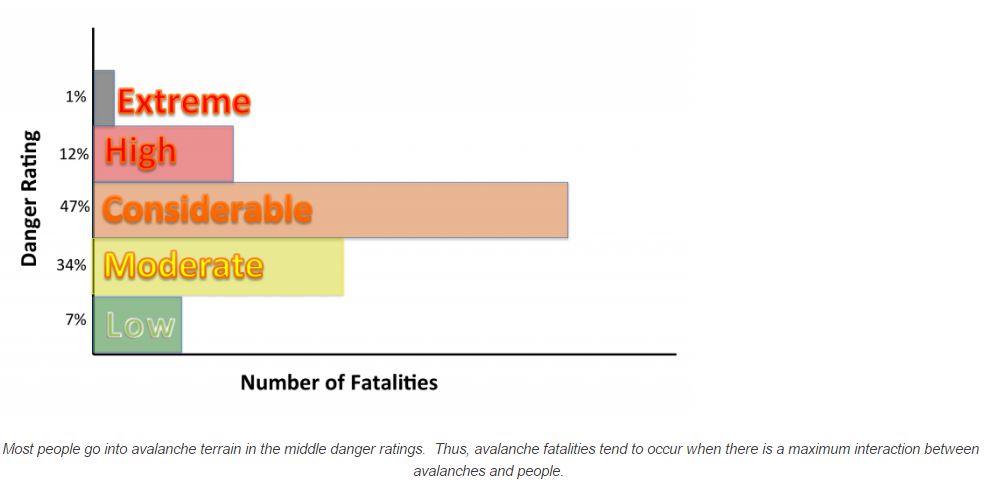
2. The majority of avalanche deaths occur during 'considerable' forecast - 47% according to Utah Avalanche Center (I tried attaching the graph - not sure if it will show up in the post).
Yes, I believe you can be relatively safe in considerable conditions with conservative terrain choices. Just because someone has a higher risk tolerance, does not mean they have bigger balls than you - they can die just as easily as anyone - it just the choice that they make. True, many are very knowledgeable and make good choices and come home safe... and unfortunately, some of the most knowledgeable go out in 'considerable' conditions and make only 1 bad decision, and that's the last decision they will ever make.
In my opinion, just looking at the amount of snowfall the night before and during the day, the wind, etc led me to make my own decision that validated the considerable forecast. I had my touring gear in my car and headed to Stevens Pass Sunday AM. there were plenty of skiers and snowshoers heading up Heather Ridge. I decided to leave my touring gear in the car and resort ski for the day. Stevens Pass did a considerable amount of avy contorl work late into the morning, again confirming my choice.
I would consider my self very conservative and on the very low risk side of the scale. It's just my nature and affects my decisions. I am by no means condemning those that are out there skiing in 'considerable' or worse conditions - the point I'm trying to make is trust your own instinct and decisions when you decide to 'stay home' instead of go out - don't follow the crowd if it doesn't feel right to you. Don't assume that 'it must be ok because those with more knowledge, experience, skill, etc. are out there'. No flame's for those that decide to stay home, and no flames for those that decide to go out.
1. Considerable means 'dangerous avalanche conditions' and 'human triggered avalanches likely'
2. The majority of avalanche deaths occur during 'considerable' forecast - 47% according to Utah Avalanche Center (I tried attaching the graph - not sure if it will show up in the post).
Yes, I believe you can be relatively safe in considerable conditions with conservative terrain choices. Just because someone has a higher risk tolerance, does not mean they have bigger balls than you - they can die just as easily as anyone - it just the choice that they make. True, many are very knowledgeable and make good choices and come home safe... and unfortunately, some of the most knowledgeable go out in 'considerable' conditions and make only 1 bad decision, and that's the last decision they will ever make.
In my opinion, just looking at the amount of snowfall the night before and during the day, the wind, etc led me to make my own decision that validated the considerable forecast. I had my touring gear in my car and headed to Stevens Pass Sunday AM. there were plenty of skiers and snowshoers heading up Heather Ridge. I decided to leave my touring gear in the car and resort ski for the day. Stevens Pass did a considerable amount of avy contorl work late into the morning, again confirming my choice.
I would consider my self very conservative and on the very low risk side of the scale. It's just my nature and affects my decisions. I am by no means condemning those that are out there skiing in 'considerable' or worse conditions - the point I'm trying to make is trust your own instinct and decisions when you decide to 'stay home' instead of go out - don't follow the crowd if it doesn't feel right to you. Don't assume that 'it must be ok because those with more knowledge, experience, skill, etc. are out there'. No flame's for those that decide to stay home, and no flames for those that decide to go out.
Please Log in or Create an account to join the conversation.
- Onward.
-
- User
-
Less
More
- Posts: 4
- Thank you received: 0
9 years 7 months ago - 9 years 7 months ago #227639
by Onward.
Replied by Onward. on topic Re: "Armchair" touring on a considerable day (12/4/16)
I have fewer years of touring experience than many others but I just get the sense that the day immediately following a really big storm is usually a good day to ride the chairs unless you know with absolute certainty that you won't be skiing/riding something steep enough to slide (which in yesterday's conditions would have been difficult anyway). For me, that means I would only go out touring in those conditions in a place I am extremely familiar with, (hopefully) making it less likely to run into the situation described here encountering unknown terrain and finding yourself on something steeper or sketchier than you expected. One thing I've learned about backcountry skiing it's that route finding is far more complicated than it appears on the surface and even seemingly small or simple terrain can be very dangerous in the wrong situation.
I have found it really helpful to practice decision-making framework that NWAC has described at many of the Going Deep workshops. The idea is you red light certain terrain based on the forecast before you go out into the field. It reduces the amount of on the fly yes/no evaluation as you travel across the terrain. For example, if wind slab is likely above treeline on east aspects, I've decided im not riding or climbing any east facing slope above treeline that day before my splitboard is even in the car.
Other terrain is green lighted, and based upon pre-trip evaluation, goes unless yellow/red flags are observed. You can always red light previously green lighted terrain but as a rule you never, ever, green light terrain in the field you decided was a red light while you were at home. This method takes a lot of the decision-making out of the field setting because you make the decisions before you go and there is less to decide on the skin track. I try to avoid evaluating terrain in the field with the mind set that "it could be really dangerous but let's go take a look at it" because honestly, once you're out there your ability to objectively evaluate a slope is often clouded by human factors and not reliable. On the other hand, if I've decided a certain aspect is good to go based on the forecast, but I discover on arrival that it's loaded or I see cracks or hear whoomps, I can red light that terrain. This should never happen the other way around, per the theory.
At the end of the day, it's true that you have to decide your own risk tolerance. I decided not to tour yesterday because there was, yes, too much fresh. Anything steep enough to ski was steep enough to slide yesterday. Conditions were epic yesterday and I don't blame people for getting after it. But even though you didn't experience any red/yellow flags in the field there were plenty of them before you left; rapid loading, wind, etc.
To the OP, good on you for recognizing that people decided to go out in reasonably dangerous conditions yesterday. That's their choice, and if they felt confident in their ability to manage the terrain and avoid dangerous slopes power to them. I'm not personally that comfortable with my terrain management skills, yet. If others are willing to simply take the risk that's their choice too. Im sure there are plenty of high IQ Backcountry skiers that had a safe fun day yesterday. I had plenty of fun off chair 6 with no complaints. That's the beauty of the sport, it's whatever you make of it.
I have found it really helpful to practice decision-making framework that NWAC has described at many of the Going Deep workshops. The idea is you red light certain terrain based on the forecast before you go out into the field. It reduces the amount of on the fly yes/no evaluation as you travel across the terrain. For example, if wind slab is likely above treeline on east aspects, I've decided im not riding or climbing any east facing slope above treeline that day before my splitboard is even in the car.
Other terrain is green lighted, and based upon pre-trip evaluation, goes unless yellow/red flags are observed. You can always red light previously green lighted terrain but as a rule you never, ever, green light terrain in the field you decided was a red light while you were at home. This method takes a lot of the decision-making out of the field setting because you make the decisions before you go and there is less to decide on the skin track. I try to avoid evaluating terrain in the field with the mind set that "it could be really dangerous but let's go take a look at it" because honestly, once you're out there your ability to objectively evaluate a slope is often clouded by human factors and not reliable. On the other hand, if I've decided a certain aspect is good to go based on the forecast, but I discover on arrival that it's loaded or I see cracks or hear whoomps, I can red light that terrain. This should never happen the other way around, per the theory.
At the end of the day, it's true that you have to decide your own risk tolerance. I decided not to tour yesterday because there was, yes, too much fresh. Anything steep enough to ski was steep enough to slide yesterday. Conditions were epic yesterday and I don't blame people for getting after it. But even though you didn't experience any red/yellow flags in the field there were plenty of them before you left; rapid loading, wind, etc.
To the OP, good on you for recognizing that people decided to go out in reasonably dangerous conditions yesterday. That's their choice, and if they felt confident in their ability to manage the terrain and avoid dangerous slopes power to them. I'm not personally that comfortable with my terrain management skills, yet. If others are willing to simply take the risk that's their choice too. Im sure there are plenty of high IQ Backcountry skiers that had a safe fun day yesterday. I had plenty of fun off chair 6 with no complaints. That's the beauty of the sport, it's whatever you make of it.
Please Log in or Create an account to join the conversation.