
- Posts: 635
- Thank you received: 0
Blue foam spacers for Dynafit ski crampons
- Amar Andalkar
-
 Topic Author
- User
-

Less
More
12 years 6 months ago - 8 years 6 months ago #211523
by Amar Andalkar
Blue foam spacers for Dynafit ski crampons was created by Amar Andalkar
Blue foam spacers for increasing Dynafit ski crampon penetration depth
[size=small]One of my regular ski partners has been wanting a set of these for himself after seeing them in action, so maybe I should write up a post on TAY...[/size]
Ski crampons are great for skinning across any number of commonly-encountered snow surfaces, especially above treeline (still-frozen early morning corn, breakable crust, windpack, rime ice, etc.). I've used them ever since I bought my first ski mountaineering setup back in 1996, and eventually after failing to bring them on a couple of trips where they would have been helpful, I even made a pact with myself to bring them along on all trips which were not certain to be deep powder days.
But ever since I switched from Fritschi to Dynafit bindings in 2005, I've been disappointed by the shorter teeth of the Dynafit ski crampons compared to my original Fritschi ski crampons (Fritschi later shortened their crampon teeth for unknown reasons, perhaps bending or breakage issues). When skinning in the highest heel elevator position, the Dynafit crampons penetrate only about 1 cm (0.4") into the snow. This is not really sufficient at all, forcing one to go no higher than the mid-height heel elevator if the snow is firm enough to need the crampons.
For many years, I thought about making some type of hard plastic spacer in the machine shop, which could easily attach atop the Dynafit crampons using the 2 holes that are already present. B&D Ski Gear provides something similar with their crampons, but I already owned 3 pairs of Dynafit crampons (80 mm, 92 mm, and 110 mm) which I'd bought for wider and wider skis over the years. I also think that the design of the Dynafit crampons is much nicer and better, formed with ribs on each tooth to reduce flexing and increase strength. In addition, I worried that a rigid spacer similar to the B&D design would increase the strain on the toepiece and the entire boot-binding interface, by making it impossible for the boot to sit flat when skinning with no heel elevator on moderate terrain. I've had ski partners using the B&D crampons who were forced to remove them for flatter sections of a route, since their spacer block prevents the boot from sitting all the way flat -- annoying, not good at all. Sometimes, the terrain is icy but varying from steep to flat repeatedly (the winter route to Muir via Pan Point being a classic example), and having to remove ski crampons for flat sections may make skinning impossible or impractical.
Several years ago, I hit upon what I thought would be an ideal solution: why not make the spacers out of semi-rigid but compressible material, like a 3/8" blue closed-cell foam pad, and attach the spacer with a single cable tie looped through the 2 holes in the crampon? This would provide about 3/8" (1 cm) of extra penetration at both mid and high elevator positions, while not interfering with the boot sole at the lowest (flat) heel position. Since there are usually very few new ideas, I figured that someone must have implemented exactly this idea before. But searching the web for " dynafit ski crampon spacer " found nothing useful, I was surprised that no one else was using any type of semi-rigid but compressible spacer. Maybe there was something wrong with my idea, maybe blue foam was way too flimsy for this purpose, or whatever -- anyway for unknown reasons, I left the idea on my mental shelf for years.
Finally, about a year ago I decided to give it a shot. I had an old blue foam sit pad which had already been partially cut up for padding a pack's waistbelt, so cutting a few more pieces off would cost nothing, nor would a few cable ties which I had lying around too, and even the time required would be minimal. I ended up making three sets of spacers in under an hour, to fit all 3 pairs of my Dynafit crampons.
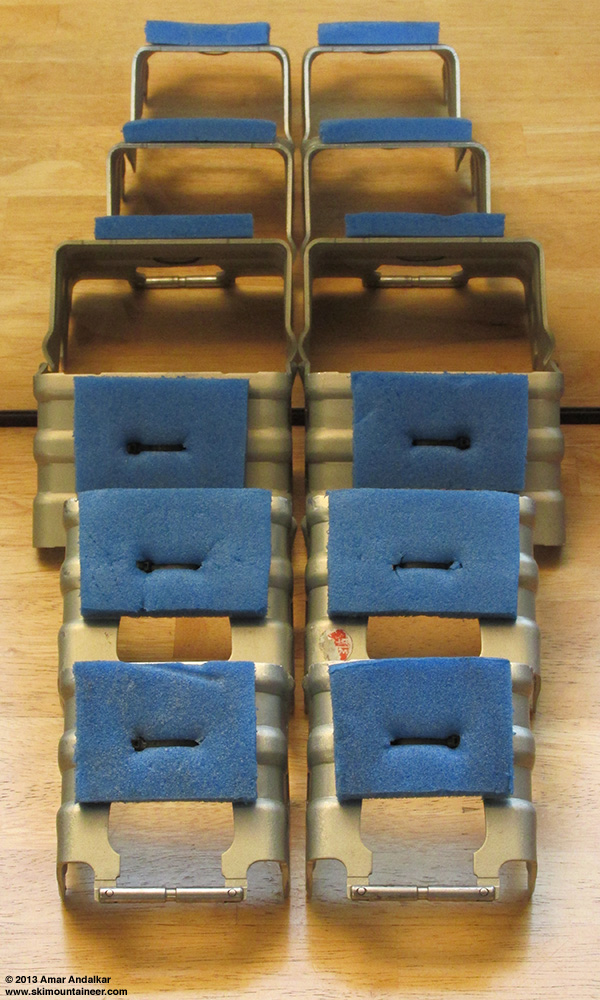
[size=small]Dynafit ski crampons in 80 mm, 92 mm, and 110 mm sizes, with blue foam spacers attached.[/size]
Since then, I've used the blue-foam-equipped crampons on many trips, probably a few dozen trips at least, and they've worked really well. As expected, they provide 1 cm of extra crampon penetration at all heel elevator positions, and are compressible enough to have no issues with preventing the boot from sitting flat when skinning without heel elevator. I've found the deeper crampon penetration to be useful even in situations which I didn't expect, such as putting in a switchbacking skin track in steep softening spring corn atop a firm base, where the crampon can act as a deep anchor into the firm base when using the mid-height elevator position. Last June in just such conditions, I managed my first complete ski ascent of Mount Shasta (after 23 previous summit ski descents with failed ski ascents), and the deep anchoring effect was very helpful for traction and confidence, especially when skinning with completely numb feet and arms (details in the belated TR which few have read: June 8, 2013, Mount Shasta: Stunning Sting of the Tarantula Hawk ). Also managed my first full ski ascent of Mount McLoughlin in late April 2013 (no TR written), after 7 previous ski descents with failed ski ascents. I definitely felt like the increased traction and thus confidence provided by the spacers helped me out on many steep, marginally sketchy ski ascents -- unlike most backcountry skiers, full ski ascents really do matter to me and are an important goal, almost as much as the ski descents are.
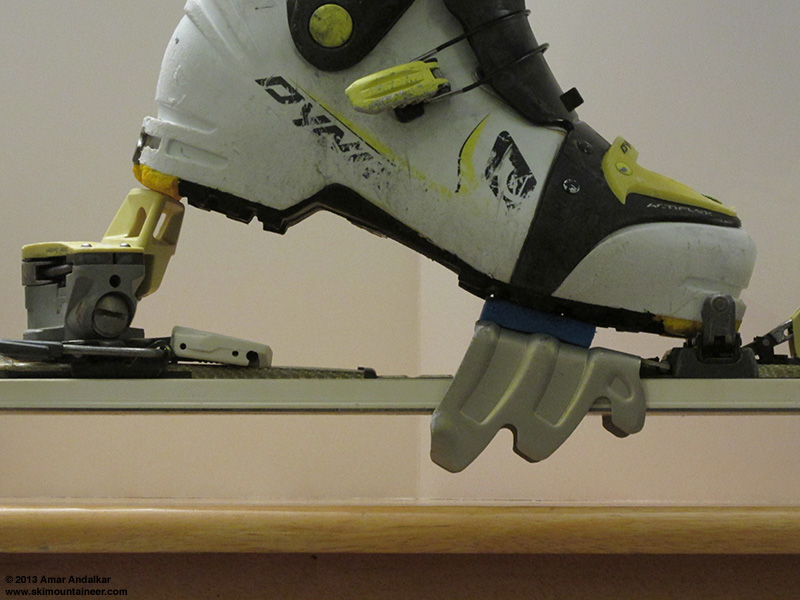
[size=small]Demonstration of the increased penetration depth of my 92 mm crampon with blue foam spacer attached.[/size]
The blue foam has been quite rugged, showing very minimal wear with no tearing, and even the small cable ties (which I suspected might be the weak link) are more than strong enough for this purpose. I've only had one of the cable ties break so far, which takes all of a few seconds to fix and then it's good for many more trips.
In addition, the blue foam pad has an R-value of 1.4, which provides significant insulation and prevents cold from conducting up through the ski crampon and into your boots when skinning on really cold, hard frozen snow. [size=7pt](just kidding!)[/size]
Materials List:
Directions:

Long Term Updates 2015 and 2018:
See replies #12-14 below.
There was also a significant change in the design of the Dynafit ski crampons in 2014, including a major change in the location and spacing of the 2 holes in the flat portion to which these foam spacers are attached. Here is a revised drawing, along with a PDF version: DynafitSkiCramponSpacers2015.pdf

[size=small]One of my regular ski partners has been wanting a set of these for himself after seeing them in action, so maybe I should write up a post on TAY...[/size]
Ski crampons are great for skinning across any number of commonly-encountered snow surfaces, especially above treeline (still-frozen early morning corn, breakable crust, windpack, rime ice, etc.). I've used them ever since I bought my first ski mountaineering setup back in 1996, and eventually after failing to bring them on a couple of trips where they would have been helpful, I even made a pact with myself to bring them along on all trips which were not certain to be deep powder days.
But ever since I switched from Fritschi to Dynafit bindings in 2005, I've been disappointed by the shorter teeth of the Dynafit ski crampons compared to my original Fritschi ski crampons (Fritschi later shortened their crampon teeth for unknown reasons, perhaps bending or breakage issues). When skinning in the highest heel elevator position, the Dynafit crampons penetrate only about 1 cm (0.4") into the snow. This is not really sufficient at all, forcing one to go no higher than the mid-height heel elevator if the snow is firm enough to need the crampons.
For many years, I thought about making some type of hard plastic spacer in the machine shop, which could easily attach atop the Dynafit crampons using the 2 holes that are already present. B&D Ski Gear provides something similar with their crampons, but I already owned 3 pairs of Dynafit crampons (80 mm, 92 mm, and 110 mm) which I'd bought for wider and wider skis over the years. I also think that the design of the Dynafit crampons is much nicer and better, formed with ribs on each tooth to reduce flexing and increase strength. In addition, I worried that a rigid spacer similar to the B&D design would increase the strain on the toepiece and the entire boot-binding interface, by making it impossible for the boot to sit flat when skinning with no heel elevator on moderate terrain. I've had ski partners using the B&D crampons who were forced to remove them for flatter sections of a route, since their spacer block prevents the boot from sitting all the way flat -- annoying, not good at all. Sometimes, the terrain is icy but varying from steep to flat repeatedly (the winter route to Muir via Pan Point being a classic example), and having to remove ski crampons for flat sections may make skinning impossible or impractical.
Several years ago, I hit upon what I thought would be an ideal solution: why not make the spacers out of semi-rigid but compressible material, like a 3/8" blue closed-cell foam pad, and attach the spacer with a single cable tie looped through the 2 holes in the crampon? This would provide about 3/8" (1 cm) of extra penetration at both mid and high elevator positions, while not interfering with the boot sole at the lowest (flat) heel position. Since there are usually very few new ideas, I figured that someone must have implemented exactly this idea before. But searching the web for " dynafit ski crampon spacer " found nothing useful, I was surprised that no one else was using any type of semi-rigid but compressible spacer. Maybe there was something wrong with my idea, maybe blue foam was way too flimsy for this purpose, or whatever -- anyway for unknown reasons, I left the idea on my mental shelf for years.
Finally, about a year ago I decided to give it a shot. I had an old blue foam sit pad which had already been partially cut up for padding a pack's waistbelt, so cutting a few more pieces off would cost nothing, nor would a few cable ties which I had lying around too, and even the time required would be minimal. I ended up making three sets of spacers in under an hour, to fit all 3 pairs of my Dynafit crampons.
[size=small]Dynafit ski crampons in 80 mm, 92 mm, and 110 mm sizes, with blue foam spacers attached.[/size]
Since then, I've used the blue-foam-equipped crampons on many trips, probably a few dozen trips at least, and they've worked really well. As expected, they provide 1 cm of extra crampon penetration at all heel elevator positions, and are compressible enough to have no issues with preventing the boot from sitting flat when skinning without heel elevator. I've found the deeper crampon penetration to be useful even in situations which I didn't expect, such as putting in a switchbacking skin track in steep softening spring corn atop a firm base, where the crampon can act as a deep anchor into the firm base when using the mid-height elevator position. Last June in just such conditions, I managed my first complete ski ascent of Mount Shasta (after 23 previous summit ski descents with failed ski ascents), and the deep anchoring effect was very helpful for traction and confidence, especially when skinning with completely numb feet and arms (details in the belated TR which few have read: June 8, 2013, Mount Shasta: Stunning Sting of the Tarantula Hawk ). Also managed my first full ski ascent of Mount McLoughlin in late April 2013 (no TR written), after 7 previous ski descents with failed ski ascents. I definitely felt like the increased traction and thus confidence provided by the spacers helped me out on many steep, marginally sketchy ski ascents -- unlike most backcountry skiers, full ski ascents really do matter to me and are an important goal, almost as much as the ski descents are.
[size=small]Demonstration of the increased penetration depth of my 92 mm crampon with blue foam spacer attached.[/size]
The blue foam has been quite rugged, showing very minimal wear with no tearing, and even the small cable ties (which I suspected might be the weak link) are more than strong enough for this purpose. I've only had one of the cable ties break so far, which takes all of a few seconds to fix and then it's good for many more trips.
In addition, the blue foam pad has an R-value of 1.4, which provides significant insulation and prevents cold from conducting up through the ski crampon and into your boots when skinning on really cold, hard frozen snow. [size=7pt](just kidding!)[/size]
Materials List:
- 3/8" blue foam sleeping pad or sit pad, 2 small pieces cut to dimensions of 2" x 3" for 92 mm or wider crampons, or 2" x 2.6" for 80 mm crampons. I used the smaller sit-pad version of this REI blue foam pad , which sold for about $3 in 1997 (must use closed-cell foam such as this, open-cell foam is far too compressible and useless for this purpose).
- 4" cable ties, UV black, tensile strength 18 lbs -- these are about 2.5 mm (3/32") wide, which easily fits through the holes in the crampons which are about 4 mm (5/32") wide. I think the ones I used were from this pack of 100 for only $5 at Home Depot , and if you can find slightly thicker cable ties which still fit easily through the holes, that might be even better.
Directions:
- Mark and cut the blue foam pieces to size as shown below, a sharp utility knife works well.
- Poke holes for the cable tie at positions shown using an awl, drilling the foam is not necessary.
- Attach foam spacer to crampon using cable tie, making sure that the latch is on top of the foam, and not below the crampon.
- Pull cable tie tight enough that the latch lies below the surface of the foam, but not so tight as to severely distort the foam.
- Cut off excess length of cable tie flush with the latch.
Long Term Updates 2015 and 2018:
See replies #12-14 below.
There was also a significant change in the design of the Dynafit ski crampons in 2014, including a major change in the location and spacing of the 2 holes in the flat portion to which these foam spacers are attached. Here is a revised drawing, along with a PDF version: DynafitSkiCramponSpacers2015.pdf
Please Log in or Create an account to join the conversation.
- Charlie Hagedorn
-
- User
-
Less
More
- Posts: 913
- Thank you received: 1
12 years 6 months ago #211525
by Charlie Hagedorn
Replied by Charlie Hagedorn on topic Re: Blue foam spacers for Dynafit ski crampons
Very cool, Amar!
Please Log in or Create an account to join the conversation.
- Chuck C
-
- User
-
Less
More
- Posts: 184
- Thank you received: 0
12 years 6 months ago #211526
by Chuck C
Replied by Chuck C on topic Re: Blue foam spacers for Dynafit ski crampons
Did you file the patent application yet?
Please Log in or Create an account to join the conversation.
- elliotts
-
- User
-
Less
More
- Posts: 6
- Thank you received: 0
12 years 6 months ago #211529
by elliotts
Replied by elliotts on topic Re: Blue foam spacers for Dynafit ski crampons
Nice! I remember seeing these on a trip with you. I'm doing it!
Please Log in or Create an account to join the conversation.
- Chris S
-

- User
-
Less
More
- Posts: 91
- Thank you received: 0
12 years 6 months ago #211532
by Chris S
Replied by Chris S on topic Re: Blue foam spacers for Dynafit ski crampons
I'm pretty sure that the length of the crampon teeth is determined by the angle of the skiers foot and the space available when moving forward - if teeth were too long you'd be dragging you ski crampons through the snow with every step. Amar, do you really think its such a problem? The combination of icy slope + ski crampon would dictate using the low or no heal lifter for me.
Please Log in or Create an account to join the conversation.
- danpeck
-
- User
-
Less
More
- Posts: 79
- Thank you received: 0
12 years 6 months ago #211536
by danpeck
Replied by danpeck on topic Re: Blue foam spacers for Dynafit ski crampons
Okay, that tarantula hawk story was **intense.
Please Log in or Create an account to join the conversation.