
- Posts: 635
- Thank you received: 0
Blue foam spacers for Dynafit ski crampons
- Amar Andalkar
-
 Topic Author
- User
-

Less
More
11 years 4 months ago - 11 years 4 months ago #224162
by Amar Andalkar
Replied by Amar Andalkar on topic Re: Blue foam spacers for Dynafit ski crampons
Long Term Update 2015:
It has now been over 2 years since I first made the spacers, and 15 months since the original post above. It's nice to see that this idea has been useful for some of you. And I continue to see interest in the blue foam spacers from some of my ski partners and even sometimes from skiers I meet along routes while using the ski crampons. So it seems like a good time for an update, especially given how useful ski crampons have been on many trips throughout this highly anomalous and unusual winter.
So how well do the blue foam spacers hold up to long-term use?
My 80 mm crampons have hardly been used at all since the original post, since they fit my old 2007 Volkl Mountain Norbert Joos skis (104-70-92 dimensions) which are only used a few days per year now on mid-to-late summer tours, typically on Muir Snowfield and Paradise Glacier. My 110 mm crampons have also been used only a few times, since they fit my Dynafit Stoke (130-106-120) skis which are primarily used for powder trips only, and are not often used in conditions which need the ski crampons, even if I bring them.
In contrast, my 92 mm crampons have been very heavily used, as they fit my Volkl Amaruq (127-88-109) and Dynafit Cho Oyu (125-89-111) skis, which have been my main year-round ski-mountaineering skis over that period (the older heavily-used Amaruq are now only taken for rocky early-season or late-season conditions since I bought the Cho Oyu in January 2014). As a rough estimate, the 92 mm crampons have been used for over 80 days and 200,000 vertical feet of ski cramponing over the 2 years since the spacers were made (the crampons were used for only a few hundred vert on some days, but several thousand vert on others), out of over 160 days and 700,000 vertical feet of skinning which those 2 pairs of skis have been used for over that period.
Here's a comparison shot of the spacers on both my 80 mm and 92 mm ski crampons, as they look now in March 2015 (compare with original 2013 photo above):
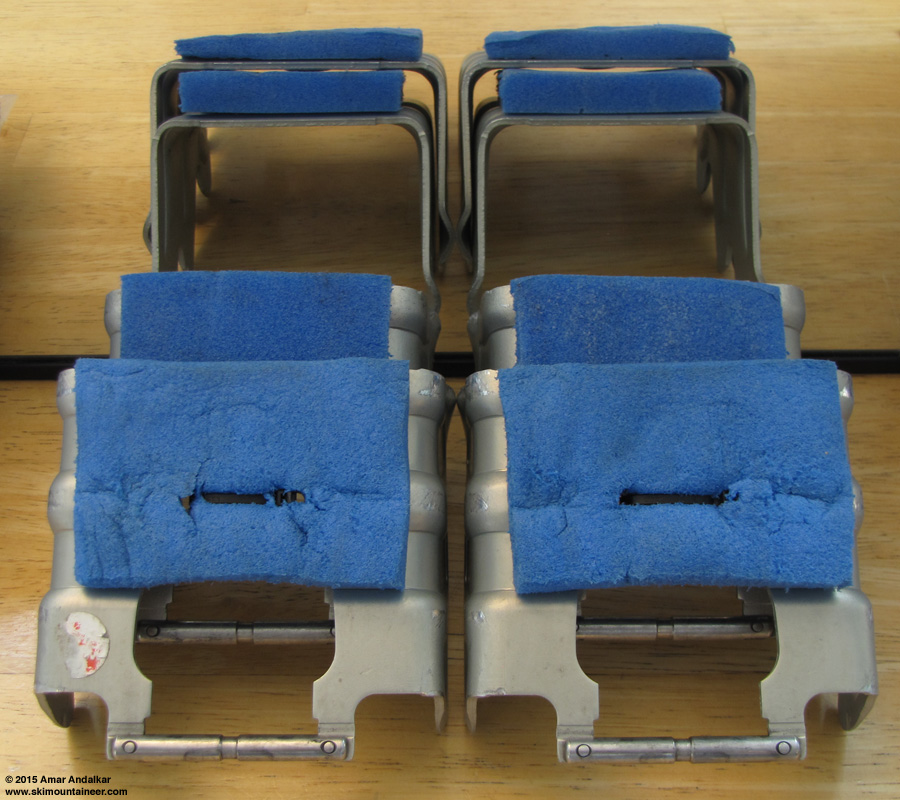
[size=small]Dynafit ski crampons in 80 mm and 92 mm sizes, with blue foam spacers attached.[/size]
Compared to the barely-used spacers on the 80 mm, those on the 92 mm show heavy wear and have eventually compressed significantly through repeated crushing under the boot soles, with about a 25-30% reduction in thickness now. I've begun to notice this reduction on recent trips, so I think I'll make a new set of spacers soon since it doesn't really cost anything.
The cable ties have broken and been replaced several times, maybe 3-4 times total. But even when they break (usually right near the latch where the stress is greatest), the blue foam still stays in place temporarily and doesn't go skittering down the slope, since the cable tie still extends through at least 1 hole in the crampon, and there is lots of friction.
Overall, the blue foam spacers have been a complete success for the purposes I intended them for, especially so considering their near-zero cost.
It has now been over 2 years since I first made the spacers, and 15 months since the original post above. It's nice to see that this idea has been useful for some of you. And I continue to see interest in the blue foam spacers from some of my ski partners and even sometimes from skiers I meet along routes while using the ski crampons. So it seems like a good time for an update, especially given how useful ski crampons have been on many trips throughout this highly anomalous and unusual winter.
So how well do the blue foam spacers hold up to long-term use?
My 80 mm crampons have hardly been used at all since the original post, since they fit my old 2007 Volkl Mountain Norbert Joos skis (104-70-92 dimensions) which are only used a few days per year now on mid-to-late summer tours, typically on Muir Snowfield and Paradise Glacier. My 110 mm crampons have also been used only a few times, since they fit my Dynafit Stoke (130-106-120) skis which are primarily used for powder trips only, and are not often used in conditions which need the ski crampons, even if I bring them.
In contrast, my 92 mm crampons have been very heavily used, as they fit my Volkl Amaruq (127-88-109) and Dynafit Cho Oyu (125-89-111) skis, which have been my main year-round ski-mountaineering skis over that period (the older heavily-used Amaruq are now only taken for rocky early-season or late-season conditions since I bought the Cho Oyu in January 2014). As a rough estimate, the 92 mm crampons have been used for over 80 days and 200,000 vertical feet of ski cramponing over the 2 years since the spacers were made (the crampons were used for only a few hundred vert on some days, but several thousand vert on others), out of over 160 days and 700,000 vertical feet of skinning which those 2 pairs of skis have been used for over that period.
Here's a comparison shot of the spacers on both my 80 mm and 92 mm ski crampons, as they look now in March 2015 (compare with original 2013 photo above):
[size=small]Dynafit ski crampons in 80 mm and 92 mm sizes, with blue foam spacers attached.[/size]
Compared to the barely-used spacers on the 80 mm, those on the 92 mm show heavy wear and have eventually compressed significantly through repeated crushing under the boot soles, with about a 25-30% reduction in thickness now. I've begun to notice this reduction on recent trips, so I think I'll make a new set of spacers soon since it doesn't really cost anything.
The cable ties have broken and been replaced several times, maybe 3-4 times total. But even when they break (usually right near the latch where the stress is greatest), the blue foam still stays in place temporarily and doesn't go skittering down the slope, since the cable tie still extends through at least 1 hole in the crampon, and there is lots of friction.
Overall, the blue foam spacers have been a complete success for the purposes I intended them for, especially so considering their near-zero cost.
Please Log in or Create an account to join the conversation.
- Amar Andalkar
-
Topic Author
- User
-
Less
More
- Posts: 635
- Thank you received: 0
11 years 4 months ago - 11 years 4 months ago #224181
by Amar Andalkar
Replied by Amar Andalkar on topic Re: Blue foam spacers for Dynafit ski crampons
There has also been a significant change in the design of the Dynafit ski crampons in 2014, including a major change in the location and spacing of the 2 holes in the flat portion to which these foam spacers are attached. Here are pictures showing the older design (left), which had not changed significantly in over 10 years, and the newer design (right) with different tooth shape and holes twice as far apart located much closer to the back edge of the crampon:
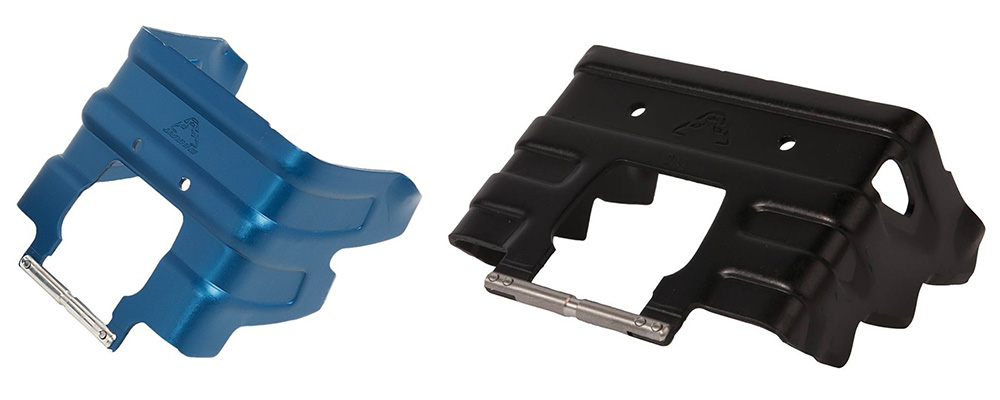
I knew that the crampon design had changed this year, but didn't realize that the hole spacing and location had changed so much until I was making a set of foam spacers for a friend a few days ago. I have no idea why they changed that, but it's not a major problem for the foam spacers anyway. It turns out the same blue foam spacer can be used on the newer design (if such a need arose, for example due to crampon breakage and replacement) just by rotating the spacer 180° and making 2 new holes in the foam 2" apart. The short 4" cable ties linked in the original post are obviously too short to loop through holes 2" apart, but 2 cable ties can easily be joined in series to make a longer tie which is still narrow enough to fit through the crampon holes (just make sure both latches on the joined cable ties end up on top of the foam, not under the crampon).
Here is a revised drawing, along with a PDF version: DynafitSkiCramponSpacers2015.pdf

I knew that the crampon design had changed this year, but didn't realize that the hole spacing and location had changed so much until I was making a set of foam spacers for a friend a few days ago. I have no idea why they changed that, but it's not a major problem for the foam spacers anyway. It turns out the same blue foam spacer can be used on the newer design (if such a need arose, for example due to crampon breakage and replacement) just by rotating the spacer 180° and making 2 new holes in the foam 2" apart. The short 4" cable ties linked in the original post are obviously too short to loop through holes 2" apart, but 2 cable ties can easily be joined in series to make a longer tie which is still narrow enough to fit through the crampon holes (just make sure both latches on the joined cable ties end up on top of the foam, not under the crampon).
Here is a revised drawing, along with a PDF version: DynafitSkiCramponSpacers2015.pdf
Please Log in or Create an account to join the conversation.
- Amar Andalkar
-
Topic Author
- User
-
Less
More
- Posts: 635
- Thank you received: 0
8 years 6 months ago #230643
by Amar Andalkar
Replied by Amar Andalkar on topic Re: Blue foam spacers for Dynafit ski crampons
2nd Long Term Update 2018:
It has now been over 5 years since I first made the blue foam spacers, 4 years since the original post, and almost 3 years since the first Long Term Update above. The spacers continue to be very useful to me, and others continue to express interest in them, so I figured I should update this thread again. I've also made several additional pairs of the spacers for friends who have now been using them for a few years.
In addition, I just acquired a pair of the newer-style 100 mm Dynafit ski crampons a few days ago, to join my previous set of old-style 80, 92, and 110 mm crampons. The 100 mm are needed to fit my new Dynafit Carbonio 88 skis (last year's model on clearance for 55% off retail), which is basically a full-carbon version of the Dynafit Cho Oyu, my all-time favorite mountaineering ski that I now have several pairs of. The Carbonio 88 have actual dimensions of 127-91-111 mm in a 184 cm length and are about 93 mm wide under the toe piece, so the 92 mm crampons will not fit those at all, and the 110 mm seem just a bit too wide for comfortable traversing on steep icy terrain (although they would work OK most of the time). So getting new 100 mm ski crampons meant making new blue foam spacers too!
Here's a comparison shot of the spacers on all 4 pairs of my Dynafit crampons. Note the change in hole placement and dimensions on the newer-style orange 100 mm crampons:
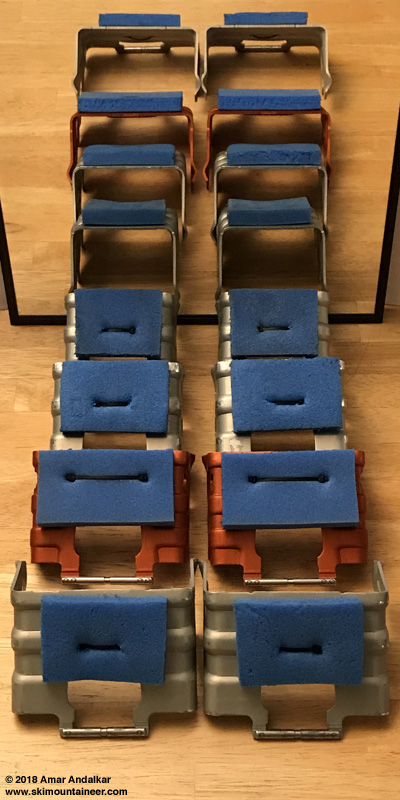
Since that March 2015 update, I've had to replace the blue foam on the most heavily-used 92mm ski crampons later that season, since it had become very worn and flattened by heavy use. That pair gets several dozen days of use every year on my main mountaineering skis, the Cho Oyus, often for 3000-5000 vertical feet in a day on a major 7000 vertical-foot volcano route such as Mount Shasta, Adams, or Baker, where I typically aim for a complete ski ascent from trailhead or snowline to the summit. Luckily, it's no big deal to replace the foam when necessary, since the blue foam costs almost nothing, and once you acquire a square of foam to make the first set, you automatically have enough foam left over to make many more sets.
I don't keep an accurate count of my ski crampon usage (although I do record ski ascent vertical feet in addition to ski descent and total vertical climbed in a spreadsheet for every trip), but the first blue foam spacers lasted for over 100 days of use and about 300,000 vertical feet of actual crampon-assisted skinning over a 3-year period. That would be the equivalent of many years (or decades) of ski crampon use for most typical backcountry skiers, so only those who use ski crampons for a lot of big vertical days would need to regularly replace the foam every few years.
It has now been over 5 years since I first made the blue foam spacers, 4 years since the original post, and almost 3 years since the first Long Term Update above. The spacers continue to be very useful to me, and others continue to express interest in them, so I figured I should update this thread again. I've also made several additional pairs of the spacers for friends who have now been using them for a few years.
In addition, I just acquired a pair of the newer-style 100 mm Dynafit ski crampons a few days ago, to join my previous set of old-style 80, 92, and 110 mm crampons. The 100 mm are needed to fit my new Dynafit Carbonio 88 skis (last year's model on clearance for 55% off retail), which is basically a full-carbon version of the Dynafit Cho Oyu, my all-time favorite mountaineering ski that I now have several pairs of. The Carbonio 88 have actual dimensions of 127-91-111 mm in a 184 cm length and are about 93 mm wide under the toe piece, so the 92 mm crampons will not fit those at all, and the 110 mm seem just a bit too wide for comfortable traversing on steep icy terrain (although they would work OK most of the time). So getting new 100 mm ski crampons meant making new blue foam spacers too!
Here's a comparison shot of the spacers on all 4 pairs of my Dynafit crampons. Note the change in hole placement and dimensions on the newer-style orange 100 mm crampons:
Since that March 2015 update, I've had to replace the blue foam on the most heavily-used 92mm ski crampons later that season, since it had become very worn and flattened by heavy use. That pair gets several dozen days of use every year on my main mountaineering skis, the Cho Oyus, often for 3000-5000 vertical feet in a day on a major 7000 vertical-foot volcano route such as Mount Shasta, Adams, or Baker, where I typically aim for a complete ski ascent from trailhead or snowline to the summit. Luckily, it's no big deal to replace the foam when necessary, since the blue foam costs almost nothing, and once you acquire a square of foam to make the first set, you automatically have enough foam left over to make many more sets.
I don't keep an accurate count of my ski crampon usage (although I do record ski ascent vertical feet in addition to ski descent and total vertical climbed in a spreadsheet for every trip), but the first blue foam spacers lasted for over 100 days of use and about 300,000 vertical feet of actual crampon-assisted skinning over a 3-year period. That would be the equivalent of many years (or decades) of ski crampon use for most typical backcountry skiers, so only those who use ski crampons for a lot of big vertical days would need to regularly replace the foam every few years.
Please Log in or Create an account to join the conversation.
- Amar Andalkar
-
Topic Author
- User
-
Less
More
- Posts: 635
- Thank you received: 0
8 years 6 months ago - 8 years 6 months ago #230645
by Amar Andalkar
Several other replies above also mention fixed ski crampons like the Voile, so maybe I should post my thoughts on them. I've often thought about trying the Voile crampons, especially due to the strong appeal of having maximum traction regardless of heel elevator position. But it's a significant initial expense and risk to try something that is not designed or intended for use with alpine touring bindings, and I have not yet had any easy opportunity to try them out.
The Voile crampons are intended for telemark bindings only, as their website makes clear ( www.voile.com/voile-ski-crampon-96mm.html ): "Voile Ski Crampons are designed to work with most telemark bindings" and "Compatible with most telemark bindings", with no mention whatsoever of AT bindings. Not sure why Voile is still so strongly pro-tele in this day and age (it's not the 1980s anymore!), especially given that they now sell Dynafit and G3 AT bindings on their website. But it would appear to be poor business practice to not mention that those items are compatible with AT bindings, if in fact they actually are. Currently, the manufacturer is effectively stating that they are not compatible with AT bindings. Maybe there is some issue which prevents them from claiming compatibility with any AT bindings? Does anyone have any insight about why they don't mention AT binding compatibility?
Regardless of that issue (which may be irrelevant or unimportant to some), there are other more practical issues with a fixed crampon which make them less than a perfect solution for all:
1. The extra drag and effort due to the inability to stride forward in firm snow without lifting your ski up completely up off the snow, unlike a hinged crampon which allows you to stride forward with only a minimal partial lift. This increased effort needed on every single stride has got to add up in a big way over the course of a long day. This extra effort may be no big deal if you only use the crampons for a short stretch of a few hundred feet, but over a full day of use over 3000 or even 5000 vertical feet of ski cramponing, it's going to be totally unacceptable for most people compared to hinged crampons. There are essentially very few routes outside of the high volcanoes where anyone would need ski crampons for that much vertical, but it happens often on those peaks.
2. The inability to cross short sections of bare rocks or hard ice, without removing the crampons or risking damage to them. This may not be an issue for many users, but it's a frequent issue in the terrain I prefer, above treeline on the volcanoes, especially in early season and near ridges and summits. For example, the standard route to Camp Muir has had short sections of rocks and bare ice above Pan Point from 6800-7500 ft throughout much of the early season so far this year. It's often easy to avoid those areas on the ski descent (sometimes by skiing down a completely different route), but really impractical to avoid them during the ski ascent. Yet I've been able to skin across those short rocky or (flat) bare ice sections each time without having to stop to remove the ski crampons, since the crampons hinge up out of the way just enough to avoid excess strain or damage during a few careful strides. Having to stop to remove the ski crampons and then put them back on again immediately, thus needing 2 transitions to cross a few feet of rocks or flat ice, seems quite unacceptable too.
The uppermost parts of the summits of the high volcanoes (especially Rainier, Shasta, and Adams) often have areas consisting of fins of hard water ice, interspersed with mostly skinnable (and skiable!) firm snow. Ski crampons are pretty much mandatory to complete full ski ascents on those volcanoes in most conditions, and having them hinge upward prevents damage while crossing the short (often less than ski length) unavoidable patches of hard water ice fins.
3. The Voile crampons have a substantial weight penalty versus the Dynafit: they weigh about 50% more, roughly 300 g (11 oz) per pair depending on width for the Voile, versus roughly 200 g (7 oz) per pair depending on width for the Dynafit. Yes, it's only 4 ounces, but as with all ski mountaineering gear, there needs to be enough net benefit to make up for the extra weight penalty.
4. The sudden Voile crampon ejection issue that both rlsg and peteyboy mention in Replies #10-11 above, where the wing nut holding the crampon rotates to the unlocked position, is very worrisome! Having a ski crampon come loose unexpectedly in steep icy terrain is a potential disaster that could lead to injury or fatality. Have they fixed this issue? The Dynafit crampon design appears to be completely immune to this issue.
Anyway, fixed crampons like the Voile may be the right solution for some, and it's nice to hear that they are working so well for those people. But for others, they may not work out so well at all.
The blue foam spacers are a simple, easy, and almost-free solution to one of the major shortcomings of the hinged Dynafit crampons (and any similarly hinged ski crampons, i.e. those not attached to the bar of a frame binding). Overall in my analysis and extensive use for several years, they let you enjoy the best of both worlds, gaining most of the deeper crampon penetration of the fixed systems, while not losing the reduced effort and skinning freedom of the hinged systems.
Replied by Amar Andalkar on topic Re: Blue foam spacers for Dynafit ski crampons
The best ski,crampons are the kind that stay fixed on the ski and don't pivot, like Voile makes.
A little less comfortable in low angle terrain like Frozen tree approaches, however up high and in exposed places were you need all the grip that you can get, Muy Bueno.
No need to fix the problem. I could never go back to a pivot setup.
Several other replies above also mention fixed ski crampons like the Voile, so maybe I should post my thoughts on them. I've often thought about trying the Voile crampons, especially due to the strong appeal of having maximum traction regardless of heel elevator position. But it's a significant initial expense and risk to try something that is not designed or intended for use with alpine touring bindings, and I have not yet had any easy opportunity to try them out.
The Voile crampons are intended for telemark bindings only, as their website makes clear ( www.voile.com/voile-ski-crampon-96mm.html ): "Voile Ski Crampons are designed to work with most telemark bindings" and "Compatible with most telemark bindings", with no mention whatsoever of AT bindings. Not sure why Voile is still so strongly pro-tele in this day and age (it's not the 1980s anymore!), especially given that they now sell Dynafit and G3 AT bindings on their website. But it would appear to be poor business practice to not mention that those items are compatible with AT bindings, if in fact they actually are. Currently, the manufacturer is effectively stating that they are not compatible with AT bindings. Maybe there is some issue which prevents them from claiming compatibility with any AT bindings? Does anyone have any insight about why they don't mention AT binding compatibility?
Regardless of that issue (which may be irrelevant or unimportant to some), there are other more practical issues with a fixed crampon which make them less than a perfect solution for all:
1. The extra drag and effort due to the inability to stride forward in firm snow without lifting your ski up completely up off the snow, unlike a hinged crampon which allows you to stride forward with only a minimal partial lift. This increased effort needed on every single stride has got to add up in a big way over the course of a long day. This extra effort may be no big deal if you only use the crampons for a short stretch of a few hundred feet, but over a full day of use over 3000 or even 5000 vertical feet of ski cramponing, it's going to be totally unacceptable for most people compared to hinged crampons. There are essentially very few routes outside of the high volcanoes where anyone would need ski crampons for that much vertical, but it happens often on those peaks.
2. The inability to cross short sections of bare rocks or hard ice, without removing the crampons or risking damage to them. This may not be an issue for many users, but it's a frequent issue in the terrain I prefer, above treeline on the volcanoes, especially in early season and near ridges and summits. For example, the standard route to Camp Muir has had short sections of rocks and bare ice above Pan Point from 6800-7500 ft throughout much of the early season so far this year. It's often easy to avoid those areas on the ski descent (sometimes by skiing down a completely different route), but really impractical to avoid them during the ski ascent. Yet I've been able to skin across those short rocky or (flat) bare ice sections each time without having to stop to remove the ski crampons, since the crampons hinge up out of the way just enough to avoid excess strain or damage during a few careful strides. Having to stop to remove the ski crampons and then put them back on again immediately, thus needing 2 transitions to cross a few feet of rocks or flat ice, seems quite unacceptable too.
The uppermost parts of the summits of the high volcanoes (especially Rainier, Shasta, and Adams) often have areas consisting of fins of hard water ice, interspersed with mostly skinnable (and skiable!) firm snow. Ski crampons are pretty much mandatory to complete full ski ascents on those volcanoes in most conditions, and having them hinge upward prevents damage while crossing the short (often less than ski length) unavoidable patches of hard water ice fins.
3. The Voile crampons have a substantial weight penalty versus the Dynafit: they weigh about 50% more, roughly 300 g (11 oz) per pair depending on width for the Voile, versus roughly 200 g (7 oz) per pair depending on width for the Dynafit. Yes, it's only 4 ounces, but as with all ski mountaineering gear, there needs to be enough net benefit to make up for the extra weight penalty.
4. The sudden Voile crampon ejection issue that both rlsg and peteyboy mention in Replies #10-11 above, where the wing nut holding the crampon rotates to the unlocked position, is very worrisome! Having a ski crampon come loose unexpectedly in steep icy terrain is a potential disaster that could lead to injury or fatality. Have they fixed this issue? The Dynafit crampon design appears to be completely immune to this issue.
Anyway, fixed crampons like the Voile may be the right solution for some, and it's nice to hear that they are working so well for those people. But for others, they may not work out so well at all.
The blue foam spacers are a simple, easy, and almost-free solution to one of the major shortcomings of the hinged Dynafit crampons (and any similarly hinged ski crampons, i.e. those not attached to the bar of a frame binding). Overall in my analysis and extensive use for several years, they let you enjoy the best of both worlds, gaining most of the deeper crampon penetration of the fixed systems, while not losing the reduced effort and skinning freedom of the hinged systems.
Please Log in or Create an account to join the conversation.