
- Posts: 150
- Thank you received: 0
Mt Hood Aerial Tram--Timberline/Ski Bowl
- DG
-

- User
-

Less
More
12 years 9 months ago #210389
by DG
Replied by DG on topic Re: Mt Hood Aerial Tram--Timberline/Ski Bowl
I'm for it, too, especially if it could be incorporated with a bus service fromt he valley to give people an alternative to driving to the mountain.
The southside between Govy and TLine where the tram would be built is already sort of developed for skiing. There is Summit ski area up part of a ways, and then two informal ski trails (Glade and Alpine) that connect up to Tline. Impact might be minimal if they ran the tram up one of those cleared runs.
The southside between Govy and TLine where the tram would be built is already sort of developed for skiing. There is Summit ski area up part of a ways, and then two informal ski trails (Glade and Alpine) that connect up to Tline. Impact might be minimal if they ran the tram up one of those cleared runs.
Please Log in or Create an account to join the conversation.
- Girafastyle
-
Topic Author
- User
-
Less
More
- Posts: 6
- Thank you received: 0
12 years 9 months ago #210390
by Girafastyle
Replied by Girafastyle on topic Re: Mt Hood Aerial Tram--Timberline/Ski Bowl
Wow!
Though I know that people have varying opinions on these things, I'm rather shocked at how many TAY people are for this. Of course, I understand the sentiment of why some might want it... Hell, I'd probably end up riding it if it were built.
As a few posters have pointed out, traffic is indeed a problem on the Mt Hood's south side, but there are a limited number of public funds available and not all projects can/will get the green light.
The main issue that I have is the the idea that public lands can be given to private interests, as well as public transportation funding going to private infrastructure projects.
Wouldn't the skiing community and the public at large benefit from prioritizing projects that would have greater impact for less money...
-Improved road safety, ie. more plowing, better chain-up spots, etc.
-A reliable public bus/shuttle transportation system connecting the valley, Govy, Hood River and the resorts.
-Improved access, ie. sno-parks (plowing/management), connector trails like the proposed Mirror Lake connector.
-Overnight parking options for winter camping... somewhere, anywhere... other than the T-Line lot and Mazama lot.
-Safer hike/ski access from Govy across the highway to Ski Bowl and the West Side other than the Collins Lake Bridge.
And to those of you who've mentioned how great it would be to ski down to Government Camp... This is already quite easy to do, though it's rather low angle (used by cross-country/snowshoers). On a decent snow day a lot of people ski this area from Timberline at the end of the day. Only issue is that there is no way to get back up to Timberline, other than a car shuttle or hitchhike. A tram in this area would provide access back up to Timberline, but the privatization and expanded downhill trail network, would either make the area off limits to cross country skiers/snowshoers or create a dangerous mix of downhill vs uphill traffic.
I guess that I'm a little old fashioned/socialist when it comes to public lands being permanently privatized for commercial interests and the limited public resources being used to offset a playground for a single user group--a user group with a generally higher than average income. I highlighted 'permanently privatized' above, because we are not talking about a temporary logging lease or other managed use. We are talking about a project that would turn public lands into private and at the end of the day, just raise the ticket prices of the two resorts.
Though I know that people have varying opinions on these things, I'm rather shocked at how many TAY people are for this. Of course, I understand the sentiment of why some might want it... Hell, I'd probably end up riding it if it were built.
As a few posters have pointed out, traffic is indeed a problem on the Mt Hood's south side, but there are a limited number of public funds available and not all projects can/will get the green light.
The main issue that I have is the the idea that public lands can be given to private interests, as well as public transportation funding going to private infrastructure projects.
Wouldn't the skiing community and the public at large benefit from prioritizing projects that would have greater impact for less money...
-Improved road safety, ie. more plowing, better chain-up spots, etc.
-A reliable public bus/shuttle transportation system connecting the valley, Govy, Hood River and the resorts.
-Improved access, ie. sno-parks (plowing/management), connector trails like the proposed Mirror Lake connector.
-Overnight parking options for winter camping... somewhere, anywhere... other than the T-Line lot and Mazama lot.
-Safer hike/ski access from Govy across the highway to Ski Bowl and the West Side other than the Collins Lake Bridge.
And to those of you who've mentioned how great it would be to ski down to Government Camp... This is already quite easy to do, though it's rather low angle (used by cross-country/snowshoers). On a decent snow day a lot of people ski this area from Timberline at the end of the day. Only issue is that there is no way to get back up to Timberline, other than a car shuttle or hitchhike. A tram in this area would provide access back up to Timberline, but the privatization and expanded downhill trail network, would either make the area off limits to cross country skiers/snowshoers or create a dangerous mix of downhill vs uphill traffic.
I guess that I'm a little old fashioned/socialist when it comes to public lands being permanently privatized for commercial interests and the limited public resources being used to offset a playground for a single user group--a user group with a generally higher than average income. I highlighted 'permanently privatized' above, because we are not talking about a temporary logging lease or other managed use. We are talking about a project that would turn public lands into private and at the end of the day, just raise the ticket prices of the two resorts.
Please Log in or Create an account to join the conversation.
- Randito
-

- User
-
Less
More
- Posts: 960
- Thank you received: 1
12 years 9 months ago #210391
by Randito
Replied by Randito on topic Re: Mt Hood Aerial Tram--Timberline/Ski Bowl
My understanding of the new tram proposal is that is basically a modern replacement for the 1950's skiway tram.
of course one important question is given the financial failure of the original skiway tram, what makes the developers believe that a modern tram will be more finacially viable now than then?
of course one important question is given the financial failure of the original skiway tram, what makes the developers believe that a modern tram will be more finacially viable now than then?
Please Log in or Create an account to join the conversation.
- Amar Andalkar
-
- User
-
Less
More
- Posts: 635
- Thank you received: 0
12 years 9 months ago - 12 years 9 months ago #210392
by Amar Andalkar
Replied by Amar Andalkar on topic Re: Mt Hood Aerial Tram--Timberline/Ski Bowl
I'm in favor of the planned gondola, too. Ever since I first skied from Mount Hood's summit in 1998, I thought it would be great if there were a chairlift (or gondola or aerial tram) connecting Government Camp (3800 ft) and Timberline Lodge (6000 ft). Combined with the other lifts which reach 8540 ft at the top of Palmer Express, it would give the Timberline ski area over 4700 ft of lift-served vertical (the most in the US), and provide an easy way to do the big run of over 7400 vert from the summit to Govy, without having to worry about hitchhiking back to Timberline.
And unlike almost all other lift construction projects, this one would have a net positive environmental impact, since it would be constructed entirely within a previously-impacted corridor and it would substantially reduce the number of cars driving the 12 mile roundtrip from Govy up to Timberline. The issue of "privatization" of additional public lands also seems minimal in this case, mainly because the same public land was already used for the same purpose in the past, namely the old Skiway tram.
Randy's comment about "the financial failure of the original skiway tram" reminded me of some research I did about the Skiway a few years ago (I'm fascinated by ski lifts and other large ropeways from an engineering perspective). Perhaps it will be of interest to some, so I'll write up my notes in polished form below. Hopefully it clarifies why the Skiway failed, along with the vast difference between it and a modern high-speed detachable gondola lift. (All of the proposals that I have seen are for that type of lift, and not an actual aerial tram, which can not have sufficient capacity per hour to be used as an access lift over that distance.)
[hr]

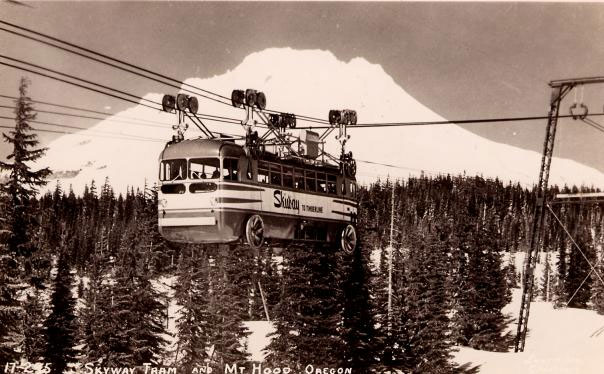
The Mount Hood Skiway: A bizarre amalgam of bus and aerial tram, the Skiway was apparently the longest passenger aerial tramway in the world when completed in 1951. Its clearcut path through the subalpine forest now hosts a power line connecting Govy and Timberline, along with parts of the Skiway and Glade ski trails (see this hybrid aerial-topo map of the area ). The Skiway was the cover story in the August 1951 issue of Popular Science magazine, it's an interesting and detailed article which can be read for free on Google books:
This Bus Rolls Through the Sky
books.google.com/books?id=lyEDAAAAMBAJ&printsec=frontcover
books.google.com/books?id=lyEDAAAAMBAJ&pg=RA1-PA10-IA4 (direct link to first page of article)
"Unlike nearly all other aerial tramways, the one on Mount Hood has stationary cables. ... All the tractive effort is contained in the bus, which literally hoists itself along the heavy lines by means of traction cables below and parallel to the weight-supporting cables." Although it seems to be common belief in some sources that the Skiway used old converted city buses for its cabins, that is not true: the article states that they were custom-built with controls at both ends, at a cost of $40,000 each (about $360,000 in 2013 dollars).
More photos and info:
* Nice video from a 1956 newsreel: (skips the first 26 seconds)
* www.skilifts.org/old/images/resort_image...ne/skiway/skiway.htm (several photos)
* www.pdxhistory.com/html/mt_hood.html (scroll to bottom)
Some stats compiled using info from the article and other sources:
[tt]
Type of Lift: Self-propelled aerial tramway
Bottom Station: 3800 ft
Top Station: 6000 ft
Vertical Rise: 2200 ft
Slope Length: 3.1 miles (16,400 ft)
Average Grade: 13 %
Maximum Grade: 28 %
Travel Time: 24 minutes uphill, 16 minutes downhill
Speed: 700 ft/min uphill, 1000 ft/min downhill
Power: 370 hp
Gas Mileage: 7 gallons per round trip, about 0.9 mpg
Support Towers: 40, ranging from 40 ft to 72 ft high
Cabins: 2 buses, which must follow each other in the same direction, at least 10 towers apart
Cabin Capacity: 36 persons
Uphill Capacity: at most 54 persons per hour with one bus, increasing to only about 80 per hour with both buses
Manufacturer: Pointer-Willamette Company, Portland, OR
Cost to Build: $750,000 (about $6.7 million in 2013 dollars)
Cost to Ride: $0.75 each way (about $6.70 in 2013 dollars)
Start Construction: 1949
Opened to Public: February 3, 1951
Closed: 1956
Removed: 1961
[/tt]
The Skiway failed for a number of reasons, both economic and engineering-related, and closed in 1956. The main reason was that a new road to Timberline opened in 1949 and was paved in 1956, and bus fares on the road cost only $0.50 instead of $0.75 on the Skiway, with a faster travel time too. But the entire concept seems to be a case of obviously and badly flawed engineering too:
* Self-propelled with no counterbalancing is extremely inefficient: In a normal aerial tramway, the two cabins are connected with a single moving cable, so the motor must lift only the net weight of passengers and cargo, not the weight of the cabins (which balances out) or the motor (which is fixed inside the terminal). It's the same for any chairlift or gondola, where the dead weight of the chairs/cabins balances out, and the motor is in one of the terminals. But in the Skiway, the motor must move the entire weight of the bus and the motor itself uphill, in addition to the passengers and cargo -- not good at all. No wonder this "bus" only got 0.9 miles per gallon.
* Icing of the Skiway's cable: The Skiway bus's 4 drive wheels (pulleys) need to maintain grip on the fixed traction cables (which are wrapped 270-degrees around each wheel) in order to drag itself up the hill, presenting a major problem in icing conditions with slippage. In contrast, the bullwheel of an aerial tram or chairlift is located under a weather-protected terminal, making haul rope slippage not much of an issue.
* Only one set of cables limits capacity: Both Skiway buses could only operate in the same direction, and needed to stay "at least 10 towers apart to avoid undesirable tension on the cable." In a normal aerial tram, one cabin is moving downhill while the other is going uphill, so the capacity is nearly double that of the Skiway system.
Apparently, these obvious issues were ignored by those that designed such a contraption, because they were worried about friction in a moving-rope system over 3 miles in length. So they came up with a scheme with no moving ropes at all, only moving cabins along fixed ropes.
It's kind of mind-boggling that they chose to try a new and untested concept (with such glaring flaws), when aerial tramways had already been around for decades and were thoroughly proven in other mountain ranges. The world's first passenger aerial tramway was built in Grindelwald, Switzerland, in 1908, while the first in North America was installed at Cannon Mountain, NH, in 1938. Simple aerial tramways for mining and cargo had been around much longer, since the 1800s, including some in the Cascades built during the early 1900s in mining towns such as Monte Cristo.
The friction that the Skiway designers were worried about appears to be a total non-issue, since some mining tramways in Europe are over 50 miles long (although these are of very different design, with multiple buckets moving on a continuous line in one direction like a chairlift, instead of 2 connected cabins which reverse directions). Since friction along the 100+ miles of haul rope in such systems is not an issue, it would not have been so in the Mount Hood tramway with a loop of just over 6 miles needed for a standard aerial tramway or gondola. If they had installed a normal aerial tramway or gondola instead, it might easily have survived for many decades instead of only 5 years.
The minuscule uphill capacity of only 80 (!) skiers per hour and excessively-long 24 minute travel time meant that the Skiway was simply not practical as a ski lift after the paved road had completely superseded and taken over the Skiway's access duties. In contrast, a modern detachable gondola lift carrying 8-10 persons per cabin has an uphill capacity of up to 2000-2400 per hour (sometimes even more) and a line speed of 5-6 m/s (1000-1200 feet per minute), which would provide a travel time of 13-16 minutes along the 3.1 mile route of the former Skiway. (Data for dozens of gondola installations is in the recent Doppelmayr yearbooks available at media.doppelmayr.com/en/media-library/me...brary/worldwide.html , look at the 8-MGD and 10-MGD types.)
So a modern high-speed gondola would be as fast or faster than driving up, since it is difficult to legally or safely travel the 6 miles of curvy road between the gondola base and Timberline in less than 13-16 minutes (and much longer in traffic or icy conditions). Also, most skier vehicles would burn the majority of a gallon of gas to cover that distance and vertical (12 miles roundtrip with 2200 ft of gain), so riding the gondola would save a few dollars in fuel costs too. Thus the planned gondola would be practical for the public both as an access lift and a legitimate ski lift, in that you could repeatedly cycle the gondola if you wished to cruise moderate groomers or if weather conditions were too nasty above treeline or on the other lifts.
Some more information about the planned gondola plus a map of its path along the former Skiway route is in this brochure of Timberline's long-term plans: www.timberlinelodge.com/wp-content/uploads/Tline-Next-50Yrs.pdf
And unlike almost all other lift construction projects, this one would have a net positive environmental impact, since it would be constructed entirely within a previously-impacted corridor and it would substantially reduce the number of cars driving the 12 mile roundtrip from Govy up to Timberline. The issue of "privatization" of additional public lands also seems minimal in this case, mainly because the same public land was already used for the same purpose in the past, namely the old Skiway tram.
Randy's comment about "the financial failure of the original skiway tram" reminded me of some research I did about the Skiway a few years ago (I'm fascinated by ski lifts and other large ropeways from an engineering perspective). Perhaps it will be of interest to some, so I'll write up my notes in polished form below. Hopefully it clarifies why the Skiway failed, along with the vast difference between it and a modern high-speed detachable gondola lift. (All of the proposals that I have seen are for that type of lift, and not an actual aerial tram, which can not have sufficient capacity per hour to be used as an access lift over that distance.)
[hr]
The Mount Hood Skiway: A bizarre amalgam of bus and aerial tram, the Skiway was apparently the longest passenger aerial tramway in the world when completed in 1951. Its clearcut path through the subalpine forest now hosts a power line connecting Govy and Timberline, along with parts of the Skiway and Glade ski trails (see this hybrid aerial-topo map of the area ). The Skiway was the cover story in the August 1951 issue of Popular Science magazine, it's an interesting and detailed article which can be read for free on Google books:
This Bus Rolls Through the Sky
books.google.com/books?id=lyEDAAAAMBAJ&printsec=frontcover
books.google.com/books?id=lyEDAAAAMBAJ&pg=RA1-PA10-IA4 (direct link to first page of article)
"Unlike nearly all other aerial tramways, the one on Mount Hood has stationary cables. ... All the tractive effort is contained in the bus, which literally hoists itself along the heavy lines by means of traction cables below and parallel to the weight-supporting cables." Although it seems to be common belief in some sources that the Skiway used old converted city buses for its cabins, that is not true: the article states that they were custom-built with controls at both ends, at a cost of $40,000 each (about $360,000 in 2013 dollars).
More photos and info:
* Nice video from a 1956 newsreel: (skips the first 26 seconds)
* www.skilifts.org/old/images/resort_image...ne/skiway/skiway.htm (several photos)
* www.pdxhistory.com/html/mt_hood.html (scroll to bottom)
Some stats compiled using info from the article and other sources:
[tt]
Type of Lift: Self-propelled aerial tramway
Bottom Station: 3800 ft
Top Station: 6000 ft
Vertical Rise: 2200 ft
Slope Length: 3.1 miles (16,400 ft)
Average Grade: 13 %
Maximum Grade: 28 %
Travel Time: 24 minutes uphill, 16 minutes downhill
Speed: 700 ft/min uphill, 1000 ft/min downhill
Power: 370 hp
Gas Mileage: 7 gallons per round trip, about 0.9 mpg
Support Towers: 40, ranging from 40 ft to 72 ft high
Cabins: 2 buses, which must follow each other in the same direction, at least 10 towers apart
Cabin Capacity: 36 persons
Uphill Capacity: at most 54 persons per hour with one bus, increasing to only about 80 per hour with both buses
Manufacturer: Pointer-Willamette Company, Portland, OR
Cost to Build: $750,000 (about $6.7 million in 2013 dollars)
Cost to Ride: $0.75 each way (about $6.70 in 2013 dollars)
Start Construction: 1949
Opened to Public: February 3, 1951
Closed: 1956
Removed: 1961
[/tt]
The Skiway failed for a number of reasons, both economic and engineering-related, and closed in 1956. The main reason was that a new road to Timberline opened in 1949 and was paved in 1956, and bus fares on the road cost only $0.50 instead of $0.75 on the Skiway, with a faster travel time too. But the entire concept seems to be a case of obviously and badly flawed engineering too:
* Self-propelled with no counterbalancing is extremely inefficient: In a normal aerial tramway, the two cabins are connected with a single moving cable, so the motor must lift only the net weight of passengers and cargo, not the weight of the cabins (which balances out) or the motor (which is fixed inside the terminal). It's the same for any chairlift or gondola, where the dead weight of the chairs/cabins balances out, and the motor is in one of the terminals. But in the Skiway, the motor must move the entire weight of the bus and the motor itself uphill, in addition to the passengers and cargo -- not good at all. No wonder this "bus" only got 0.9 miles per gallon.
* Icing of the Skiway's cable: The Skiway bus's 4 drive wheels (pulleys) need to maintain grip on the fixed traction cables (which are wrapped 270-degrees around each wheel) in order to drag itself up the hill, presenting a major problem in icing conditions with slippage. In contrast, the bullwheel of an aerial tram or chairlift is located under a weather-protected terminal, making haul rope slippage not much of an issue.
* Only one set of cables limits capacity: Both Skiway buses could only operate in the same direction, and needed to stay "at least 10 towers apart to avoid undesirable tension on the cable." In a normal aerial tram, one cabin is moving downhill while the other is going uphill, so the capacity is nearly double that of the Skiway system.
Apparently, these obvious issues were ignored by those that designed such a contraption, because they were worried about friction in a moving-rope system over 3 miles in length. So they came up with a scheme with no moving ropes at all, only moving cabins along fixed ropes.
It's kind of mind-boggling that they chose to try a new and untested concept (with such glaring flaws), when aerial tramways had already been around for decades and were thoroughly proven in other mountain ranges. The world's first passenger aerial tramway was built in Grindelwald, Switzerland, in 1908, while the first in North America was installed at Cannon Mountain, NH, in 1938. Simple aerial tramways for mining and cargo had been around much longer, since the 1800s, including some in the Cascades built during the early 1900s in mining towns such as Monte Cristo.
The friction that the Skiway designers were worried about appears to be a total non-issue, since some mining tramways in Europe are over 50 miles long (although these are of very different design, with multiple buckets moving on a continuous line in one direction like a chairlift, instead of 2 connected cabins which reverse directions). Since friction along the 100+ miles of haul rope in such systems is not an issue, it would not have been so in the Mount Hood tramway with a loop of just over 6 miles needed for a standard aerial tramway or gondola. If they had installed a normal aerial tramway or gondola instead, it might easily have survived for many decades instead of only 5 years.
The minuscule uphill capacity of only 80 (!) skiers per hour and excessively-long 24 minute travel time meant that the Skiway was simply not practical as a ski lift after the paved road had completely superseded and taken over the Skiway's access duties. In contrast, a modern detachable gondola lift carrying 8-10 persons per cabin has an uphill capacity of up to 2000-2400 per hour (sometimes even more) and a line speed of 5-6 m/s (1000-1200 feet per minute), which would provide a travel time of 13-16 minutes along the 3.1 mile route of the former Skiway. (Data for dozens of gondola installations is in the recent Doppelmayr yearbooks available at media.doppelmayr.com/en/media-library/me...brary/worldwide.html , look at the 8-MGD and 10-MGD types.)
So a modern high-speed gondola would be as fast or faster than driving up, since it is difficult to legally or safely travel the 6 miles of curvy road between the gondola base and Timberline in less than 13-16 minutes (and much longer in traffic or icy conditions). Also, most skier vehicles would burn the majority of a gallon of gas to cover that distance and vertical (12 miles roundtrip with 2200 ft of gain), so riding the gondola would save a few dollars in fuel costs too. Thus the planned gondola would be practical for the public both as an access lift and a legitimate ski lift, in that you could repeatedly cycle the gondola if you wished to cruise moderate groomers or if weather conditions were too nasty above treeline or on the other lifts.
Some more information about the planned gondola plus a map of its path along the former Skiway route is in this brochure of Timberline's long-term plans: www.timberlinelodge.com/wp-content/uploads/Tline-Next-50Yrs.pdf
Please Log in or Create an account to join the conversation.