
- Posts: 62
- Thank you received: 0
Human Factor Observation Tool
- jwplotz
-

- User
-

Less
More
15 years 3 months ago #198923
by jwplotz
Replied by jwplotz on topic Re: Human Factor Observation Tool
The HF becomes greatly simplified if you tour with the same posse of shredders, especially if you've had both successful and bailure tours with them. Trust and rapport are like extra touring gear, much easier to make decisions without fear of being judged.
Extra bonus if they provide smoked salmon!
Extra bonus if they provide smoked salmon!
Please Log in or Create an account to join the conversation.
- Col
-
- User
-
Less
More
- Posts: 11
- Thank you received: 0
15 years 3 months ago #198936
by Col
Replied by Col on topic Re: Human Factor Observation Tool
How about Confidence? By this I mean true confidence in one's (group's) ability and decision making, which may be challenging to identify near the edge of one's comfort zone.
I've been considering this especially when I ski alone in the bc. So far, I have developed trust in my decision making because I have not been lost, hurt, or found unmanageable danger. But I also don't push it too far (beyond my own comfort zone), so I feel confident in my choices. Additionally, I do know how quickly AOK turns to SOL, so that helps keep my decisions conservative.
This is all subjective of course, so having some baseline info like Heart Rate and possibly some kind of cognitive test could be useful.
I like this. Thanks Dan.
I've been considering this especially when I ski alone in the bc. So far, I have developed trust in my decision making because I have not been lost, hurt, or found unmanageable danger. But I also don't push it too far (beyond my own comfort zone), so I feel confident in my choices. Additionally, I do know how quickly AOK turns to SOL, so that helps keep my decisions conservative.
This is all subjective of course, so having some baseline info like Heart Rate and possibly some kind of cognitive test could be useful.
I like this. Thanks Dan.
Please Log in or Create an account to join the conversation.
- otter
-
Topic Author
- User
-
Less
More
- Posts: 43
- Thank you received: 0
15 years 3 months ago #198946
by otter
That is exactly what I was thinking. By having a common language, we reduce the chance/ fear of offending others.
Thanks for the input.
Replied by otter on topic Re: Human Factor Observation Tool
I like the idea. I think one thing that makes discussing human factors amongst a group harder than discussing snow conditions is that you can make statements about the state of the snow without hurting anyone's feelings. Saying "this slope received some cross loading" doesn't insult the snowpack. Telling a group that you fear they are falling into the expert halo or that someone has powder fever can hurt people’s feelings, so people can be less apt to do so. It doesn’t make it less important, but it happens. I think that giving a more objective framework may lessen some of that apprehension and make the discussion easier. If you are running down a checklist it could be easier to broach a subject that a person might not have tackled. It has been my experience that in larger groups the reluctance to speak up can be the biggest human factor and it can magnify the effect of other human factors. I think your idea, Dan, may help solve that problem.
I have found that I make better decisions when I am happy and having a good time than when I am not happy. I don’t know what label would best describe it, but something like level of enjoyment is how I think of it.
That is exactly what I was thinking. By having a common language, we reduce the chance/ fear of offending others.
Thanks for the input.
Please Log in or Create an account to join the conversation.
- Lowell_Skoog
-
- User
-
Less
More
- Posts: 1460
- Thank you received: 16
15 years 3 months ago #198949
by Lowell_Skoog
Replied by Lowell_Skoog on topic Re: Human Factor Observation Tool
Interesting idea. I haven't pondered the details much, but if you could come up with a straightforward, comfortable way to discuss this before each trip, it could become as routine as a beacon check. And possibly more valuable.
Please Log in or Create an account to join the conversation.
- otter
-
Topic Author
- User
-
Less
More
- Posts: 43
- Thank you received: 0
15 years 3 months ago #198952
by otter
Replied by otter on topic Re: Human Factor Observation Tool
I was purposefully vague with my description earlier to see what might come up in discussion. Please keep the ideas coming.
Here are the Descriptors I have come up with with the help and input from CookieMonster. Any suggestions are welcome.
"Desire"- AKA Stoke, excitement, commitment. This is why we go out and ski. Desire can be spiked by great skiing conditions, commitment to an objective, blue bird days, good times with friends, lack of skiing opportunities, etc. High Desire levels result in "Powder Fever", "Summit or Plummet", "Let's get rad", "I'm going to go bigger than you" mindsets that can have negative impacts on decision making. Another way to think of it, is "Desire" is our arousal level and we are known to make poorer decisions when aroused. Think about it.
"Uncertainty"- AKA Lack of confidence. Uncertainty works in opposition to desire and inhibits our actions and decisions. I use "Uncertainty" instead of "Confidence" because I think it is more important to consider sources of uncertainty rather than sources of confidence. This forces us to think about information gaps, sources of nervousness, fear and other negative feelings. It is a huge category because there are so many sources of uncertainty. Some examples: Degree of planning, familiarity with terrain, snowpack, weather, and group, experience and knowledge, poor visibility, poor view because of position in terrain, presence of persistent weak layers, etc. If people have other sources to add to this list, please share them. Often times Uncertainty will manifest itself as intuition, specifically a negative intuitive feeling. The more Uncertainty, the more conservative decisions should be.
"Stress"- When Desire and Uncertainty levels are in conflict, we experience Stress. Stress can also have other sources, but ultimately we make worse decisions when we are under Stress. One idea to measure Stress would be to take a resting heart rate, but I don't know how practical that it. On the other hand, simply taking the time and getting your heart rate to a resting rate gives you the chance to step back and consider your options. If Stress levels are high, you need to take a some deep breathes, eat a snack and do whatever else you need to do to chill out.
"Communication"- How communicative are you feeling? How well has the group been communicating? Are things being verbalized? Are you making any assumptions that are remaining unspoken. Are you communicating well with yourself? Are you being honest? If communication levels are low, you need to be proactive in increasing it. Simply going through this observation process will increase communication
"Overall Well-being"- (I don't know about the label, so please make suggestions) This is kind of a catch all that includes energy level, injuries, mood, distracting problems back in the city, sickness, etc.
For each Descriptor, group members rate their levels as "Hi" "Mod" or "Lo" (Should there be a "Very Hi" and Very Lo"???)
"Hi" ratings for Desire, Uncertainty, and Stress are red flags, as or "Lo" ratings for "Communication" and "Overall Well-being". Another red flag is when there are discrepancies between group members. Members should explain the rationale behind their rating so the group can get on the same page.
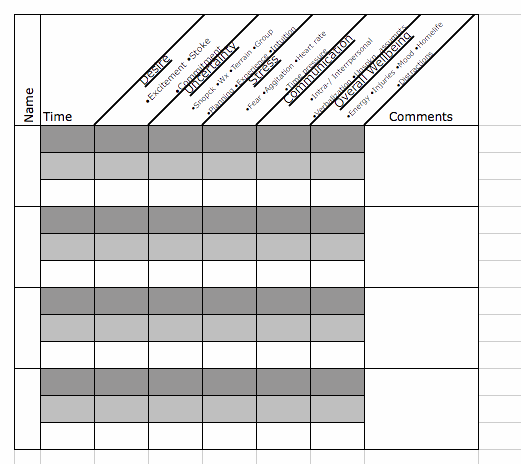
Below is the format I have come up with for recording the observations. When first implementing this tool, I think it is advisable to go through the process of actually recording your obs. Obs. should be taken at the trailhead and then throughout the day, especially at decision points. Recording will give you a visual to track trends for a person throughout the day and a way to compare individuals of the group. After going through the process several times, it will become fluid and observations can be made continually throughout the day. Ultimately, these descriptors give us a common vocabulary to talk about targeted Human Factor Observations.
I will be the first to admit that the actual utility of making ratings and extrapolating useful or definitive conclusions from them is weak. But again, the goal of this tool is to force us to have the Human Factor conversation and give a vocabulary that makes it more comfortable.
I invite all comments and suggestions. Is this something people would actually use? Would this be a useful addition to L1 avalanche curriculum? Would you change any of the descriptors, add any, improve the recording format? Open forum.
Here are the Descriptors I have come up with with the help and input from CookieMonster. Any suggestions are welcome.
"Desire"- AKA Stoke, excitement, commitment. This is why we go out and ski. Desire can be spiked by great skiing conditions, commitment to an objective, blue bird days, good times with friends, lack of skiing opportunities, etc. High Desire levels result in "Powder Fever", "Summit or Plummet", "Let's get rad", "I'm going to go bigger than you" mindsets that can have negative impacts on decision making. Another way to think of it, is "Desire" is our arousal level and we are known to make poorer decisions when aroused. Think about it.
"Uncertainty"- AKA Lack of confidence. Uncertainty works in opposition to desire and inhibits our actions and decisions. I use "Uncertainty" instead of "Confidence" because I think it is more important to consider sources of uncertainty rather than sources of confidence. This forces us to think about information gaps, sources of nervousness, fear and other negative feelings. It is a huge category because there are so many sources of uncertainty. Some examples: Degree of planning, familiarity with terrain, snowpack, weather, and group, experience and knowledge, poor visibility, poor view because of position in terrain, presence of persistent weak layers, etc. If people have other sources to add to this list, please share them. Often times Uncertainty will manifest itself as intuition, specifically a negative intuitive feeling. The more Uncertainty, the more conservative decisions should be.
"Stress"- When Desire and Uncertainty levels are in conflict, we experience Stress. Stress can also have other sources, but ultimately we make worse decisions when we are under Stress. One idea to measure Stress would be to take a resting heart rate, but I don't know how practical that it. On the other hand, simply taking the time and getting your heart rate to a resting rate gives you the chance to step back and consider your options. If Stress levels are high, you need to take a some deep breathes, eat a snack and do whatever else you need to do to chill out.
"Communication"- How communicative are you feeling? How well has the group been communicating? Are things being verbalized? Are you making any assumptions that are remaining unspoken. Are you communicating well with yourself? Are you being honest? If communication levels are low, you need to be proactive in increasing it. Simply going through this observation process will increase communication
"Overall Well-being"- (I don't know about the label, so please make suggestions) This is kind of a catch all that includes energy level, injuries, mood, distracting problems back in the city, sickness, etc.
For each Descriptor, group members rate their levels as "Hi" "Mod" or "Lo" (Should there be a "Very Hi" and Very Lo"???)
"Hi" ratings for Desire, Uncertainty, and Stress are red flags, as or "Lo" ratings for "Communication" and "Overall Well-being". Another red flag is when there are discrepancies between group members. Members should explain the rationale behind their rating so the group can get on the same page.
Below is the format I have come up with for recording the observations. When first implementing this tool, I think it is advisable to go through the process of actually recording your obs. Obs. should be taken at the trailhead and then throughout the day, especially at decision points. Recording will give you a visual to track trends for a person throughout the day and a way to compare individuals of the group. After going through the process several times, it will become fluid and observations can be made continually throughout the day. Ultimately, these descriptors give us a common vocabulary to talk about targeted Human Factor Observations.
I will be the first to admit that the actual utility of making ratings and extrapolating useful or definitive conclusions from them is weak. But again, the goal of this tool is to force us to have the Human Factor conversation and give a vocabulary that makes it more comfortable.
I invite all comments and suggestions. Is this something people would actually use? Would this be a useful addition to L1 avalanche curriculum? Would you change any of the descriptors, add any, improve the recording format? Open forum.
Please Log in or Create an account to join the conversation.
- normanclyde
-
- User
-
Less
More
- Posts: 28
- Thank you received: 0
15 years 3 months ago #198962
by normanclyde
Replied by normanclyde on topic Re: Human Factor Observation Tool
This is an extremely interesting topic. People who study error prevention (medical errors for instance) have delved into it, but in the case of avalanche safety, the pack has barely been probed and the weak layers are little understood. Psychology research has defined certain human biases which help to illustrate the pitfalls. Foremost among these, in my opinion, is confirmation bias. This is the human tendency, when presented with conflicting information, to ignore troubling facts in favor of the data you prefer. It has a powerful influence on group dynamics. Confirmation bias makes it easier for each member of a group to bury his/her individual misgivings and accept collective risk. Most of us have probably experienced this in the backcountry more than once. It can be extremely difficult from a psychological standpoint to resist the momentum of the group. Pressure to follow the crowd has led me into places I would otherwise not have ventured-- places where my fears were confirmed.
My experience in the area of medical error prevention, plus my less extensive experience with backcountry dynamics, lead me to make one recommendation above others. Each member of the team, no matter his or her relative status within it, must be equally empowered to point out errors and call a halt. This is the unstable layer in the human pack, which we can identify before the trip begins, if we make the effort. It should be a teaching point in avalanche safety courses, on a par with understanding unstable layers in the snowpack. I know it gets dealt with to some degree. But any graduate of a safety course should understand it, the same way they do a beacon, shovel and probe.
My experience in the area of medical error prevention, plus my less extensive experience with backcountry dynamics, lead me to make one recommendation above others. Each member of the team, no matter his or her relative status within it, must be equally empowered to point out errors and call a halt. This is the unstable layer in the human pack, which we can identify before the trip begins, if we make the effort. It should be a teaching point in avalanche safety courses, on a par with understanding unstable layers in the snowpack. I know it gets dealt with to some degree. But any graduate of a safety course should understand it, the same way they do a beacon, shovel and probe.
Please Log in or Create an account to join the conversation.