
- Posts: 47
- Thank you received: 0
For the bird nerds...
- Hyakbc
-
 Topic Author
- User
-

Less
More
15 years 3 months ago #198617
by Hyakbc
Replied by Hyakbc on topic Re: For the bird nerds...
Savor the sweet sweet irony. On point as always Mr. Andalkar. Hehe, looks like my bird book is old. Have been seeing these guys regularly, had three burst out of the snow in front of me a while back.
Please Log in or Create an account to join the conversation.
- markharf
-
- User
-
Less
More
- Posts: 344
- Thank you received: 4
15 years 3 months ago #198628
by markharf
I've always assumed that their apparent instinct to freeze in the presence of threat, in combination with their effective camouflage, is the reason they've survived. In other words, that's their evolutionary adaptation--not panic or flight. As evidence I've got only the fact that I never see them until they move; as long as they're still, they're quite safe from whatever threat I might pose. Of course, it also means I've almost run them over on skis quite a few times.
Another way to look at it would be to ask what their natural predators have been: probably not so much land mammals (human, cougar, wolf, bear) as hawks or eagles. Remaining perfectly still is a good defense against these. But basically I'm just exercising my love of idle speculation.
Mark
Replied by markharf on topic Re: For the bird nerds...
It has always surprised me that a species with so little panic response and flight instinct upon seeing a potential predator approach has managed to survive and thrive. They certainly are well camouflaged in summer or winter, though.
I've always assumed that their apparent instinct to freeze in the presence of threat, in combination with their effective camouflage, is the reason they've survived. In other words, that's their evolutionary adaptation--not panic or flight. As evidence I've got only the fact that I never see them until they move; as long as they're still, they're quite safe from whatever threat I might pose. Of course, it also means I've almost run them over on skis quite a few times.
Another way to look at it would be to ask what their natural predators have been: probably not so much land mammals (human, cougar, wolf, bear) as hawks or eagles. Remaining perfectly still is a good defense against these. But basically I'm just exercising my love of idle speculation.
Mark
Please Log in or Create an account to join the conversation.
- Big Steve
-
- User
-
Less
More
- Posts: 141
- Thank you received: 0
15 years 3 months ago - 15 years 3 months ago #198638
by Big Steve
WT Ptarmigans are indeed "uncommon" in birding parlance.
That sort of behavior is common to all WA grouse species, including the much more common Blue Grouse (which some split into two species, i.e., Sooty and Dusky) and Ruffed Grouse. I've seen one WT Ptarmigan for every 100+ Blues exhibiting the behavior you describe.
Re southern margin of range, I have ID'd WT Ptarmigan in Goat Rocks Wilderness.
Replied by Big Steve on topic Re: For the bird nerds...
For a bird which is "uncommon" in the Cascades (as stated on Birdweb), I seem to stumble upon ptarmigans (in their summer plumage) quite often during late-summer and fall hikes to various peaks and alpine areas. Usually sitting right in the middle of the trail, and then running along the trail for quite a long distance as I continue to walk, before eventually darting off to the side or (very rarely) making a short hop-like flight to escape.
WT Ptarmigans are indeed "uncommon" in birding parlance.
That sort of behavior is common to all WA grouse species, including the much more common Blue Grouse (which some split into two species, i.e., Sooty and Dusky) and Ruffed Grouse. I've seen one WT Ptarmigan for every 100+ Blues exhibiting the behavior you describe.
Re southern margin of range, I have ID'd WT Ptarmigan in Goat Rocks Wilderness.
Please Log in or Create an account to join the conversation.
- rnbfish
-
- User
-
Less
More
- Posts: 84
- Thank you received: 0
15 years 3 months ago #198639
by rnbfish
Replied by rnbfish on topic Re: For the bird nerds...
yes I too have seen many in the goat rocks and futher south.. have them on my land in thurston county but not white. ( not too much snow here )
Please Log in or Create an account to join the conversation.
- Splitter
-
- User
-
Less
More
- Posts: 104
- Thank you received: 0
15 years 3 months ago #198640
by Splitter
Replied by Splitter on topic Re: For the bird nerds...
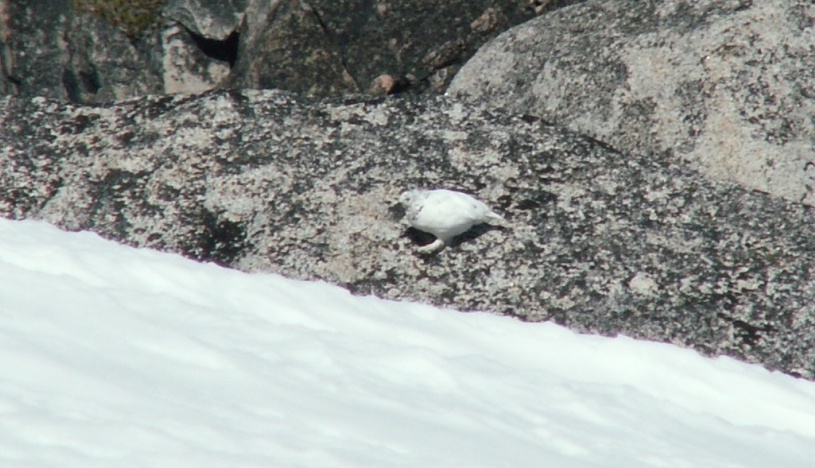
From Little Annapurna in the Enchantments
Please Log in or Create an account to join the conversation.
- Big Steve
-
- User
-
Less
More
- Posts: 141
- Thank you received: 0
15 years 3 months ago #198641
by Big Steve
Replied by Big Steve on topic Re: For the bird nerds...
Nice pic
WT Ptarmigan are white during non-breeding season, i.e., late fall through early spring, and their habitat in WA is confined to alpine terrain, i.e., snowy places in winter.
WT Ptarmigan are white during non-breeding season, i.e., late fall through early spring, and their habitat in WA is confined to alpine terrain, i.e., snowy places in winter.
Please Log in or Create an account to join the conversation.