
Overcoat-Lemah Traverse
I've been thinking on and off about whether I should post this trip report from the spring. Putting up reports many months after the fact often doesn't make sense to me, but maybe this is exactly the right time to post this, just as a reminder to people stoked for the coming pow…
In May, Jon and I completed a beautiful route -- a traverse from the Middle Fork to Pete Lake, skiing the north couloir on Overcoat and then the SE couloir on Lemah on the way -- but we made some atrocious choices and were extremely lucky that we made it out intact. I don't often feel shame, but that's exactly how I felt after completing this trip. It was humbling. It taught me an emotional lesson about heuristic traps, partner choice and communication, and also gave me perspective on other people's accident reports in which they completely disregard red flags.
It started with years of stoke about skiing these two couloirs, too little flexibility for the timing of attempting it, and being greedy for snow coverage down low. In early April, Jon asked me if I was still interested in his Overcoat to Lemah idea, perhaps around May 1st. My response: "Hell yes! It better start doing some melt-freeze cycles soon, there's pow in the mountains now, even as low as 5k' around Snoqualmie." We both kept a handful of days free in early May for the car shuttle one evening followed by two full days to complete the traverse. Jon later had to cut a day off his availability window.
We decided to go for it. As I drove to meet Jon at the Pete Lake trailhead (2820’) so we could leave one vehicle and drive to the west end of the traverse, I realized something that should have been obvious before: will this trailhead still be under snow? How far will we get on the road? And indeed, we were stopped by impassable snow 3.5 miles from the trailhead. Memorably, we stopped and chatted with folks who had made it to the trailhead in an SUV with a winch lashed to the front of the vehicle then (I think?) connected to the car battery. They were all kind of hyper/hysterical with their adventure -- it sounds like they’d macgyvered their winch to work (they’d thrown it in the car, still in the box, before leaving home) and then used it like 20+ times to get themselves out? We left Jon's car, moved his bike and gear into my borrowed CRV, and drove back west and up the Middle Fork road, up past Garfield Ledges and to the Dingford Creek trailhead (1430’). Before tucking in for the night, we went over the route together again and discussed how long we thought it would take to get to different points, focusing on the solar aspects and the latest we'd want to travel on and under steep slopes. We came up with an alarm time that seemed wise.
In the morning, maybe 20 minutes later than planned, we unloaded bikes, mounted our skis on our two-day packs, and started pedaling the 7.5 miles, 1,400’ gain up to Hardscrabble horse camp (2830') under clear skies. I had my VCB (very capable [gravel] bike) with 2.2" tires; Jon was on an older mountain bike with 26" wheels.
Finishing this first crux took about twice as long as we expected. Hmm. We locked up bikes, snacked, and set off on the lovely Dutch Miller Gap trail. We came across the first few snow patches and to my utter dismay, they were total mush. No, no, these should be very firm right now, this does not bode well... I muttered to myself, as a disturbingly hot wind blew through. Soon we arrived at our creek crossing. After a few minutes to find the shallowest spot, I crossed first, pretty straightforward, up to mid-thigh deep, and watched as Jon almost went for a little swim. From there, we took a downed tree highway out of the alder and into the ground-up dirt and avalanche debris, and started some real gain. Up the dirt, up the rocky gully, into some easy scrambling. The rock steepened and began to turn into a waterfall gully. Jon took us right, out of the gully, and into the evergreens. Schwacking in steep trees is mentally and physically exhausting and slow AF; maybe triply so with skis on your back.
Finally we crested out onto somewhat continuous snow and carefully climbed it up to a waterfall blocky-scrambly rock section, then pieced together some lighter evergreen schwack to escape the trees. Wow, that section also took way longer than expected. Going back down that way felt fairly off the table. We stepped onto the snow: sloppy. Skinning was not easy. Jon put his ski crampons on to try to get more traction in the mush. We continued on. Even if we'd arrived two hours earlier, would the snow have been in any different shape? I don't really think so.
Beautiful views abound as we approached the north side of Overcoat, but the wind was ferocious and sustained, even with sloppy snow underfoot. I asked Jon: “Are the mountains trying to tell us that today isn't the day for this?” I asked my question, but we didn’t stop, look each other in the eyes, and really have a discussion to seriously consider pulling the plug on the full traverse. When this question comes to mind in the future, I probably already know the answer. I think this would have been the first good spot to have turned around. From this TR, we knew about an alternative way to get down so we wouldn't have had to downclimb the wet slabs and scrambling.
I was super curious to see what the snow in the north-facing wide couloir on Overcoat would be like. I was not keen to ski it in anything sloppy or icy. It is not long, but it is unquestionably steep at the top. Very happily, the conditions seemed good for skiing it! It was around 2pm (!) when we stuffed our overnight gear into the rocks at the base and booted up (fairly firm but not icy). Soon we were faced with a snowier-than-expected scramble, as we were hoping to be able to summit. It looked doubtful for our gear, but we left our skis and scrambled up a bit to a climber’s left ridge and eyed the terrain above us. We were discussing how technical it looked, the time, and how long it might take, when suddenly a pretty large natural avalanche released two gullies to our left (I think a cornice failed) and that made our decision pretty easy. We carefully downclimbed the step back down to our skis and enjoyed skiing the couloir – firm, but grippy and smooth. This would have been a beautiful spot to camp for the night and descend from to get back to the Middle Fork the next morning.
As we continued on, now nearing the Overcoat-Chimney Rock col, the snow started to get wetter and we heard another natural avalanche come down somewhere. Ugh. Not good. We are way behind schedule, and we have some long traverses under steep and rocky slopes on solar aspects ahead of us to get to our camp for the night. But we just have to get to our camp and tomorrow we'll be out of here, was one thought. I voiced my concerns to Jon: “I think we should chill somewhere safe for a while, until things cool down..” He agreed, so we very carefully skied rotten snow around gaping moats and cracks over slabs, setting off a couple wet loose mini-avalanches, then a pitch of corn, down to a little safe knoll-ish rise in the terrain about halfway down to Iceberg Lake.
It was HOT. I set up my betalight for some shade, and we listened to some Amadou & Mariam and other things. After a couple hours, around 6pm, Jon suggested we keep moving. In retrospect, even if we’d waited another while, until the sun went down, even if we'd waited until the middle of the night, I'm not sure how much difference it would have made (and that would have added additional hazards).
As we headed up to the little mini-pass just south of Iceberg Lake, we realized we were following bear prints and the biggest swath of glacial/ice worms I've ever encountered. We followed the bear prints all the way to the pass north of Chikamin Lake, so over half a mile! This west-facing traverse under the rocky pinnacles of Lemah, at times with mini cliffs below, was very risky and it was stupid. At one point, above those mini cliffs, I heard Jon behind me yell, “Avalanche!” as a natural wet loose released above us, and we were separated by the 15-foot wide river of slowly flowing, powerful debris that seemed to continue moving forever. Luckily, as it slowed to a creep, Jon was able to quickly get over it and we continued on our way. While no one got hurt, that was a close call that could have ended much differently. We shouldn’t have been there.
Finally we reached the pass north of Chikamin Lake in a stiff breeze, and as darkness closed in around us, we dug into a slope for the night near some trees, set up the betalight, and passed out. At this point we’d realized that the likelihood of our summiting Lemah was very low. The goal was just to get through and down the Lemah couloir safely.
In the beautiful early hours, we set out on snow that was great for skinning, needing ski crampons! This is how it should be! We entered into pretty complex terrain and peered over a windscoop lip into an east-facing gully we'd need to descend to get around the toe of the massif. It did not look great, but it looked manageable, and much better than the other options to get down. You could see some cracks and holes and the snow was mush. I thought: if we take this slowly and carefully and communicate well, we can cut the top layer, not slough ourselves or each other, and get out of here. That went fine enough: slice, pull off, wait, call partner down, repeat…
We came out into the basin below into rolling terrain. I remember enjoying one pitch of perfect corn. Soon we had to gain a short steep section -- still in the shade -- to get on top of a sort of mini-rib. "Seems kinda steep and icy, just gonna transition to boot," I said. But that was the wrong move, because as the angle ramped up, the firm snow turned into breakable crust with unconsolidated snow underneath. After a couple easy steps, I was suddenly postholing to my knees and mid-thigh. Cursing + sigh. Transition again to skinning – steep, but I was able to break through the crust a bit, stay on top, and get good traction.
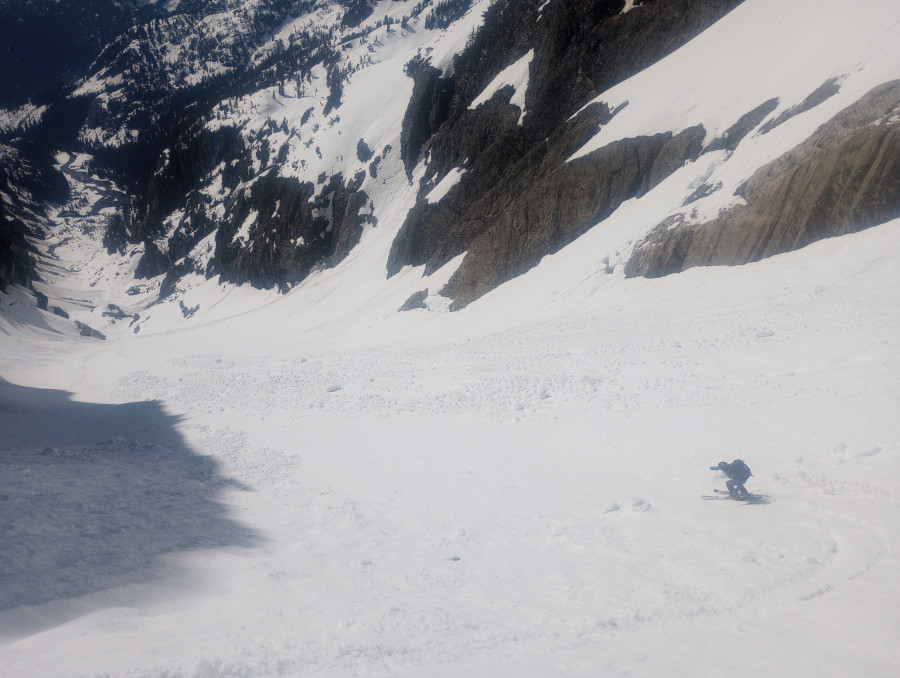
We made some progress over and up toward the top of the couloir, observing a couple of small wet loose come down. We had to make one short descent – simple, gradual-to-flat runout, and we had our most real incident: Jon went first, conservatively, ensuring he didn't slough himself. His first turns felt good, he said, and things felt stable, so he opened it up a bit more -- and sloughed himself. He was caught and carried, losing one ski, but staying on top until he came to rest in the middle of the basin. I had never witnessed someone caught and carried like that and I felt absolutely helpless since I knew that my skiing would almost surely trigger more snow, potentially burying him. Luckily we could communicate via radio and I could see him the whole time; he was able to extricate himself and one-ski-shuffle uphill and away from the debris pile. I carefully retrieved his ski (which was actually very stuck in the heavy snow and ridiculously close to a hole-into-the-abyss near some rocks) and got down to him. A good reminder of how a difference of just a few degrees/angle can make the difference in snow strength and movement. After chatting about what had just happened, we continued on...
Finally we got to our final objective hazard: traversing under tons of steep rocky terrain, crossing old avalanche debris with rocks in it, to get to the safer side of the gut of the long, mellow couloir, and then getting the fuck outta there. It felt like every 20 minutes there was another small wet loose coming down from above, and most of the traverse was in the sun. I floated the idea of trying to get down another way that wasn't such an obvious terrain trap, but with all the shallow weak snow over rock and the complex terrain, we decided to roll the dice to get out of there in the most straightforward way possible. I think that was the right choice.
Moving very quickly and one at a time, we traversed the funnel successfully (a small natural came down about 30 seconds after I passed, crossing our tracks) and then we quickly skied some actually pretty good snow down the wide couloir and arrived safely to the flats! We were so relieved to finally be out of the complex danger zones around 10:30am.
After a quick break, we continued onward and happily the snowpack was still fat enough to cover the slide alder, no schwack. Down and into the dirty, sloppy forest we went. Soon it flattened out enough to skin. Promptly our skins were completely saturated and full of pine needles and we both needed multiple voile straps to keep our skins working. I think it ended up being 10+ miles of skinning and then booting through forest that varied between 0 and 2’+ of snow, hollow and melting out in many places. Lots of unexpected postholing in snow patches, once we were mainly off-snow. It was all very, very tiring. I’m glad neither of us twisted a knee.
Finally we got to the Pete Lake trailhead, switched to our trail runners, and reached the car just before needing headlamps. Our initial plan was to then drive back up the Middle Fork and run up the road (you know, a quick 7.5-mile jog) to get our bikes, but we decided to sleep and do it the next day. That was definitely the right choice and the bike descent was great!
--
So, what were the takeaways? What did I learn? How did we observe so many red flags yet continue onward?
I think the primary heuristic trap at play was summit fever. In this case, it was more like "traverse fever" -- being overly goal-oriented. We *so badly* wanted to complete this interesting route that we convinced ourselves at each red flag that it wasn’t that bad, that the problems were manageable, that our persistence and smarts would allow us to succeed in achieving our goal. I think the amount of experience I have with wet loose problems definitely made me more complacent. If the problem we were facing was a persistent layer or something less predictable, less known to me, I think I would have treated it differently. But basically, we were impatient with the mountains. We should have, could have recognized that the mountains were not ready for a spring traverse. On the very first morning, we could have swallowed our bigger goal and said, "Welp, these aren't the conditions to do this kind of thing in, we've had a beautiful day outside, and now we're going to have a sweet downhill ski and bike ride back to the car." Or we could have skied the couloir on Overcoat, had an awesome night out, and turned back then. The goal should be to enjoy the little time we get in the mountains and look for green lights to see if they’ll let us pass more or less safely. This is a philosophy I’ve voiced over and over, but I’m still learning to really follow it.
Second, I think that Jon and I are still developing our communication. While we'd skied together a handful of times before, and knew each other's mountain experience and fitness pretty well, we hadn't done anything very complicated or more than a day trip. I think that both of us tend toward being a little more tolerant of risk, which is perhaps a sort of "mountain immaturity.” Being willing to roll the dice more often or with larger consequence is certainly not an actual way to manage risk. I've come to really appreciate my mountain partners with lower risk tolerance who pull me back a little more, keep me in check when I'm trying to forge ahead with stupid shit. Unfortunately, in this case, neither Jon nor I ventured to say, "Yo, we're being stupid here." I usually think of myself as being a pretty direct communicator and not being afraid to voice my concerns, but it’s clear that I didn’t do it adequately in this situation. And maybe there was something, too, about not wanting to disappoint Jon. I didn’t trust my gut enough to be confident about how I was feeling.
Other factors:
- We seriously underestimated how much time each section would take. We should have estimated the biking time on more actual data, and we should have built in more time for shenanigans!
- There were a lot of uncertainties on this route, including what the snow would be like. We didn’t have any recent TRs that gave us good evidence of what we’d encounter. I need to keep in mind the mantra: when uncertainty increases, the margin of safety should increase…
For those interested, our first day was about 7400’ gain/4.25 miles, second day was about 2400’ gain/19.5 miles.
If anyone has any observations to add to my takeaways, or any of their own “damn good lesson” stories, I’d love to hear it all.
Schwack #2
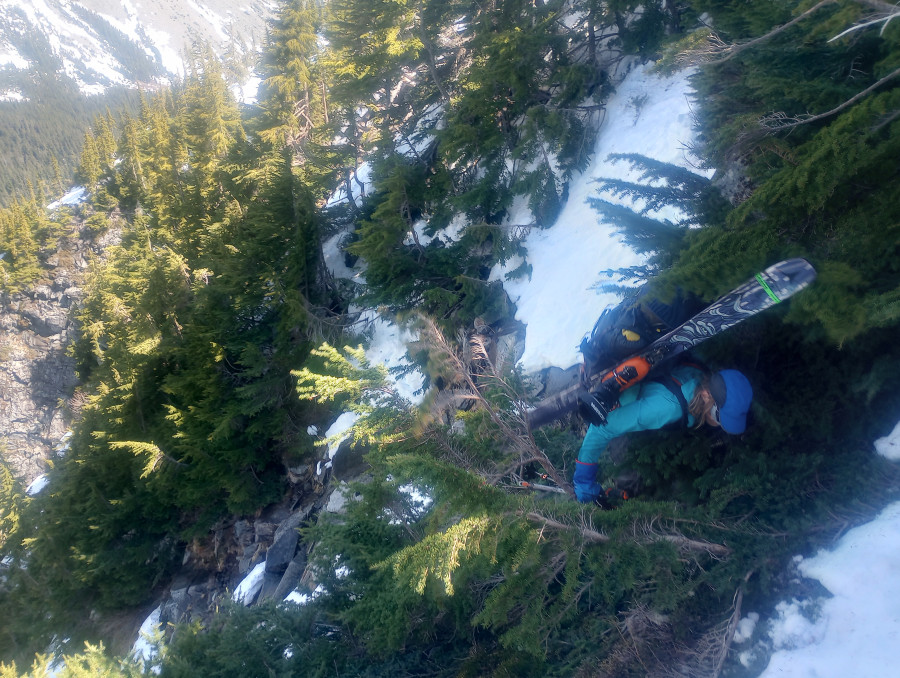
Getting up there...
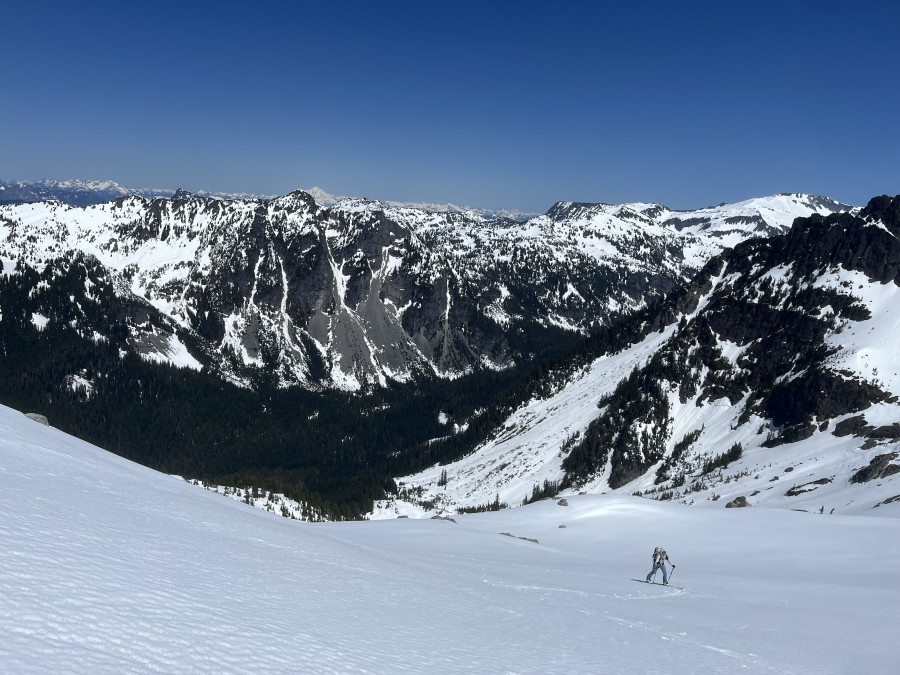
Overcoat
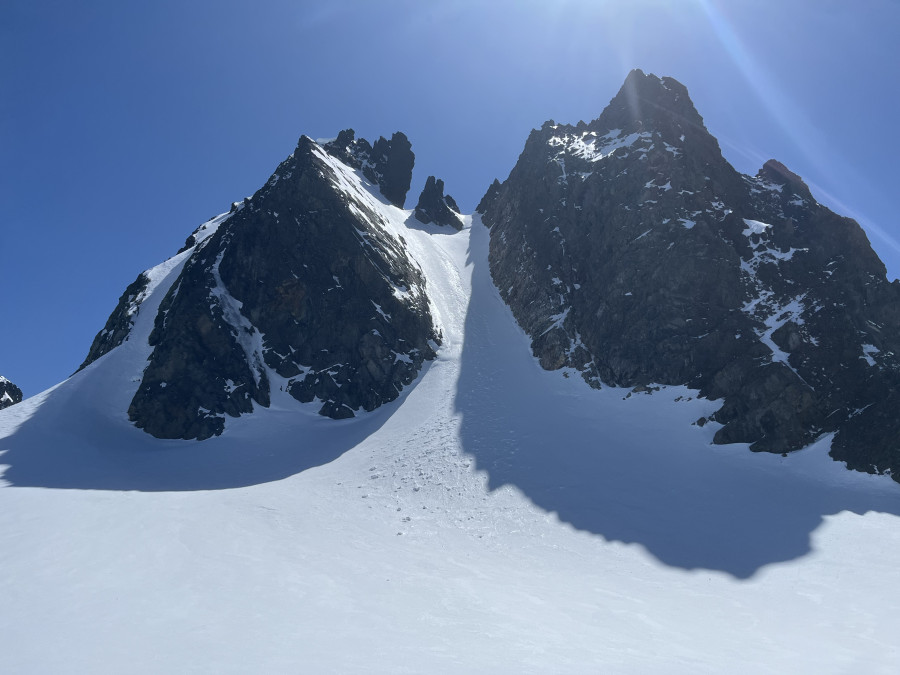
Booter
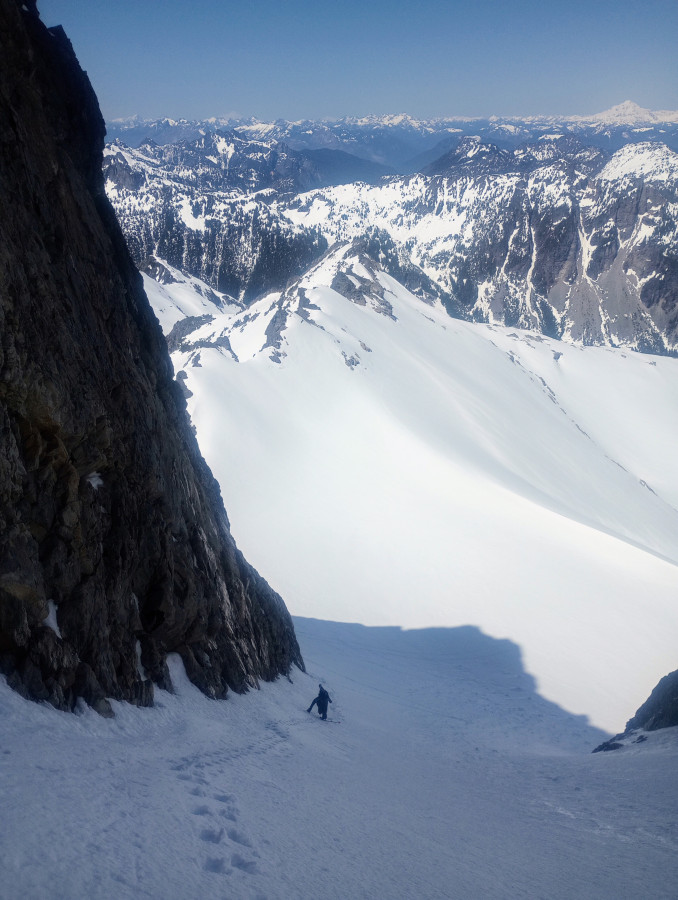
Yewww!
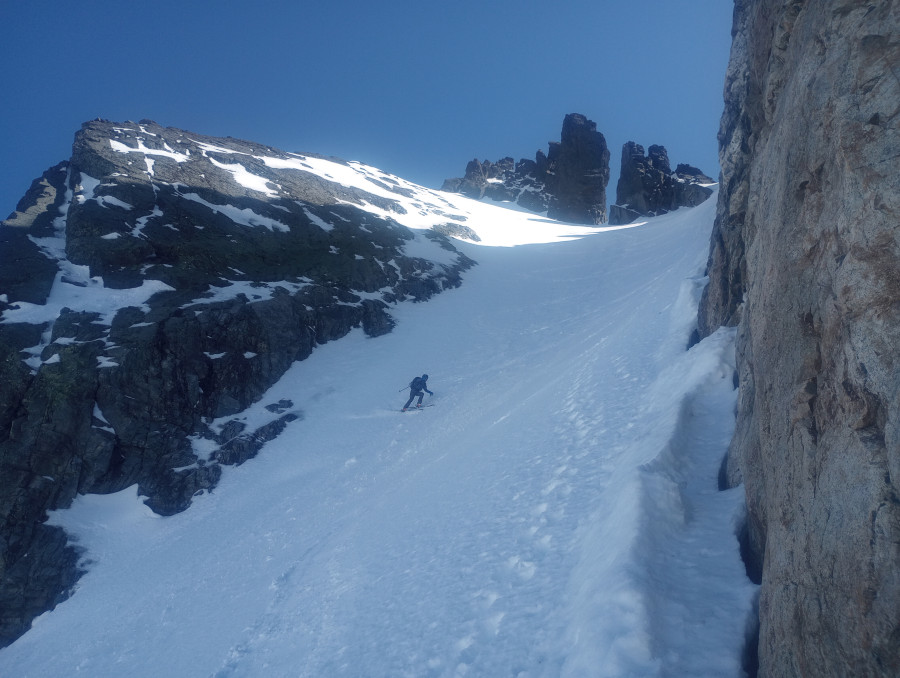
From the Overcoat-Chimney Rock col
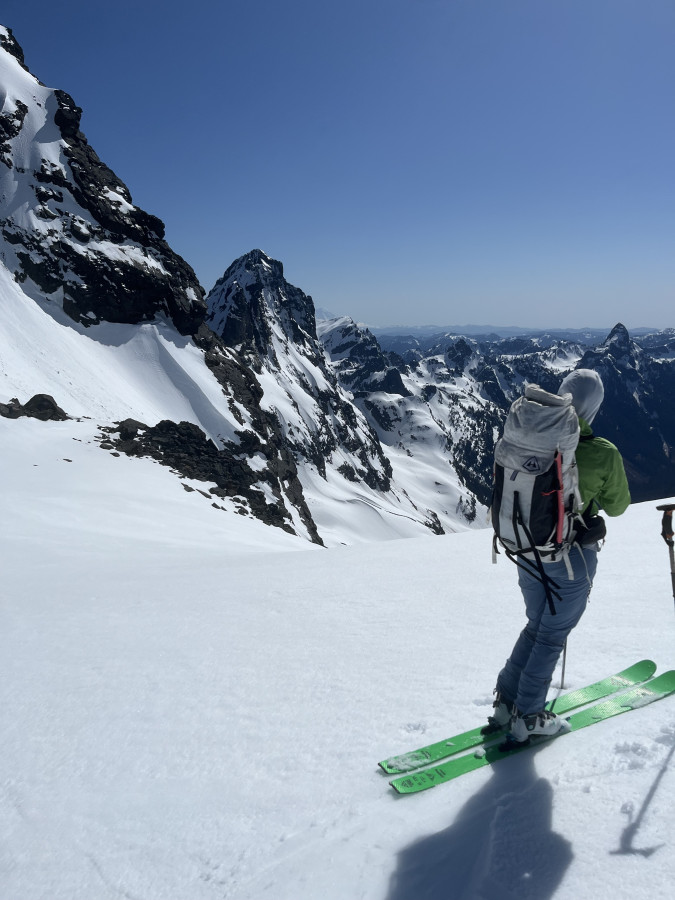
Sketchy traverse
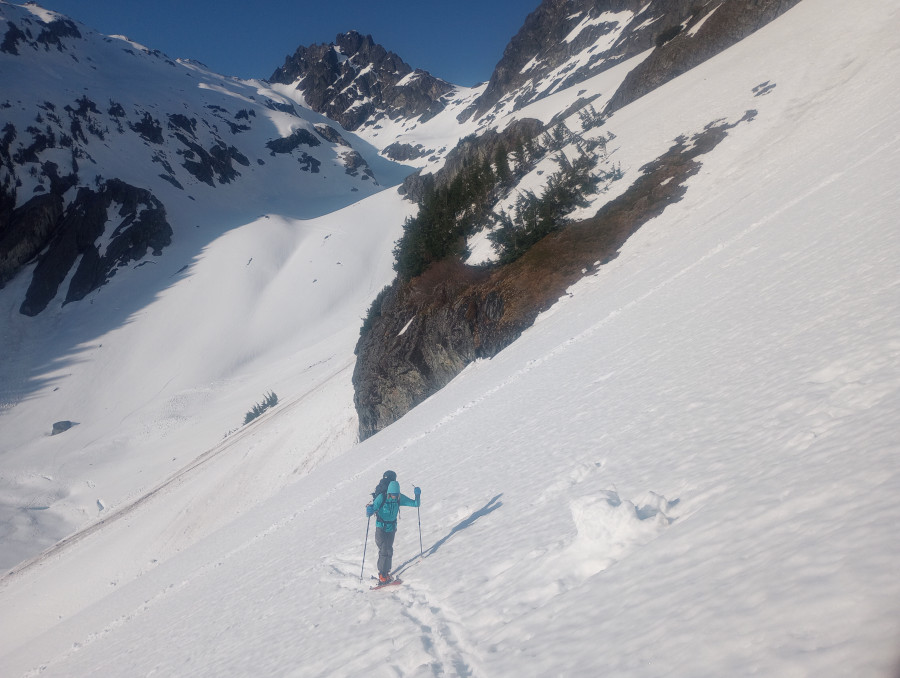
Don't go in a hole
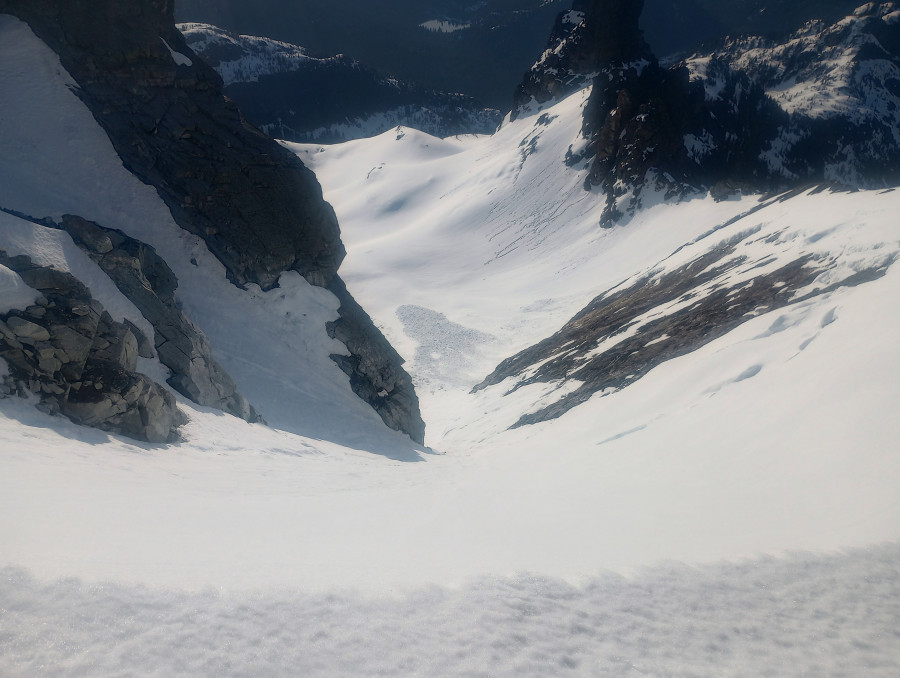
Time to get going
Thanks for posting! That's an ambitious route, and you pulled it off (mostly) and lived to tell us about it. Gotta be thankful for that!
It's a fabulous reminder for everyone that trip planning is not all about vert and mileage stats. As your TR demonstrates, there is so much more (especially in the Snoqualmie environs).
I'm surprised you were surprised about the conditions...seems like you get out quite a bit, and part of that is keeping up with the weather. You don't need somebody else's TR for that.
I'm also curious about your choice of access leaving the Dutch Miller...not sure if you were just following someone else's TR but it seems to me there may be other options. No need to dive in so early (schwacky!). Sometimes longer is faster.
Lots of variables to consider--and it sounds like you've considered a lot of them already.
Thank you for engaging in a thoughtful way!
Great questions. I don't have good memory of what the weather was doing leading up to the trip, but of course I was watching it. I don't think we wouldn't have set out for this if there hadn't been some amount of freeze-thaw cycles going on. So probably just poor analysis into how it would translate in the snowpack :) That said...if I'm reading this set of simulation history graphs for April 2025 correctly (I'm curious how this compares to what actually happened), combined with my texts with Jon from early April about some new snow at 5k', and the benefit of hindsight, it doesn't look like a month that would lead to a very consolidated snowpack.
Regarding the decision about where we left the Dutch Miller: yes, you are right that we didn't do enough critical thinking about this. This TR highly influenced our choice and it refers to their ascent route being recommended in "the Volken book" although I couldn't exactly find the recommendation in the only Volken guidebook I know. Their TR did prepare us (a bit) for the slow travel we encountered. They describe their descent route via the main Overcoat drainage as a "steep, but descendable route through some open trees...the trail was relatively easy to find again after crossing the river and more thick alder." I can't really justify our decision to follow their ascent choice instead of hiking on-trail a bit more to try ascending their downtrack. Sounds suspiciously like we were just being too sheeple-ish. What do you mean when you say "no need to dive in so early (schwacky!)"?
yeah, I think the downtrack (if that's the main Overcoat drainage) is what I had in mind. The only Volken guide I have is the one where he tells us to boot up the Slot...no, no, no, even if you are a certified AMGA instructor...OK, just having a little fun...I know, times change; routes change.
Mostly I'm just advocating for independent thought. And you seem very capable of this. There is much subjectivity afoot in what we do. In guidebooks the route is often the ONLY route that was done, and now it is suddenly THE route. Given that this is all about SNOW, and snow is a constantly changing mass of questionably solidified water in various states of coming and going, any given ski route or guide is merely a suggestion, always subject to question.
There's definitely creativity in your route, it's just a little shy of perfection (whatever that is!)...shy of perfect conditions.
Can't deny the adventure tho..!
The only other thing to add is that if there is ever any question as to stability, or to what visibly or invisibly is above you that may impact you, it is a good idea to ski it as if it will fail. That way you'll have some foreknowledge as to where you will end up if it does.
Thanks for the frank discussion! I admire your choice to put some of your questionable decisions on display. I can see talking myself into the same kinds of choices, but I'm pretty sure I would need a third day to cover all that ground in the conditions you describe.
Appreciate the reflection here!
Alisse, thanks for sharing this even later after the fact! It sounds like you learned a lot and I think I learned something or it reinforced something for me reading it. I have been "there", not in those peaks but in similar situations. It's good to not beat yourself up about it.
One thing I've learned to respect more in recent years is the mush and shed season (Lowell's website has a lot of wisdom on that) which is easy to get complacent about. Some years it just takes forever to consolidate to proper summer snow, and some years it seems to just not happen. Those superficial freezes we get overnight aren't really enough to setup a corn cycle in the heat of May.
If only every year we could get a corn cycle like that one during COVID in Snoqualmie, wow.
Reply to this TR
Please login first: