
- Posts: 214
- Thank you received: 0
The "Seattle Skintrack" on Table Mountain
- trees4me
-

- User
-

Less
More
11 years 7 months ago #138273
by trees4me
Yes risk assessment is not binary. That is exactly my point, I don't see why this slope is ALWAYS deemed unsafe to climb. Let's try not to regurgitate avy 1 generalizations and focus on the slope of table mt being discussed.
To respond specifically to your 4 points in the context of this particular slope:
1) IF you've already skied the slope and are heading up for another lap then you should have made a solid decision on the risk of this slope. If it's risky, then why would you go around and ski it again? Why not just stand in the middle of the freeway and wait for a car to hit you? If you think it's got the potential to slide then why ski it? If you think it's safe to ski then it should be safe to climb (less stress on snowpack).
Also, going around and up the heavily travelled route to artist point tells you very little about the snowpack on this slope. I think you're much much more likely to arrive at the top of this zone with no clue on snowpack if you go around the route that many have suggested. Going around doesn't allow you to observe this slope, it doesn't allow you to observe similar aspects, and it puts you in a well traveled path on a ridgeline that likely has very different snow conditions.
2) That is a wide slope with very little or no islands of safety. There are several rollovers at the top. If you think you're going to trigger something with a ski cut, then see you at the bottom where it piles up in a terrain trap. In my mind, this is the kind of slope where ski cuts should NOT be applied as they can not be done in a safe manner.
3) Yes, by going around you limit your time in exposed terrain. That's fine and many times the right choice. If you've already skied this and you feel there isn't a chance for it to slide, then why not lap it? Let's say it's spring corn, do your hard rules still apply? To me that's overkill. Once again, if you really think this slope is going to slide then why are you willing to accept that risk on the way down?
4) Party spacing is always an issue. And for me that might be why I choose to take the group I'm skiing with around. I think that's a compelling argument for not going up this slope. This implies that a party is accepting higher risk when it's just one person. That's certainly better than placing everyone on a highly risky slope at the same time, but what about placing everyone on a low-risk slope at the same time? That's a call that just needs to get hashed out by the party.
Replied by trees4me on topic Re: The "Seattle Skintrack" on Table Mountain
Taking a route with a lower risk profile on the ascent reduces risk exposure in the following ways.
1) You learn more about the snow-pack as you ascend, perhaps you turn back partway up or choose to retrace your lower risk ascent route.
2) Ski cuts and other techniques can be used to gauge slope stability from above without commiting to skiing the steeper slopes.
3) Time of exposure to risky terrain is greater during the ascent than during the ascent.
4) It is more feasable to spread out party members so that only one is exposed to higher risk terrain at a time on the descent.
Yes risk assessment is not binary. That is exactly my point, I don't see why this slope is ALWAYS deemed unsafe to climb. Let's try not to regurgitate avy 1 generalizations and focus on the slope of table mt being discussed.
To respond specifically to your 4 points in the context of this particular slope:
1) IF you've already skied the slope and are heading up for another lap then you should have made a solid decision on the risk of this slope. If it's risky, then why would you go around and ski it again? Why not just stand in the middle of the freeway and wait for a car to hit you? If you think it's got the potential to slide then why ski it? If you think it's safe to ski then it should be safe to climb (less stress on snowpack).
Also, going around and up the heavily travelled route to artist point tells you very little about the snowpack on this slope. I think you're much much more likely to arrive at the top of this zone with no clue on snowpack if you go around the route that many have suggested. Going around doesn't allow you to observe this slope, it doesn't allow you to observe similar aspects, and it puts you in a well traveled path on a ridgeline that likely has very different snow conditions.
2) That is a wide slope with very little or no islands of safety. There are several rollovers at the top. If you think you're going to trigger something with a ski cut, then see you at the bottom where it piles up in a terrain trap. In my mind, this is the kind of slope where ski cuts should NOT be applied as they can not be done in a safe manner.
3) Yes, by going around you limit your time in exposed terrain. That's fine and many times the right choice. If you've already skied this and you feel there isn't a chance for it to slide, then why not lap it? Let's say it's spring corn, do your hard rules still apply? To me that's overkill. Once again, if you really think this slope is going to slide then why are you willing to accept that risk on the way down?
4) Party spacing is always an issue. And for me that might be why I choose to take the group I'm skiing with around. I think that's a compelling argument for not going up this slope. This implies that a party is accepting higher risk when it's just one person. That's certainly better than placing everyone on a highly risky slope at the same time, but what about placing everyone on a low-risk slope at the same time? That's a call that just needs to get hashed out by the party.
Please Log in or Create an account to join the conversation.
- Randito
-
- User
-
Less
More
- Posts: 960
- Thank you received: 1
11 years 7 months ago #138275
by Randito
Again with the binary thinking. It's not about how absolutely safe ascending the steep route is on any particular day (or hour) -- but that ascending the gentler route has fewer risks.
When crossing a bridge over a chasm, it's safer to walk on the sidewalk than to tightrope walk the hand-rail. But certainly less impressive.
Replied by Randito on topic Re: The "Seattle Skintrack" on Table Mountain
Yes risk assessment is not binary. That is exactly my point, I don't see why this slope is ALWAYS deemed unsafe to climb. ...
Again with the binary thinking. It's not about how absolutely safe ascending the steep route is on any particular day (or hour) -- but that ascending the gentler route has fewer risks.
When crossing a bridge over a chasm, it's safer to walk on the sidewalk than to tightrope walk the hand-rail. But certainly less impressive.
Please Log in or Create an account to join the conversation.
- chmnyboy
-
- User
-
Less
More
- Posts: 78
- Thank you received: 0
11 years 7 months ago #138282
by chmnyboy
Replied by chmnyboy on topic Re: The "Seattle Skintrack" on Table Mountain
Sounds like the northwest needs some snow.
Please Log in or Create an account to join the conversation.
- hop
-
Topic Author
- User
-
Less
More
- Posts: 49
- Thank you received: 0
11 years 7 months ago #138289
by hop
Replied by hop on topic Re: The "Seattle Skintrack" on Table Mountain
Italics copy/pasted from the post by trees4me since for some reason the "reply w/ quote" function isn't working with Firefox and Safari.
First off, I thought you were done with this thread?
To respond specifically to your 4 points in the context of this particular slope:
1) IF you've already skied the slope and are heading up for another lap then you should have made a solid decision on the risk of this slope. If it's risky, then why would you go around and ski it again? Why not just stand in the middle of the freeway and wait for a car to hit you? If you think it's got the potential to slide then why ski it? If you think it's safe to ski then it should be safe to climb (less stress on snowpack).
As Randy said this environment isn't binary. It may be safer in some conditions than others, or may react differently to different activities (skiing vs. skinning). If you're one person on the ascent you might be getting away with less stress, but how often are you one person? In the photo there are FIVE people all w/in a few meters of each other. Five people stomping around is probably a bit more impact than one person gliding down. Also, should something move on you while you're on that slope, it's probably better to be actively skiing down vs. climbing up. See the video of Jason4 for example. No chance in hell you'd get out of that if you triggered that while climbing.
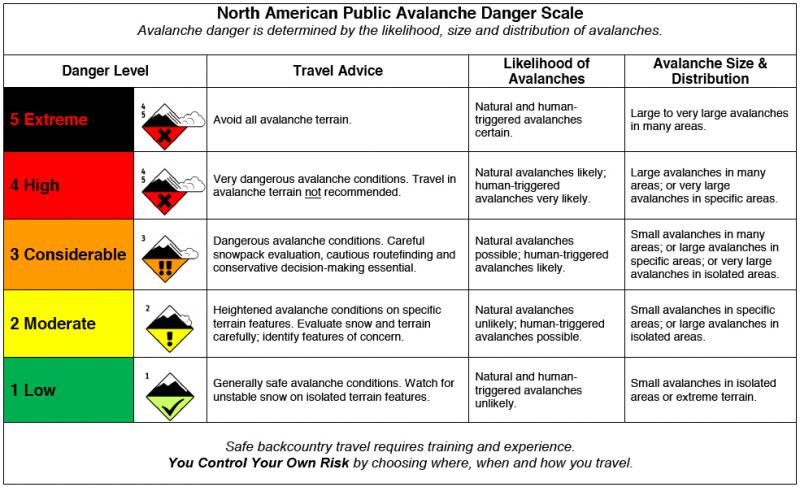
Let’s also remember the uncertainty in avalanche reports There are variables, from “Low” all the way to “High”. “Extreme” is the only avalanche rating where anything is listed as “certain”. Re-read the definition of “considerable” (which is what the report was for that area that day) and think about your route. If you’re more certain than NWAC on a considerable day because you’re assessing that route from below, starting in the flats… more on this later.
Also, going around and up the heavily travelled route to artist point tells you very little about the snowpack on this slope. I think you're much much more likely to arrive at the top of this zone with no clue on snowpack if you go around the route that many have suggested. Going around doesn't allow you to observe this slope, it doesn't allow you to observe similar aspects, and it puts you in a well traveled path on a ridgeline that likely has very different snow conditions.
Depending on where you are in the queue you can watch people descending from much of the ascent route. There are also test slopes that have the same aspect on the way that you can dig around/stomp/assess. It's not the same exact slope you're skiing but that's why they call them test slopes. If you use the exact slope you plan on skiing as your test slope and it turns out to be no good, well then you really f'd up because now you're on it. And furthermore, if you try and assess that run from the bottom up you’ll be starting in the runout/flatter section, which is less likely to be the trouble spot. Once you get to the steeper section where you’d really want to know what’s going on – do you really want to stop and dig around with all the rest of it above you?
2) That is a wide slope with very little or no islands of safety. There are several rollovers at the top. If you think you're going to trigger something with a ski cut, then see you at the bottom where it piles up in a terrain trap. In my mind, this is the kind of slope where ski cuts should NOT be applied as they can not be done in a safe manner.
Depending on the actual drop-in ski cuts may or may not be applicable. You also keep mentioning it’s a terrain trap – unless that zone rips absolutely huge and the runout goes to the base of Herman, that area’s actually less terrain-trappy than the Arm. It’s a gradually flattening slope that fans out into the flats.
3) Yes, by going around you limit your time in exposed terrain. That's fine and many times the right choice. If you've already skied this and you feel there isn't a chance for it to slide, then why not lap it? Let's say it's spring corn, do your hard rules still apply? To me that's overkill. Once again, if you really think this slope is going to slide then why are you willing to accept that risk on the way down?
If it's spring corn then it's probably warm out and that MONSTER cornice is above you looming, ready to fall. Avalanches aren't the only hazard on that slope. Go around in the spring too.
4) Party spacing is always an issue. And for me that might be why I choose to take the group I'm skiing with around. I think that's a compelling argument for not going up this slope. This implies that a party is accepting higher risk when it's just one person. That's certainly better than placing everyone on a highly risky slope at the same time, but what about placing everyone on a low-risk slope at the same time? That's a call that just needs to get hashed out by the party.
I'm not entirely sure what you're saying here because it seems you're arguing that the safer choice for a group of BC travelers would place their entire group on a low-risk slope vs. a high-risk slope, and only cross or descend or expose themselves to high-risk terrain one at a time. Which is why putting everyone on that high-risk slope all at once is nuts.
And yes, chmnyboy, we need more snow.
First off, I thought you were done with this thread?
To respond specifically to your 4 points in the context of this particular slope:
1) IF you've already skied the slope and are heading up for another lap then you should have made a solid decision on the risk of this slope. If it's risky, then why would you go around and ski it again? Why not just stand in the middle of the freeway and wait for a car to hit you? If you think it's got the potential to slide then why ski it? If you think it's safe to ski then it should be safe to climb (less stress on snowpack).
As Randy said this environment isn't binary. It may be safer in some conditions than others, or may react differently to different activities (skiing vs. skinning). If you're one person on the ascent you might be getting away with less stress, but how often are you one person? In the photo there are FIVE people all w/in a few meters of each other. Five people stomping around is probably a bit more impact than one person gliding down. Also, should something move on you while you're on that slope, it's probably better to be actively skiing down vs. climbing up. See the video of Jason4 for example. No chance in hell you'd get out of that if you triggered that while climbing.
Let’s also remember the uncertainty in avalanche reports There are variables, from “Low” all the way to “High”. “Extreme” is the only avalanche rating where anything is listed as “certain”. Re-read the definition of “considerable” (which is what the report was for that area that day) and think about your route. If you’re more certain than NWAC on a considerable day because you’re assessing that route from below, starting in the flats… more on this later.
Also, going around and up the heavily travelled route to artist point tells you very little about the snowpack on this slope. I think you're much much more likely to arrive at the top of this zone with no clue on snowpack if you go around the route that many have suggested. Going around doesn't allow you to observe this slope, it doesn't allow you to observe similar aspects, and it puts you in a well traveled path on a ridgeline that likely has very different snow conditions.
Depending on where you are in the queue you can watch people descending from much of the ascent route. There are also test slopes that have the same aspect on the way that you can dig around/stomp/assess. It's not the same exact slope you're skiing but that's why they call them test slopes. If you use the exact slope you plan on skiing as your test slope and it turns out to be no good, well then you really f'd up because now you're on it. And furthermore, if you try and assess that run from the bottom up you’ll be starting in the runout/flatter section, which is less likely to be the trouble spot. Once you get to the steeper section where you’d really want to know what’s going on – do you really want to stop and dig around with all the rest of it above you?
2) That is a wide slope with very little or no islands of safety. There are several rollovers at the top. If you think you're going to trigger something with a ski cut, then see you at the bottom where it piles up in a terrain trap. In my mind, this is the kind of slope where ski cuts should NOT be applied as they can not be done in a safe manner.
Depending on the actual drop-in ski cuts may or may not be applicable. You also keep mentioning it’s a terrain trap – unless that zone rips absolutely huge and the runout goes to the base of Herman, that area’s actually less terrain-trappy than the Arm. It’s a gradually flattening slope that fans out into the flats.
3) Yes, by going around you limit your time in exposed terrain. That's fine and many times the right choice. If you've already skied this and you feel there isn't a chance for it to slide, then why not lap it? Let's say it's spring corn, do your hard rules still apply? To me that's overkill. Once again, if you really think this slope is going to slide then why are you willing to accept that risk on the way down?
If it's spring corn then it's probably warm out and that MONSTER cornice is above you looming, ready to fall. Avalanches aren't the only hazard on that slope. Go around in the spring too.
4) Party spacing is always an issue. And for me that might be why I choose to take the group I'm skiing with around. I think that's a compelling argument for not going up this slope. This implies that a party is accepting higher risk when it's just one person. That's certainly better than placing everyone on a highly risky slope at the same time, but what about placing everyone on a low-risk slope at the same time? That's a call that just needs to get hashed out by the party.
I'm not entirely sure what you're saying here because it seems you're arguing that the safer choice for a group of BC travelers would place their entire group on a low-risk slope vs. a high-risk slope, and only cross or descend or expose themselves to high-risk terrain one at a time. Which is why putting everyone on that high-risk slope all at once is nuts.
And yes, chmnyboy, we need more snow.
Please Log in or Create an account to join the conversation.
- Theo-san
-
- User
-
Less
More
- Posts: 15
- Thank you received: 0
11 years 7 months ago #138303
by Theo-san
Replied by Theo-san on topic Re: The "Seattle Skintrack" on Table Mountain
The risk of navigating through this (or any) terrain is a matter of probability and consequence. Although the probability of an avalanche may remain constant (or similar enough to be negligible) with 5 climbing the slope instead of one climbing or skiing the slope - the consequences are drastically higher if an incident were to happen when that many skiiers are all sitting on the same fall line of an avalanche slope. This is the reasoning behind most best practices for BC travel - reduce exposure to risks, even small probability ones.
The idea that it is safe to ski, therefore it is safe to climb 5 at a time while people ski on top of you is not logically sound. Exposing each single person in a group to one hazard at a time is different than exposing all five to the same hazard at the same time. And I think most would agree that this is a good slope to ski one at a time due not only to the probability of an avalanche (which is historically above average on this slope although obviously influenced by snowpack, weather, temp, etc.), but due to the consequences of an avalanche on this slope. Putting an entire group of climbers in danger (however low the probability might be) of getting caught by the exact same hazard at the exact same time to save 10 minutes a lap seems like a difficult justification over taking a much more conservative route which takes a bit longer. Even if in theory you were/could climb this route one at a time, this route makes for a long time on an exposed slope. The more time you are on the slope, the greater the probability of an avalanche. I am also going to make the assumption that most BC skiiers would rather encounter an avalanche while they are downhill skiing, due to the increase in control, options for escape, and ability to use inertia to your advantage to escape the avalanche path. Would you rather be in a parked car with the keys on the passenger seat, or be in a running car when you see someone skidding into you from across the parking lot? The chances may be slim that you can drive away unscathed, but having some semblance of control is better than having none.
Best practices aren't rules, but they are called best practices for a reason - and I think it's good to ask oneself to ask why they aren't following convention.. is this making the group safer because convention doesn't fit an unusual situation? will following convention sacrifice a significant amount of efficiency, and possibly lead to greater dangers later on in the tour (certain aspects receiving more solar because you weren't fast enough)? or are you just too macho badass to follow a 10* skin track when you can blast right up the middle of a 45* chute?
The idea that it is safe to ski, therefore it is safe to climb 5 at a time while people ski on top of you is not logically sound. Exposing each single person in a group to one hazard at a time is different than exposing all five to the same hazard at the same time. And I think most would agree that this is a good slope to ski one at a time due not only to the probability of an avalanche (which is historically above average on this slope although obviously influenced by snowpack, weather, temp, etc.), but due to the consequences of an avalanche on this slope. Putting an entire group of climbers in danger (however low the probability might be) of getting caught by the exact same hazard at the exact same time to save 10 minutes a lap seems like a difficult justification over taking a much more conservative route which takes a bit longer. Even if in theory you were/could climb this route one at a time, this route makes for a long time on an exposed slope. The more time you are on the slope, the greater the probability of an avalanche. I am also going to make the assumption that most BC skiiers would rather encounter an avalanche while they are downhill skiing, due to the increase in control, options for escape, and ability to use inertia to your advantage to escape the avalanche path. Would you rather be in a parked car with the keys on the passenger seat, or be in a running car when you see someone skidding into you from across the parking lot? The chances may be slim that you can drive away unscathed, but having some semblance of control is better than having none.
Best practices aren't rules, but they are called best practices for a reason - and I think it's good to ask oneself to ask why they aren't following convention.. is this making the group safer because convention doesn't fit an unusual situation? will following convention sacrifice a significant amount of efficiency, and possibly lead to greater dangers later on in the tour (certain aspects receiving more solar because you weren't fast enough)? or are you just too macho badass to follow a 10* skin track when you can blast right up the middle of a 45* chute?
Please Log in or Create an account to join the conversation.
- T. Eastman
-
- User
-
Less
More
- Posts: 288
- Thank you received: 0
11 years 7 months ago #138316
by T. Eastman
Replied by T. Eastman on topic Re: The "Seattle Skintrack" on Table Mountain
Interesting responses...
Please Log in or Create an account to join the conversation.