
- Posts: 342
- Thank you received: 3
Mount Rainier Paradise reaches 200" snow depth
- markharf
-

- User
-

Less
More
15 years 1 month ago - 15 years 1 month ago #198759
by markharf
Replied by markharf on topic Re: Mount Rainier Paradise reaches 200" snow depth
Amar sed: "....settlement at Paradise pushed it back under 200" "
I'm predisposed to favor Mt. Baker (where the telemetry snow depth now reads 206 inches, but where the ski area snowstake at 5000 feet is currently over 230"), but in fairness I don't think that what you're seeing at Paradise was due to natural settlement. Look at the readings around noon today: you'll see that the snow depth plummeted 5 inches abruptly just as the 24 hour gauge was re-set. That's not coincidental.
I've always been fascinated by the disparities between measurements at official stations and measurements elsewhere. A couple of thousand feet higher on Mt. Baker, snowfalls and snow depths are far deeper than they are at the official measuring station at the ski area. At the summit, however, depths have already begun to lessen (as far as I can tell). Same is presumably true on Mt. Rainier: summit snowfalls are typically not as deep as they are at some unspecified moderate elevation....or so I presume, presumptuously.
At any rate, the "World Record (tm)" is just the greatest snowfall measured according to various specific parameters; it certainly snows far more at other spots which lack, for obvious reasons, weather stations. I wouldn't be surprised if the actual deepest snows in the world are somewhere further north in the Coast Range, or perhaps along the Gulf of Alaska, or even somewhere in the southern Andes in Chile. And I don't know Japan, but it sounds like there might be some contenders there as well.
I'd be interested in hearing any speculation even marginally more informed than my own.
Mark
I'm predisposed to favor Mt. Baker (where the telemetry snow depth now reads 206 inches, but where the ski area snowstake at 5000 feet is currently over 230"), but in fairness I don't think that what you're seeing at Paradise was due to natural settlement. Look at the readings around noon today: you'll see that the snow depth plummeted 5 inches abruptly just as the 24 hour gauge was re-set. That's not coincidental.
I've always been fascinated by the disparities between measurements at official stations and measurements elsewhere. A couple of thousand feet higher on Mt. Baker, snowfalls and snow depths are far deeper than they are at the official measuring station at the ski area. At the summit, however, depths have already begun to lessen (as far as I can tell). Same is presumably true on Mt. Rainier: summit snowfalls are typically not as deep as they are at some unspecified moderate elevation....or so I presume, presumptuously.
At any rate, the "World Record (tm)" is just the greatest snowfall measured according to various specific parameters; it certainly snows far more at other spots which lack, for obvious reasons, weather stations. I wouldn't be surprised if the actual deepest snows in the world are somewhere further north in the Coast Range, or perhaps along the Gulf of Alaska, or even somewhere in the southern Andes in Chile. And I don't know Japan, but it sounds like there might be some contenders there as well.
I'd be interested in hearing any speculation even marginally more informed than my own.
Mark
Please Log in or Create an account to join the conversation.
- Amar Andalkar
-
Topic Author
- User
-
Less
More
- Posts: 635
- Thank you received: 0
15 years 1 month ago #198763
by Amar Andalkar
Of course that 5" drop looks suspicious, I was even thinking of phrasing that sentence as "after settlement (or disturbance?) at Paradise". But then I looked carefully at many factors: it had stopped snowing just before 10am, the temps also hit 32 during that 11am-noon hour, and the solar radiation was at a maximum (baking under the cloud layer), so it could have been non-human-related. The early morning snowfall that fell between 5am and 7am was very light and fluffy, so it could have rapidly settled with some solar cooking. The freshly plowed parking lot melted out very quickly after 11am, and by 12:50pm looked like this:
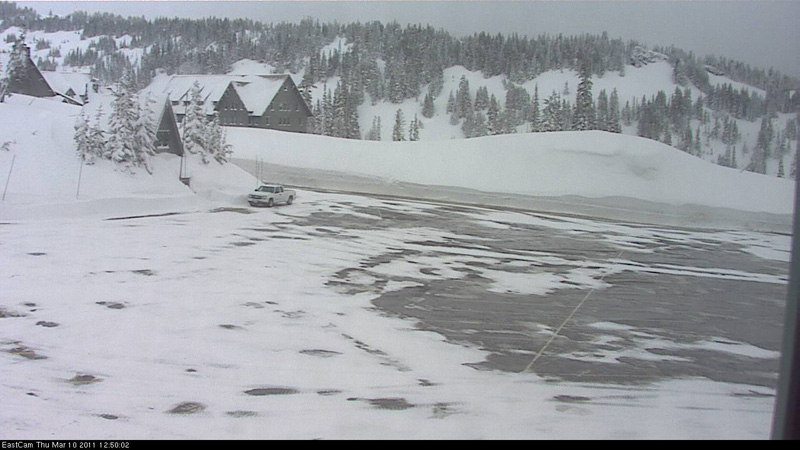
Then it started started to snow again just minutes before 1pm, quickly hiding the bare pavement. Based on the evidence from multiple sources (temperature, solar radiation, and webcam), I'm inclined to consider the settlement as likely natural, and not due to the ranger who cleaned off the 24-hour snow depth board.
Replied by Amar Andalkar on topic Re: Mount Rainier Paradise reaches 200" snow depth
Amar sed: "....settlement at Paradise pushed it back under 200" "
I'm predisposed to favor Mt. Baker (where the telemetry snow depth now reads 206 inches, but where the ski area snowstake at 5000 feet is currently over 230"), but in fairness I don't think that what you're seeing at Paradise was due to natural settlement. Look at the readings around noon today: you'll see that the snow depth plummeted 5 inches abruptly just as the 24 hour gauge was re-set. That's not coincidental.
Of course that 5" drop looks suspicious, I was even thinking of phrasing that sentence as "after settlement (or disturbance?) at Paradise". But then I looked carefully at many factors: it had stopped snowing just before 10am, the temps also hit 32 during that 11am-noon hour, and the solar radiation was at a maximum (baking under the cloud layer), so it could have been non-human-related. The early morning snowfall that fell between 5am and 7am was very light and fluffy, so it could have rapidly settled with some solar cooking. The freshly plowed parking lot melted out very quickly after 11am, and by 12:50pm looked like this:
Then it started started to snow again just minutes before 1pm, quickly hiding the bare pavement. Based on the evidence from multiple sources (temperature, solar radiation, and webcam), I'm inclined to consider the settlement as likely natural, and not due to the ranger who cleaned off the 24-hour snow depth board.
Please Log in or Create an account to join the conversation.
- Amar Andalkar
-
Topic Author
- User
-
Less
More
- Posts: 635
- Thank you received: 0
15 years 1 month ago #198767
by Amar Andalkar
True, the disparities are interesting. Snowfall increases substantially above 4000 ft in the Cascades, reaching a maximum at about the 7000-9000 ft elevations, and decreasing above that due to the colder drier atmosphere. However, snowfall and snowdepth measurement sites generally must be located below treeline to avoid the effects of wind, which can cause a +/- 100% (zero to double) spatial variation in snow depths above treeline.
But I've always been more surprised by the lack of disparity between snow depth measurement sites located hundreds of miles apart along the Cascade Range. The Paradise and Baker Ski Area sites often track each other in eerie similarity (as today, hitting 200" only hours apart), with depths within a few % of each other for months at a time. Their average values reflect this similarity too throughout the season, until the Baker site's lower elevation melts it out much more rapidly during the spring.
During many winters, the snowdepth at Timberline Lodge on Mount Hood tracks just 5-10% behind the Paradise and Baker sites throughout the season too. The Baker site is about 130 miles north of Paradise, while Timberline is about 105 miles south. All three sites are located in open subalpine forest about 1000 ft below treeline, and are in zones of enhanced snowfall near large isolated stratovolcanoes, with Paradise and Timberline both directly on the south flank of their volcanoes, and Baker Ski Area within a convergence-zone-like area of enhanced snowfall extending ENE from Baker's cone. The fact that sites which are hundreds of miles apart track each other so closely in snowdepth is strong evidence that the sites are very well-located and are highly representative of the snowpack over a wide area.
I think the scientific consensus for the location in the world with the greatest snowfall and greatest average snowdepths is somewhere in the coastal ranges of south-central and SE Alaska, with locations in the eastern Chugach, Saint Elias, and Coast Mountains in contention for the top spot. The other possible contenders are the southern Andes of Chile and the Southern Alps of New Zealand, but these are probably vying for the southern hemisphere title and not likely to surpass coastal AK.
However, the greatest recorded snowdepths at measurement sites DO NOT occur at the sites which have the maximum average annual snowfalls. They occur at sites which have freakishly huge sustained snowstorms, but too much in-season variability to ever challenge for the full-year snowfall records. Thus we have sites in the Sierra Nevada and the west coast of Honshu, Japan, holding the records for snowdepth and one-month snowfall -- these places are the most likely to get 15-20 ft of snowfall in a single storm cycle, which is the kind of snowfall rate you need to build snowdepths over 400". The Sierra gets the huge snows when cutoff lows dive south just off the Pacific Coast and park themselves west of northern CA, while Honshu's snowfall is due entirely to ocean-effect snowfall caused by arctic outflow pouring SE from Siberian high pressure, crossing the warm water of the Sea of Japan, and slamming into the mountainous west coast of the island. These patterns can produce monthly snowfalls over 300", but don't stay in place long enough over a full season to reach annual snowfalls over 1000".
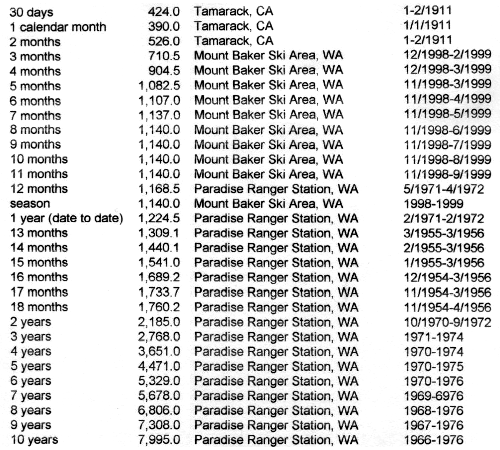
Paradise and Baker Ski Area remain the only sites worldwide to have recorded over 1000" of snowfall in a single season, with Paradise breaking that mark 5 different times. All of the time-period snowfall records for periods 3 months or longer are held by those two sites. Here's part of a collection snowfall records compiled and sent to me by Fred Richardson:
Replied by Amar Andalkar on topic Re: Mount Rainier Paradise reaches 200" snow depth
I've always been fascinated by the disparities between measurements at official stations and measurements elsewhere. A couple of thousand feet higher on Mt. Baker, snowfalls and snow depths are far deeper than they are at the official measuring station at the ski area. At the summit, however, depths have already begun to lessen (as far as I can tell). Same is presumably true on Mt. Rainier: summit snowfalls are typically not as deep as they are at some unspecified moderate elevation....or so I presume, presumptuously.
True, the disparities are interesting. Snowfall increases substantially above 4000 ft in the Cascades, reaching a maximum at about the 7000-9000 ft elevations, and decreasing above that due to the colder drier atmosphere. However, snowfall and snowdepth measurement sites generally must be located below treeline to avoid the effects of wind, which can cause a +/- 100% (zero to double) spatial variation in snow depths above treeline.
But I've always been more surprised by the lack of disparity between snow depth measurement sites located hundreds of miles apart along the Cascade Range. The Paradise and Baker Ski Area sites often track each other in eerie similarity (as today, hitting 200" only hours apart), with depths within a few % of each other for months at a time. Their average values reflect this similarity too throughout the season, until the Baker site's lower elevation melts it out much more rapidly during the spring.
During many winters, the snowdepth at Timberline Lodge on Mount Hood tracks just 5-10% behind the Paradise and Baker sites throughout the season too. The Baker site is about 130 miles north of Paradise, while Timberline is about 105 miles south. All three sites are located in open subalpine forest about 1000 ft below treeline, and are in zones of enhanced snowfall near large isolated stratovolcanoes, with Paradise and Timberline both directly on the south flank of their volcanoes, and Baker Ski Area within a convergence-zone-like area of enhanced snowfall extending ENE from Baker's cone. The fact that sites which are hundreds of miles apart track each other so closely in snowdepth is strong evidence that the sites are very well-located and are highly representative of the snowpack over a wide area.
At any rate, the "World Record (tm)" is just the greatest snowfall measured according to various specific parameters; it certainly snows far more at other spots which lack, for obvious reasons, weather stations. I wouldn't be surprised if the actual deepest snows in the world are somewhere further north in the Coast Range, or perhaps along the Gulf of Alaska, or even somewhere in the southern Andes in Chile. And I don't know Japan, but it sounds like there might be some contenders there as well.
I think the scientific consensus for the location in the world with the greatest snowfall and greatest average snowdepths is somewhere in the coastal ranges of south-central and SE Alaska, with locations in the eastern Chugach, Saint Elias, and Coast Mountains in contention for the top spot. The other possible contenders are the southern Andes of Chile and the Southern Alps of New Zealand, but these are probably vying for the southern hemisphere title and not likely to surpass coastal AK.
However, the greatest recorded snowdepths at measurement sites DO NOT occur at the sites which have the maximum average annual snowfalls. They occur at sites which have freakishly huge sustained snowstorms, but too much in-season variability to ever challenge for the full-year snowfall records. Thus we have sites in the Sierra Nevada and the west coast of Honshu, Japan, holding the records for snowdepth and one-month snowfall -- these places are the most likely to get 15-20 ft of snowfall in a single storm cycle, which is the kind of snowfall rate you need to build snowdepths over 400". The Sierra gets the huge snows when cutoff lows dive south just off the Pacific Coast and park themselves west of northern CA, while Honshu's snowfall is due entirely to ocean-effect snowfall caused by arctic outflow pouring SE from Siberian high pressure, crossing the warm water of the Sea of Japan, and slamming into the mountainous west coast of the island. These patterns can produce monthly snowfalls over 300", but don't stay in place long enough over a full season to reach annual snowfalls over 1000".
Paradise and Baker Ski Area remain the only sites worldwide to have recorded over 1000" of snowfall in a single season, with Paradise breaking that mark 5 different times. All of the time-period snowfall records for periods 3 months or longer are held by those two sites. Here's part of a collection snowfall records compiled and sent to me by Fred Richardson:
Please Log in or Create an account to join the conversation.
- Robert Connor
-
- User
-
Less
More
- Posts: 123
- Thank you received: 0
15 years 1 month ago #198783
by Robert Connor
Replied by Robert Connor on topic Re: Mount Rainier Paradise reaches 200" snow depth
Will there ever be a technical or scientific question to which Amar doesn't have the correct answer supported by reams of backup data? Thank you Amar. It is like TAY has our own private research department.
Please Log in or Create an account to join the conversation.
- Jason_H.
-
- User
-
Less
More
- Posts: 276
- Thank you received: 0
15 years 1 month ago #198788
by Jason_H.
Replied by Jason_H. on topic Re: Mount Rainier Paradise reaches 200" snow depth
When I spoke to you about this before Amar, you mentioned that the area around the Blue Glacier on Mount Olympus contends with other regions of the World that get potentially more snow than paradise. How would you guess this compares to places in SE Alaska?
Please Log in or Create an account to join the conversation.
- garyabrill
-
- User
-
Less
More
- Posts: 464
- Thank you received: 0
15 years 1 month ago - 15 years 1 month ago #198793
by garyabrill
Replied by garyabrill on topic Re: Mount Rainier Paradise reaches 200" snow depth
Whoa, now. How about January 1990 at Mt. Baker...actually a 3-1/2 week period ending around February 5 (approximate). Baker received just under 500" in that 3-1/2 week period (I don't recall exactly but something like mid 480's as reported by the ski area). Stevens got 330" in the same period. When the freezing level rose to 4500' briefly towards the end of that period the biggest slides in the Cascades since perhaps 1972 came down - notably the Phantom slide path on Snoqualmie, the slide path that crossed 20 beneath Ruby Mtn, and to my knowledge the biggest slide I know of in the Cascades in Grouse Creek - I'd guess that one took out 100 acres of old growth and reached an astonishing 400' up the opposite side of a narrow gully leaving an impressive trimline. The largest fracture I saw from Mt. Herman around February 5th was on the Mazama Glacier of Baker and having skied the Mazama once (for scale) I estimated the crown at 20-25 feet - probably about the same size as the Grouse Creek crown. There was a crown measured at 13' near the Blueberry ropetow. Other than those 3-1/2 weeks 1990 was a poor snow year.
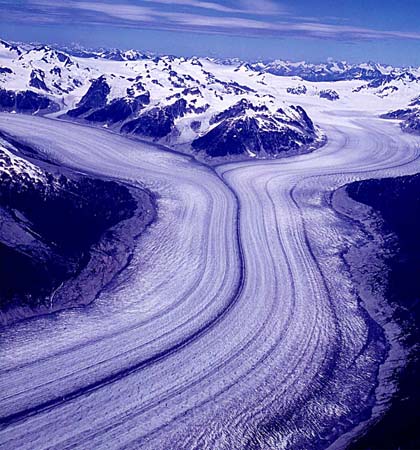
As far as where the greatest snows are my vote would be for Mt. Silverthrone in the BC coast mountains where the Klinaklini Glacier descends 20+ miles, still extending to just 500-800' above sea level. I flew over the snout of the Klinaklini on a sight seeing daytrip two years ago. Five miles above the snout the glacier (maybe at 5000') still rises nearly to it's trimlines. There are several mile wide feeder glaciers. Apparently in the last ice age the apex of glaciation was at the latitude of Tweedsmuir Park with glaciers flowing both ways from that point (I don't remember where I got that trivia) so it would make sense that would be the zone of heaviest snowfall.
In 1996 it looked to me that the Palisades in CA had around 600" (50') of snow on the ground in mid to late April. That was a guess based on the fact that numerous 50' polished nunataks that one passes on the trail into the northern portion of the Palisade Glacier were essentially buried by the huge snowpack. I should add that was around the 11000' level.
As far as where the greatest snows are my vote would be for Mt. Silverthrone in the BC coast mountains where the Klinaklini Glacier descends 20+ miles, still extending to just 500-800' above sea level. I flew over the snout of the Klinaklini on a sight seeing daytrip two years ago. Five miles above the snout the glacier (maybe at 5000') still rises nearly to it's trimlines. There are several mile wide feeder glaciers. Apparently in the last ice age the apex of glaciation was at the latitude of Tweedsmuir Park with glaciers flowing both ways from that point (I don't remember where I got that trivia) so it would make sense that would be the zone of heaviest snowfall.
In 1996 it looked to me that the Palisades in CA had around 600" (50') of snow on the ground in mid to late April. That was a guess based on the fact that numerous 50' polished nunataks that one passes on the trail into the northern portion of the Palisade Glacier were essentially buried by the huge snowpack. I should add that was around the 11000' level.
Please Log in or Create an account to join the conversation.