
- Posts: 314
- Thank you received: 0
Climbing Coleman Deming Un-roped
- Rusty Knees
-
 Topic Author
- User
-

Less
More
14 years 2 weeks ago #205514
by Rusty Knees
Climbing Coleman Deming Un-roped was created by Rusty Knees
I see a lot of people climbing this route un- roped. I know it's marginally safer on skies , but what about for companions who may be just booting up?
Every once in awhile, I read about folks falling through a snow bridge. Advice? Thoughts?
Every once in awhile, I read about folks falling through a snow bridge. Advice? Thoughts?
Please Log in or Create an account to join the conversation.
- E_N
-
- User
-
Less
More
- Posts: 27
- Thank you received: 0
14 years 2 weeks ago #205526
by E_N
Replied by E_N on topic Re: Climbing Coleman Deming Un-roped
I don't know that I would be excited to boot the route unroped, but it really depends on the time and conditions.
I'll generally prefer to take off the rope if on foot on the Roman wall based on the hazard potential between crevasse fall (pretty small the last three years) and the potential to arrest a fall. Running protection might be something to consider depending on conditions if there is considerable danger from either of those hazards.
I advise not paying too much attention to what everybody else is doing if your judgement is telling you to rope up.
I'll generally prefer to take off the rope if on foot on the Roman wall based on the hazard potential between crevasse fall (pretty small the last three years) and the potential to arrest a fall. Running protection might be something to consider depending on conditions if there is considerable danger from either of those hazards.
I advise not paying too much attention to what everybody else is doing if your judgement is telling you to rope up.
Please Log in or Create an account to join the conversation.
- Bill G
-
- User
-
Less
More
- Posts: 8
- Thank you received: 0
14 years 2 weeks ago #205542
by Bill G
Replied by Bill G on topic Re: Climbing Coleman Deming Un-roped
I totally agree about the headwall and once you're on the ridge between the C and D. Howqever, the Coleman has some very large cravasses depending on how far you stray to the left. There are some really impressive maws as you wander over towards the North Ridge area. For the standard route up the Coleman I'd still recommend roped travel for boot packing. I've even seen people in cracks as low as the pitch above the Heliotrope ridge campsites.
But, as E_N says, these are personal decisions.
Bill G
But, as E_N says, these are personal decisions.
Bill G
Please Log in or Create an account to join the conversation.
- ebeam
-
- User
-
Less
More
- Posts: 17
- Thank you received: 0
14 years 2 weeks ago #205553
by ebeam
Replied by ebeam on topic Re: Climbing Coleman Deming Un-roped
Yeah, this subject is personal.
It got too personal when I lost a friend (Kevin) on Baker’s CD route in April of 2008. Though not exactly what Rusty Knees specifically asked about in this thread (unroped and booting), Kevin was solo skiing (obviously not roped) and he likely fell into a crevasse rather than was lost by other causes such as avalanche burial. This accident caused me to join the other volunteers with mountain rescue and made me more cautious.
Now I always have glacier gear and a partner. Without these I won’t go on the CD route (and almost any other glacier ice). I make it my practice to wear my harness before accessing the glacier and if we are only a party of two – we both carry rando ropes. Whether we rope up depends on the specific conditions which are influenced by season, time of day, aspect, terrain, and your travel pattern verses the orientation of crevasses (i.e., traversing, crossing) if predictable. Most of this is in Lowell’s short piece on skiing roped www.alpenglow.org/skiing/high-route-tips/part6-glaciers.html which is worth reading and not repeated by me.
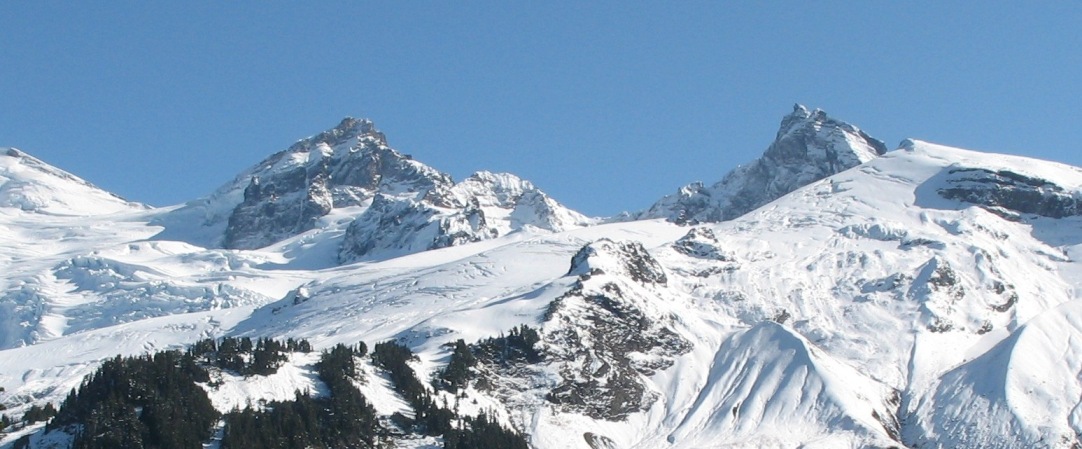
Another reason I am more cautious has stemmed from a more careful viewing what Baker’s CD route looks like over early and late season, and over low and high snow pack years. As said earlier, there are some huge crevasses along the route, especially climber’s left. But there are crevasses throughout the route starting with first pitch up from the hogsback to some real gapers along the summit ice cap – all areas of accidents. See the picture below from early October 2009. It show some of the CD route but also shows several of the high points along Heliotrope Ridge, a popular early season ski area that many people assume is safe and don’t carry any glacier gear.
Also, it is erroneous to think skiers are always climbing (even the CD route) completely on skis (and thus safer). There can be short or long booting sections when climbing or even descending, depending on conditions and your exact route. Descending skiers and boarders are forced to make transitions (skins or booting) on descents that involve flats or traverse areas. Because of these areas are often short and you are on the descent, it can be easy to compromise on safety. On the south side of Baker, I had a friend on a snowboard punch through a snow bridge up to his chest while carrying his splitboard on such a descent while the skiers skated through without a hitch. It was in an area where we were all roped and on skins when climbing earlier the same day. We probably can all share these types of experiences.
Also, hazards exist below any glacier travel on the CD route. One specific hazard is a moat located just west of the summer trail along the hogsback (moraine). While moats are a common hazard in any mountainous terrain with a deep snow pack, what makes this moat so hazardous includes four somewhat unique factors:
1. The moat site is near a busy route.
2. People using the route are not on the glacier so they are not necessarily thinking of falling through a snow bridge. Also, many non-climbers use the area and are not even aware of hazards such as moats.
3. The terrain naturally funnels you to the moat site when there is enough snow depth (late winter through early summer); this is especially true for people without skis/boards that are butt glissading.
4. The moat site is a > 50ft waterfall so drowning and quick hypothermia are added risks to those that take a fall.
I had a scare with this moat many years ago one spring day before I knew the specific terrain. The day was cloudy with people and tracks everywhere. After climbing above the hogsback a few hundred feet we broke through the clouds and were treated to 360 degree views on the ridge’s highpoint. After a bit, we descended into the clouds (fog) following our tracks and letting the terrain dictate the path of least resistance knowing that it led to the trail at treeline. I skied down to a roll over and barely noticed a manhole sized opening in the snow. It was the moat just starting to show itself. No crack had developed – just a round hole. My wife and daughter were following without skis but were butt glissading and not able to see very well downhill because of their low position. I intercepted them before the moat, but it was close. It scared me because they wouldn’t have discovered the hazard until it was too late without my help.
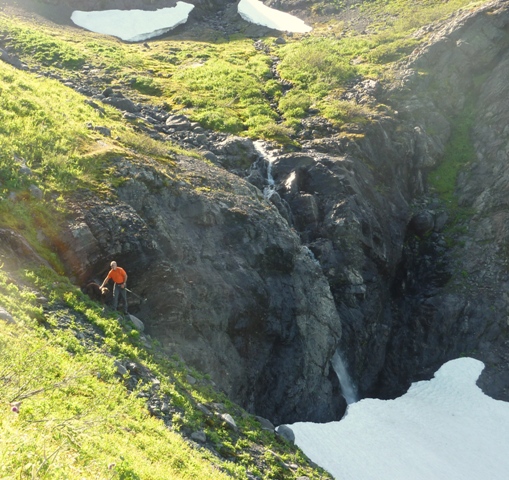
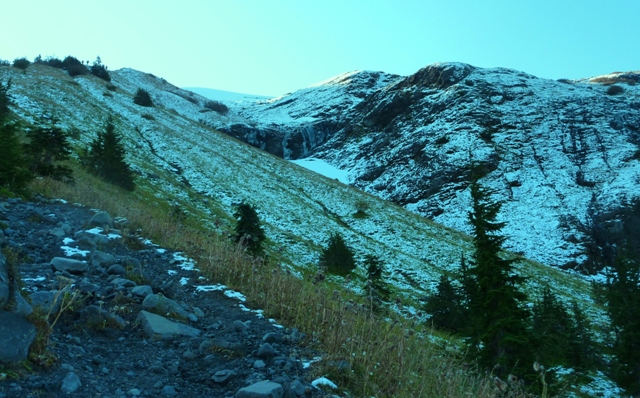
Last year, at least two people fell in the moat on separate accidents. One did not survive. This moat has claimed more than one life. I don’t know the exact count. The Baker climbing rangers blogged about the hazard here: mtbakerclimbing.blogspot.com/2011/07/hogsback-moat.html . I have added a couple of pictures below showing the site without snow.
I make mention of losing Kevin and the moat accidents from last year because they are real. I don’t want to lose other friends, have an accident myself, or put my friends or family through what I went through looking for Kevin or what we see when doing body recovery on mountain rescue. The risks can be mitigated through safe travel practices and not just following what the crowd is doing.
Early season crevasses along the CD route and Heliotrope area.
It got too personal when I lost a friend (Kevin) on Baker’s CD route in April of 2008. Though not exactly what Rusty Knees specifically asked about in this thread (unroped and booting), Kevin was solo skiing (obviously not roped) and he likely fell into a crevasse rather than was lost by other causes such as avalanche burial. This accident caused me to join the other volunteers with mountain rescue and made me more cautious.
Now I always have glacier gear and a partner. Without these I won’t go on the CD route (and almost any other glacier ice). I make it my practice to wear my harness before accessing the glacier and if we are only a party of two – we both carry rando ropes. Whether we rope up depends on the specific conditions which are influenced by season, time of day, aspect, terrain, and your travel pattern verses the orientation of crevasses (i.e., traversing, crossing) if predictable. Most of this is in Lowell’s short piece on skiing roped www.alpenglow.org/skiing/high-route-tips/part6-glaciers.html which is worth reading and not repeated by me.
Another reason I am more cautious has stemmed from a more careful viewing what Baker’s CD route looks like over early and late season, and over low and high snow pack years. As said earlier, there are some huge crevasses along the route, especially climber’s left. But there are crevasses throughout the route starting with first pitch up from the hogsback to some real gapers along the summit ice cap – all areas of accidents. See the picture below from early October 2009. It show some of the CD route but also shows several of the high points along Heliotrope Ridge, a popular early season ski area that many people assume is safe and don’t carry any glacier gear.
Also, it is erroneous to think skiers are always climbing (even the CD route) completely on skis (and thus safer). There can be short or long booting sections when climbing or even descending, depending on conditions and your exact route. Descending skiers and boarders are forced to make transitions (skins or booting) on descents that involve flats or traverse areas. Because of these areas are often short and you are on the descent, it can be easy to compromise on safety. On the south side of Baker, I had a friend on a snowboard punch through a snow bridge up to his chest while carrying his splitboard on such a descent while the skiers skated through without a hitch. It was in an area where we were all roped and on skins when climbing earlier the same day. We probably can all share these types of experiences.
Also, hazards exist below any glacier travel on the CD route. One specific hazard is a moat located just west of the summer trail along the hogsback (moraine). While moats are a common hazard in any mountainous terrain with a deep snow pack, what makes this moat so hazardous includes four somewhat unique factors:
1. The moat site is near a busy route.
2. People using the route are not on the glacier so they are not necessarily thinking of falling through a snow bridge. Also, many non-climbers use the area and are not even aware of hazards such as moats.
3. The terrain naturally funnels you to the moat site when there is enough snow depth (late winter through early summer); this is especially true for people without skis/boards that are butt glissading.
4. The moat site is a > 50ft waterfall so drowning and quick hypothermia are added risks to those that take a fall.
I had a scare with this moat many years ago one spring day before I knew the specific terrain. The day was cloudy with people and tracks everywhere. After climbing above the hogsback a few hundred feet we broke through the clouds and were treated to 360 degree views on the ridge’s highpoint. After a bit, we descended into the clouds (fog) following our tracks and letting the terrain dictate the path of least resistance knowing that it led to the trail at treeline. I skied down to a roll over and barely noticed a manhole sized opening in the snow. It was the moat just starting to show itself. No crack had developed – just a round hole. My wife and daughter were following without skis but were butt glissading and not able to see very well downhill because of their low position. I intercepted them before the moat, but it was close. It scared me because they wouldn’t have discovered the hazard until it was too late without my help.
Last year, at least two people fell in the moat on separate accidents. One did not survive. This moat has claimed more than one life. I don’t know the exact count. The Baker climbing rangers blogged about the hazard here: mtbakerclimbing.blogspot.com/2011/07/hogsback-moat.html . I have added a couple of pictures below showing the site without snow.
I make mention of losing Kevin and the moat accidents from last year because they are real. I don’t want to lose other friends, have an accident myself, or put my friends or family through what I went through looking for Kevin or what we see when doing body recovery on mountain rescue. The risks can be mitigated through safe travel practices and not just following what the crowd is doing.
Early season crevasses along the CD route and Heliotrope area.
Please Log in or Create an account to join the conversation.
- ebeam
-
- User
-
Less
More
- Posts: 17
- Thank you received: 0
14 years 2 weeks ago #205554
by ebeam
Replied by ebeam on topic Re: Climbing Coleman Deming Un-roped
Heliotrope moat site without snow from climbers trail along hogsback
Please Log in or Create an account to join the conversation.
- Lowell_Skoog
-
- User
-
Less
More
- Posts: 1460
- Thank you received: 16
14 years 2 weeks ago #205555
by Lowell_Skoog
Replied by Lowell_Skoog on topic Re: Climbing Coleman Deming Un-roped
Great information about the moats below Heliotrope Ridge. I bet more accidents have taken place there than any other part of the mountain. There are several parallel gullies west of the Hogsback, and I think they each develop a moat at some point during the summer.
I was involved in a rescue at one of those moats during an early climb of Mt Baker, many years ago. A member of another party was glissading and he went into the moat. Fortunately he was wearing a harness. His partners lowered him a rope and he was able to clip into it before going hypothermic. He was wedged way down in the moat with ice-cold water running over him. His partners winched him out and we transported him down to Kulshan Cabin. A helicopter took him to a hospital where he recovered.
Claustrophobia and hypothermia scare me as much as anything and I've been spooked by those moats ever since.
I was involved in a rescue at one of those moats during an early climb of Mt Baker, many years ago. A member of another party was glissading and he went into the moat. Fortunately he was wearing a harness. His partners lowered him a rope and he was able to clip into it before going hypothermic. He was wedged way down in the moat with ice-cold water running over him. His partners winched him out and we transported him down to Kulshan Cabin. A helicopter took him to a hospital where he recovered.
Claustrophobia and hypothermia scare me as much as anything and I've been spooked by those moats ever since.
Please Log in or Create an account to join the conversation.