
- Posts: 464
- Thank you received: 0
Avalanche forecasting format
- garyabrill
-

- User
-

Less
More
15 years 3 months ago #198855
by garyabrill
If you want to discuss this start a different thread or PM me. Check winter telemetry for Mt. Fidelity at Roger's Pass as opposed to the pass elevation to get a good feel for why I said that. I assume the Canadians know why they have their distinctions and make the same assumption for NWAC.
Replied by garyabrill on topic Re: Avalanche forecasting format
This is incorrect.
If you want to discuss this start a different thread or PM me. Check winter telemetry for Mt. Fidelity at Roger's Pass as opposed to the pass elevation to get a good feel for why I said that. I assume the Canadians know why they have their distinctions and make the same assumption for NWAC.
Please Log in or Create an account to join the conversation.
- CookieMonster
-
- User
-
Less
More
- Posts: 392
- Thank you received: 0
15 years 3 months ago #198856
by CookieMonster
I don't want to start an argument, and pointing out an error in your post doesn't warrant another thread. Another thread would be useful if I wanted to point out the many facts that contradict your statement, but TAY most certainly doesn't need a useless thread in which you and I argue about whether or not elevation band is useful for avalanche forecasting in the Columbia Mountains.
It's fine to have an *opinion*, and if your post is indeed your opinion, then I apologise for pointing out an error.
Replied by CookieMonster on topic Re: Avalanche forecasting format
If you want to discuss this start a different thread or PM me. Check winter telemetry for Mt. Fidelity at Roger's Pass as opposed to the pass elevation to get a good feel for why I said that. I assume the Canadians know why they have their distinctions and make the same assumption for NWAC.
I don't want to start an argument, and pointing out an error in your post doesn't warrant another thread. Another thread would be useful if I wanted to point out the many facts that contradict your statement, but TAY most certainly doesn't need a useless thread in which you and I argue about whether or not elevation band is useful for avalanche forecasting in the Columbia Mountains.
It's fine to have an *opinion*, and if your post is indeed your opinion, then I apologise for pointing out an error.
Please Log in or Create an account to join the conversation.
- khyak
-
- User
-
Less
More
- Posts: 112
- Thank you received: 1
15 years 3 months ago #198862
by khyak
Replied by khyak on topic Re: Avalanche forecasting format
cookie, it would be more helpful if you posted reasons for your statement. To say that Gary's statement is incorrect, with no explanation, brings nothing to the discusssion. Back to the original question. I have always liked the format for the Utah site. I have a problem with NWAC use of the rose -- It's too dang small. Maybe it's my eyesite, but can't they make it a little bigger?? I am always leaning into the screen monitor trying to see the elevation lines.
Please Log in or Create an account to join the conversation.
- garyabrill
-
- User
-
Less
More
- Posts: 464
- Thank you received: 0
15 years 3 months ago #198869
by garyabrill
Replied by garyabrill on topic Re: Avalanche forecasting format
Regarding NWAC format: I agree with Khyak that it might be helpful for the avalanche rose to come up larger when one clicks on a map area. It is hard to see the elevation distinctions (printed) on the rose icon.
Also, having to scroll down to get the descriptions of the rose and icon might be disadvantageous for some. I would suggest that at the top of the segment that says "There are special warnings in effect, a link to the rose description could be put opposite "show affected areas".
I don't feel that the icons that CAA has that show type of avalanche, etc. (from Utah) are that useful. Some of the CAA detail in segmenting avalanche hazard into different categories could be redundant and therefore might overload the reader with information as compared to verbalizing these distinctions.
Also, having to scroll down to get the descriptions of the rose and icon might be disadvantageous for some. I would suggest that at the top of the segment that says "There are special warnings in effect, a link to the rose description could be put opposite "show affected areas".
I don't feel that the icons that CAA has that show type of avalanche, etc. (from Utah) are that useful. Some of the CAA detail in segmenting avalanche hazard into different categories could be redundant and therefore might overload the reader with information as compared to verbalizing these distinctions.
Please Log in or Create an account to join the conversation.
- Col
-
- User
-
Less
More
- Posts: 11
- Thank you received: 0
15 years 3 months ago #198888
by Col
Replied by Col on topic Re: Avalanche forecasting format
I've been using the NWAC, UAC, and CAC sites for a while, and I must comment on how impressed I am with the format now being used in Utah. Granted, it is a much smaller forecast area with a relatively large number of forecasters and many local skiers contributing observations.
As mentioned, the UAC budget is the highest in the US, which has resulted in the development of a super clean website and great graphic symbols beyond the danger rose. This is clearly the result of some great avalanche minds working together with capable web developers and graphic designers.
It is my hope that this tech will be shared with other avalanche centers that don't have the resources to develop something similar (which would be really redundant). This would still require a significant investment of time and money for each region to develop methods for that area. Perhaps there is or will be a guild of avalanche and web experts who can assist each region in adopting new tech.
I was fortunate to attend an Advanced Avalanche Skills workshop with some of the UAC forecasters in January, which gave me an opportunity to learn firsthand how they are using this system. Some key elements include:
The Bottom Line: A simple explanation of the primary dangers each day, presented clearly at the top of the page.
Current Conditions: One or two paragraphs explaining the most up to date weather and snowpack information for the day.
Recent Activity: This paragraph has direct links to observations that have been posted in a template that is consistent for each report from a wide variety of observers ranging from novices to avalanche experts, with varying amounts of information in each obs.
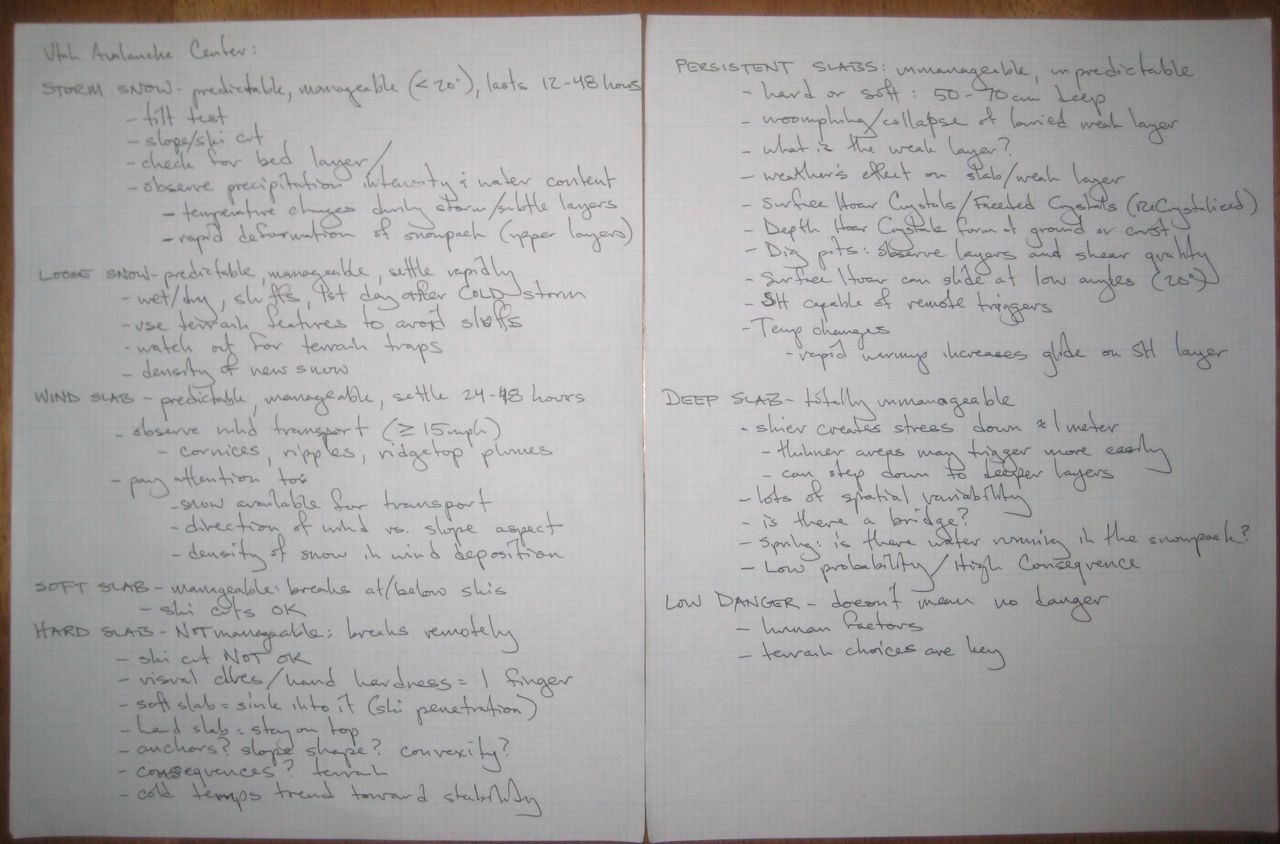
Threats: UAC has identified 7 specific dangers and lists the threats that apply each day. Each threat gets its own danger rose, probability rating, size rating, trend (all with graphic representation), and 1-2 paragraph discussion of that threat. The 7 threats are: Storm Snow; Loose Snow; Wind Slab; Soft Slab; Hard Slab; Persistent Slab; and Deep Slab.
This might not have meant as much to me without a discussion of how to manage or avoid each one, so I have included my notes from that discussion. The primary thing I took note of is which threats are manageable while in avy terrain (using ski cuts, etc) and which are not, and should be avoided altogether.
Mountain Weather: Finally, there are 1-2 paragraphs briefly describing the conditions for the day.
All of this information is formatted on a single page that is easy to read and understand, and it arrives in my email at 6am. I am impressed.
I want to note that I also really appreciate all the work that NWAC does, and that I recognize the much greater challenge of forecasting for such a large region with a fewer number of forecasters. However, I tend to use NWAC primarily for the telemetry data, possibly because I am more visually oriented than verbal.
Big thanks to everyone who contributes to the effort.
As mentioned, the UAC budget is the highest in the US, which has resulted in the development of a super clean website and great graphic symbols beyond the danger rose. This is clearly the result of some great avalanche minds working together with capable web developers and graphic designers.
It is my hope that this tech will be shared with other avalanche centers that don't have the resources to develop something similar (which would be really redundant). This would still require a significant investment of time and money for each region to develop methods for that area. Perhaps there is or will be a guild of avalanche and web experts who can assist each region in adopting new tech.
I was fortunate to attend an Advanced Avalanche Skills workshop with some of the UAC forecasters in January, which gave me an opportunity to learn firsthand how they are using this system. Some key elements include:
The Bottom Line: A simple explanation of the primary dangers each day, presented clearly at the top of the page.
Current Conditions: One or two paragraphs explaining the most up to date weather and snowpack information for the day.
Recent Activity: This paragraph has direct links to observations that have been posted in a template that is consistent for each report from a wide variety of observers ranging from novices to avalanche experts, with varying amounts of information in each obs.
Threats: UAC has identified 7 specific dangers and lists the threats that apply each day. Each threat gets its own danger rose, probability rating, size rating, trend (all with graphic representation), and 1-2 paragraph discussion of that threat. The 7 threats are: Storm Snow; Loose Snow; Wind Slab; Soft Slab; Hard Slab; Persistent Slab; and Deep Slab.
This might not have meant as much to me without a discussion of how to manage or avoid each one, so I have included my notes from that discussion. The primary thing I took note of is which threats are manageable while in avy terrain (using ski cuts, etc) and which are not, and should be avoided altogether.
Mountain Weather: Finally, there are 1-2 paragraphs briefly describing the conditions for the day.
All of this information is formatted on a single page that is easy to read and understand, and it arrives in my email at 6am. I am impressed.
I want to note that I also really appreciate all the work that NWAC does, and that I recognize the much greater challenge of forecasting for such a large region with a fewer number of forecasters. However, I tend to use NWAC primarily for the telemetry data, possibly because I am more visually oriented than verbal.
Big thanks to everyone who contributes to the effort.
Please Log in or Create an account to join the conversation.