
- Posts: 12
- Thank you received: 0
CT test procedures
- Monty_B
-

- User
-

Less
More
15 years 3 months ago #198556
by Monty_B
Replied by Monty_B on topic Re: CT test procedures
Seems like he's using a different CT test scale to me. The author's email is at the bottom of the first page and at the very end of the document it says:
"The author is extremely interested in input and feedback regarding these strength test correlations. Please send your comments to the email or address listed."
Perhaps someone should drop him a line.
"The author is extremely interested in input and feedback regarding these strength test correlations. Please send your comments to the email or address listed."
Perhaps someone should drop him a line.
Please Log in or Create an account to join the conversation.
- Chris S
-

- User
-
Less
More
- Posts: 91
- Thank you received: 0
15 years 3 months ago #198565
by Chris S
Replied by Chris S on topic Re: CT test procedures
www.avalanche.org/research/guidelines/pdf/Chapter2.pdf
, page 45 and 46
Please Log in or Create an account to join the conversation.
- Koda
-
Topic Author
- User
-
Less
More
- Posts: 166
- Thank you received: 0
15 years 3 months ago #198610
by Koda
Replied by Koda on topic Re: CT test procedures
So the bottom line is I jumped the gun on correlating NWAC Correlations test results (table 1) with CT procedures because I could not find any other information regarding proper CT procedures on their website. I assumed there were two methods of procedures for the CT test and just rolled with it. NWAC Correlations paper is not clear (to me) in regards to correlating CT test results with CT procedures, and leads to confusion with Table1 “wrist+elbow” etc. descriptors divided into 5 categories.... this just does not correlate with 3 categories (wrist, elbow, shoulder) of the proper CT procedure they lack to mention. After evaluating this with a new perspective, I believe I misinterpreted the paper... and that Orion is correct in how to interpret Table 1. It would be great if NWAC could make available all the information needed on their website.
After reading the Chapter2 article from Avalanche-research.com (seems to be the same ‘chapter2.pdf’ as available on avalanche.org’s website) the CT test is easily understood on the objective, equipment, procedure, and interpretation... as well as other test methods. (regarding interpretation, Table 2.11 keeps the 3 wrist, elbow, shoulder categories. Again, this is why I always assumed the NWAC document was using a different method) This is the document I will be referring to from now on.
In the end it works out... I got some great replies from the TAY community and case closed. thanks everyone for their replies.
After reading the Chapter2 article from Avalanche-research.com (seems to be the same ‘chapter2.pdf’ as available on avalanche.org’s website) the CT test is easily understood on the objective, equipment, procedure, and interpretation... as well as other test methods. (regarding interpretation, Table 2.11 keeps the 3 wrist, elbow, shoulder categories. Again, this is why I always assumed the NWAC document was using a different method) This is the document I will be referring to from now on.
In the end it works out... I got some great replies from the TAY community and case closed. thanks everyone for their replies.
Please Log in or Create an account to join the conversation.
- snomet
-
- User
-
Less
More
- Posts: 14
- Thank you received: 0
15 years 3 months ago #198622
by snomet
Replied by snomet on topic Re: CT test procedures
Normally I don't jump into these threads but since I wrote and presented the Correlations article, I wanted to make a few comments. First the correlations are guidelines and are but a part of the overall stability rating process and the structure/energy/strength triad that represent avalanche release. Second, any numbers obtained from any single snow stability test site may or may not be representative of other nearby areas. And third...there really are no single tests that will tell you all you need to know.
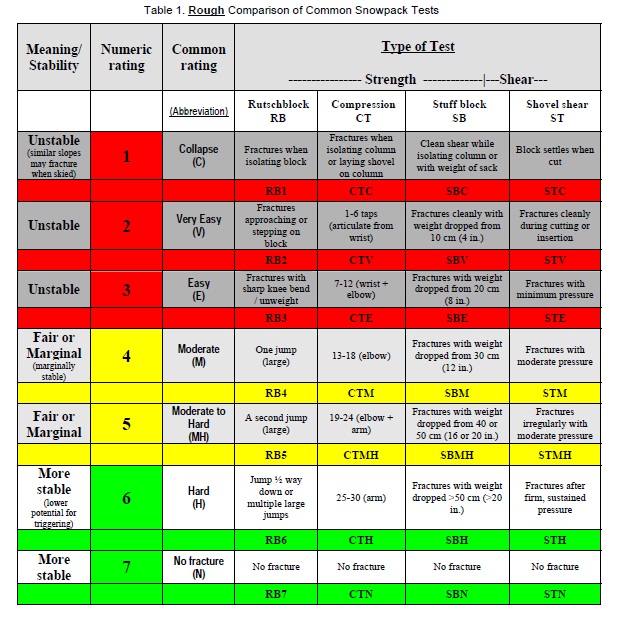
That said, the 3x10 method of taps for the CT is indeed correct..10 from the wrist, 10 from the elbow and 10 from the shoulder...(with the arm laid along the shovel providing the best control for regulating tapping force). The seven yellow to red delineations discussed in the Correlation article and presented graphically in the table below are convenient ways to compare relative stability ratings across several tests, with the 7 level Rutschblock taken as the standard at the time of the article. So as is stated in the article, the "7-12 (wrist + elbow)" or any of the other numerical groupings listed are just experience-based groupings of the normally recorded number of taps before release using the 3x10 method.
For instance, if one tapped 10 times from the wrist and 1 time from the elbow, this would total 11 taps in the CT test scheme. The 11 would fit into the "7-12" grouping and would roughly correlate to Rutschblock 3 and a red or unstable rating.
I hope this clears up most of the misunderstanding in the thread, and I apologize if the article created it.
Best, Mark Moore--NWAC
That said, the 3x10 method of taps for the CT is indeed correct..10 from the wrist, 10 from the elbow and 10 from the shoulder...(with the arm laid along the shovel providing the best control for regulating tapping force). The seven yellow to red delineations discussed in the Correlation article and presented graphically in the table below are convenient ways to compare relative stability ratings across several tests, with the 7 level Rutschblock taken as the standard at the time of the article. So as is stated in the article, the "7-12 (wrist + elbow)" or any of the other numerical groupings listed are just experience-based groupings of the normally recorded number of taps before release using the 3x10 method.
For instance, if one tapped 10 times from the wrist and 1 time from the elbow, this would total 11 taps in the CT test scheme. The 11 would fit into the "7-12" grouping and would roughly correlate to Rutschblock 3 and a red or unstable rating.
I hope this clears up most of the misunderstanding in the thread, and I apologize if the article created it.
Best, Mark Moore--NWAC
Please Log in or Create an account to join the conversation.
- Koda
-
Topic Author
- User
-
Less
More
- Posts: 166
- Thank you received: 0
15 years 3 months ago #198624
by Koda
Replied by Koda on topic Re: CT test procedures
Mark, thanks for replying. If I read your reply correct, I think it verifies what Orion suggested earlier in this thread as how to interpret Table1.
 ...anyways, it was my own assumption to use my (mis) interpretation and not validate the actual procedure with more sources. Lessons learned, my next study is to learn the extended column test... I've been shown how to do this once, but would like to find an article on this as well. What I am looking for overall is to keep up with a source of information to develop my own experience skill set for safe touring and skiing in avalanche terrain. The information is out there, but it seems to be scattered... I tend to focus on one place when I find it but I'm learning Is it possible the NWAC can post more information on test procedures?
...I think this is the part I mis-interpreted when I would reference your article. When I first found the article on the NWAC site, I was searching for procedures for stability tests, after reading through yours I simply used table1 as my guideline for procedures. (I've always had a tough time explaining to touring partners what 6 taps from the "wrist+elbow" was)For instance, if one tapped 10 times from the wrist and 1 time from the elbow...
...anyways, it was my own assumption to use my (mis) interpretation and not validate the actual procedure with more sources. Lessons learned, my next study is to learn the extended column test... I've been shown how to do this once, but would like to find an article on this as well. What I am looking for overall is to keep up with a source of information to develop my own experience skill set for safe touring and skiing in avalanche terrain. The information is out there, but it seems to be scattered... I tend to focus on one place when I find it but I'm learning Is it possible the NWAC can post more information on test procedures?Please Log in or Create an account to join the conversation.
- RonL
-
- User
-
Less
More
- Posts: 259
- Thank you received: 0
15 years 3 months ago #198629
by RonL
Replied by RonL on topic Re: CT test procedures
While there is a good panel thinking about this topic I figured I would take advantage and ask about differences between compression and shear tests. I occasionally notice troubling shear tests along side not so scary compression tests. This was the case on Saturday at Mt Snoqualomie. We noticed the skin track fractured when a third person passed on a close parallel track on about a 35 plus degree slope. This prompted the tests and two of us found compression tests that didn't raise too many red flags - we didn't turn back, but we did rule out some routes - when I cut the sides out of the column just sliding the shovel behind got an easy slide a little less than 2' down where there was an easily identified change in snow density. We caught up again with the others and found he had done a shear test too and found the easy slide on that layer. The skiing was great, mostly in the trees. On an obvious steep pitch about the waterfall one of our party ski cut and sent a good section down the hill but this was after when things were warming up and tree bombs were dropping but not quite enough for snow wheels or anything, and I don't recall sign of naturals releasing. Although it wasn't a bomber snowpack by any means, I didn't feel particularly reckless skiing what we did, and don't really in hindsight either. I am just looking for some new insight in how to interpret a day where a shear test seems more troubling that compression test.
Please Log in or Create an account to join the conversation.