
- Posts: 1230
- Thank you received: 0
Dynafit/Ski equipment failure question
- Marcus
-

- User
-

Less
More
15 years 4 months ago #197980
by Marcus
Replied by Marcus on topic Re: Dynafit/Ski equipment failure question
Ahh, gotcha -- okay, thanks. I'm going solely based on appearance relative to the internal threads, but yes they're not as aggressive as an wood screw. Thanks for the specifics.
I assume the fact that the holes are tapped, rather than self-tapping like most bindings screws, would help increase the pullout strength. Perhaps not -- clearly out of my depth re: details.
I assume the fact that the holes are tapped, rather than self-tapping like most bindings screws, would help increase the pullout strength. Perhaps not -- clearly out of my depth re: details.
Please Log in or Create an account to join the conversation.
- Big Steve
-
- User
-
Less
More
- Posts: 141
- Thank you received: 0
15 years 4 months ago - 15 years 4 months ago #197981
by Big Steve
Replied by Big Steve on topic Re: Dynafit/Ski equipment failure question
Please Log in or Create an account to join the conversation.
- Randito
-

- User
-
Less
More
- Posts: 960
- Thank you received: 1
15 years 4 months ago #197983
by Randito
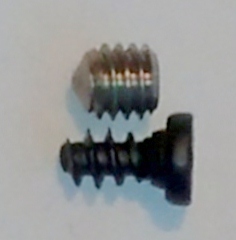
Here is a pic of an insert and conventional mounting screw side by side.
The screw does have deeper threads. My wood working geek friends tell me that the strength of the bond is essentially proportional to the surface area of the bond. The insert has shallower threads -- but is a larger diameter -- so without a CAD model to calculate it anybody's guess which has more.
Emperically, I think a bigger factor in binding pull out is the quality of the glue used and the tightness of the fastener to the ski structure. When I've ripped bindings out of skis in the past they were "shop mounted" using some form of "waterproof" wood working glue. This glue eventually loosened with annoying "miles from the trailhead" results. Since I switched to mounting bindings myself and using either slow cure epoxy or ureathane glue I haven't ripped anything out.
I don't know in any sort of scientific manner whether helicoils or inserts have stronger pull-out strength -- or for that matter whether pull-out strength is the critical issue -- shear strength likely plays an important role as well. I think inserts may have an edge there.
Replied by Randito on topic Re: Dynafit/Ski equipment failure question
Ah, I just noticed this. I've used these and these , which have deep coarse knife threads, similar to a wood screw or helicoil. QK/BF are different animals w/ machine screw threads. See above.
Here is a pic of an insert and conventional mounting screw side by side.
The screw does have deeper threads. My wood working geek friends tell me that the strength of the bond is essentially proportional to the surface area of the bond. The insert has shallower threads -- but is a larger diameter -- so without a CAD model to calculate it anybody's guess which has more.
Emperically, I think a bigger factor in binding pull out is the quality of the glue used and the tightness of the fastener to the ski structure. When I've ripped bindings out of skis in the past they were "shop mounted" using some form of "waterproof" wood working glue. This glue eventually loosened with annoying "miles from the trailhead" results. Since I switched to mounting bindings myself and using either slow cure epoxy or ureathane glue I haven't ripped anything out.
I don't know in any sort of scientific manner whether helicoils or inserts have stronger pull-out strength -- or for that matter whether pull-out strength is the critical issue -- shear strength likely plays an important role as well. I think inserts may have an edge there.
Please Log in or Create an account to join the conversation.
- Big Steve
-
- User
-
Less
More
- Posts: 141
- Thank you received: 0
15 years 4 months ago - 15 years 3 months ago #197984
by Big Steve
ETA: Eyeballing your pic, the ABS screw seems to be roughly 2X as coarse, i.e., 9 TPI, or maybe a bit finer than that, say 10 TPI or 11 TPI. (It would be easy to measure but I'm not in my shop). If it's, say, 1.5 times coarser, that puts 1-1/2 X as much core material in shear for each thread. Add the increased diameter of a helicoil, and, hmmmm, maybe there's 3X or more core material loaded in shear by a helicoil thread. (yes, I acknowledge that QK inserts have more threads, but, IME, it seems that core shear failures very localized). Machine screws were designed to bite nuts and threaded metal. Wood screws were designed to bite wood. So, again, my concern is using a machine screw thread in wood. That's my point.
But, as I mentioned above, QK/BL theory assumes that the glue is not merely keeping the screw from turning, but is also creating a resin & wood "inverted cup." If that successfully happens, then all should be fine. Note that I've used a heat gun to lower the viscosity of the epoxy to get it to soak into the wood. When I did that, the QK inserts did not pull out as easily, but helicoils still won the day on 4 different (DIY non-scientific) test skis (3 wood core, 1 foam).
Again, my QK vs. Helicoil DIY pullout tests are not scientific and not measured with precise equipment and might be specific to the skis tested. Zeno's tests seem to demonstrate that a metric (8mm-1.25) machine screw based insert very similar to QK/BF does not anchor as strongly as the more coarse/deeper ABS screw thread. Helicoil is a wood screw-like thread, but with a bigger cross section than ABS. Zeno notes that "the external threads [of the machine screw-based insert] aren't very deep (M8-1.25), since the insert is intended for metal use."

Replied by Big Steve on topic Re: Dynafit/Ski equipment failure question
Unless the pullout resullts from a loose screw (which does sometimes happen), pullouts are shear failures of the core, not bond failures. The shear strength of the core is the weak link. Deeper thread >> wider bite in the core >> dispersing load across a wider horizontal area. Coarser thread >> dispersing shear load on bigger vertical area. Because helicoils have big thru-voids, they bite into a bigger core cross section than QK's. I haven't measured it but I would guess its 2X+. See Conundrum's pic, below.My wood working geek friends tell me that the strength of the bond is essentially proportional to the surface area of the bond. * * * -- or for that matter whether pull-out strength is the critical issue -- shear strength likely plays an important role as well.
ETA: Eyeballing your pic, the ABS screw seems to be roughly 2X as coarse, i.e., 9 TPI, or maybe a bit finer than that, say 10 TPI or 11 TPI. (It would be easy to measure but I'm not in my shop). If it's, say, 1.5 times coarser, that puts 1-1/2 X as much core material in shear for each thread. Add the increased diameter of a helicoil, and, hmmmm, maybe there's 3X or more core material loaded in shear by a helicoil thread. (yes, I acknowledge that QK inserts have more threads, but, IME, it seems that core shear failures very localized). Machine screws were designed to bite nuts and threaded metal. Wood screws were designed to bite wood. So, again, my concern is using a machine screw thread in wood. That's my point.
But, as I mentioned above, QK/BL theory assumes that the glue is not merely keeping the screw from turning, but is also creating a resin & wood "inverted cup." If that successfully happens, then all should be fine. Note that I've used a heat gun to lower the viscosity of the epoxy to get it to soak into the wood. When I did that, the QK inserts did not pull out as easily, but helicoils still won the day on 4 different (DIY non-scientific) test skis (3 wood core, 1 foam).
Again, my QK vs. Helicoil DIY pullout tests are not scientific and not measured with precise equipment and might be specific to the skis tested. Zeno's tests seem to demonstrate that a metric (8mm-1.25) machine screw based insert very similar to QK/BF does not anchor as strongly as the more coarse/deeper ABS screw thread. Helicoil is a wood screw-like thread, but with a bigger cross section than ABS. Zeno notes that "the external threads [of the machine screw-based insert] aren't very deep (M8-1.25), since the insert is intended for metal use."
Please Log in or Create an account to join the conversation.