
- Posts: 267
- Thank you received: 0
4 November 2010: More Paradise climax avalanches.
- JibberD
-

- User
-

Less
More
15 years 7 months ago #194665
by JibberD
Replied by JibberD on topic Re: 4 November 2010: More Paradise climax avalanches.
So would it be fair to say this thread has spawned a new hybrid TAYer?
The SailorMonster:

Seriously though, the debate is appreciated.
Getting us all to think about these things is a good thing. Avy science is complex and nuanced, yet it seeks answers for the ultimate, drooling primal joneser who just wants to know: "dude, that is a sweet line of untracked, will I suffer a nasty fate if I drop in for some bliss...?" That's a tough beast to reason with as we all know.
The SailorMonster:
Seriously though, the debate is appreciated.
Getting us all to think about these things is a good thing. Avy science is complex and nuanced, yet it seeks answers for the ultimate, drooling primal joneser who just wants to know: "dude, that is a sweet line of untracked, will I suffer a nasty fate if I drop in for some bliss...?" That's a tough beast to reason with as we all know.
Please Log in or Create an account to join the conversation.
- CookieMonster
-
- User
-
Less
More
- Posts: 392
- Thank you received: 0
15 years 7 months ago #194666
by CookieMonster
What can I do to make you feel expensive?!
Jibber, I love the graphic. I'll stick to being The CookieMonster, there is no substitute.
Someone in an earlier post commented my "inciteful" remarks ( instead of insightful remarks ). Gosh, could he have picked a better term?
This CookieMonster loves to incite!
Replied by CookieMonster on topic Re: 4 November 2010: More Paradise climax avalanches.
I feel so cheap - CookieMonster, I agree with you, aspect is a poor predictor of avalanches and that's what new visitors need to know. However, my partners and I will continue to consider aspect an important factor when choosing which slopes to ski.
What can I do to make you feel expensive?!
Jibber, I love the graphic. I'll stick to being The CookieMonster, there is no substitute.
Someone in an earlier post commented my "inciteful" remarks ( instead of insightful remarks ). Gosh, could he have picked a better term?
This CookieMonster loves to incite!
Please Log in or Create an account to join the conversation.
- Andrew Carey
-
 Topic Author
- User
-
Less
More
- Posts: 914
- Thank you received: 0
15 years 7 months ago #194671
by Andrew Carey
Replied by Andrew Carey on topic Re: 4 November 2010: More Paradise climax avalanches.
Interesting discussion. IMHO, everything in nature is multi-factoral (has multiple factors contributing to the phenomenon [snowpack] being observed) and very often there are interactions between two factors and among several factors. All nature has some aspects of chaotic systems, which means starting conditions and history are important (but it does not mean that the likelihood of a phenomenon [e.g., avalanche during skiing or traversing a slope] can not be assessed, only that there is some inherent uncertainty [variance] associated with any evaluation).
So, ever since I gave up being a quantitative-statistically-oriented natural scientist : , I no longer take field measurements but I follow the weather and snowpack history on NWAC, read their summaries, remember their warnings, assess conditions qualitatively and on ranked scales as I move about the landscape observing the effects of recent and ongoing weather and testing the snow with my ski poles and with ski cuts. And where I have had considerable bc experience, I know many of the terrain features underlying the snow and the propensity of different individual slopes to slide, and I integrate all this qualitative and rank-order data in my mind to assess conditions on different aspect and on different elevations in a binary fashion (go, no go) and because my risk-taking has decreased with age, no go becomes increasingly common
  . After all, I am out there just to experience nature, get some hearty exercise, and get home safely; if a few cheap thrills present themselves with good omens, so be it.
So, ever since I gave up being a quantitative-statistically-oriented natural scientist :
, I no longer take field measurements but I follow the weather and snowpack history on NWAC, read their summaries, remember their warnings, assess conditions qualitatively and on ranked scales as I move about the landscape observing the effects of recent and ongoing weather and testing the snow with my ski poles and with ski cuts. And where I have had considerable bc experience, I know many of the terrain features underlying the snow and the propensity of different individual slopes to slide, and I integrate all this qualitative and rank-order data in my mind to assess conditions on different aspect and on different elevations in a binary fashion (go, no go) and because my risk-taking has decreased with age, no go becomes increasingly common . After all, I am out there just to experience nature, get some hearty exercise, and get home safely; if a few cheap thrills present themselves with good omens, so be it. Please Log in or Create an account to join the conversation.
- andyrew
-
- User
-
Less
More
- Posts: 116
- Thank you received: 0
15 years 7 months ago #194675
by andyrew
But it seems like the main warrant to your assertion that aspect, alone, is not a significant predictor of avalanches is their research?
I find myself agnostic on this question, although certainly more aware of how important additional covariates are important on making inferences related to aspect.
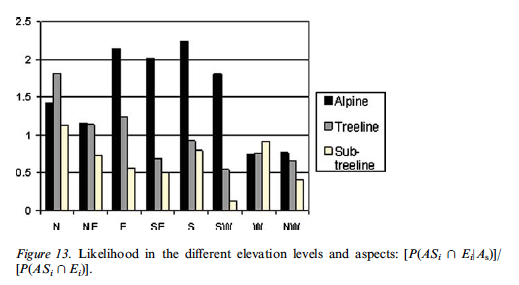
Trumpetsailor and you are still talking past each other. He posted bunch of citations that showed that aspect, conditioned on other information, makes a very good predictor of avalanches, and I think that's the whole point behind this thread. You said "aspect is a poor predictor of avalanches" and that got everyone riled up, because aspect, conditioned on other covariates, can be a very good predictor. For example, I reproduce for you figures 13 and 17 from Grismdottir McClung [2006]. Figure 13 shows that conditioned on elevation band, in the alpine, SE aspects have 2.5-fold higher likelihood of avalanche than westerly aspects.
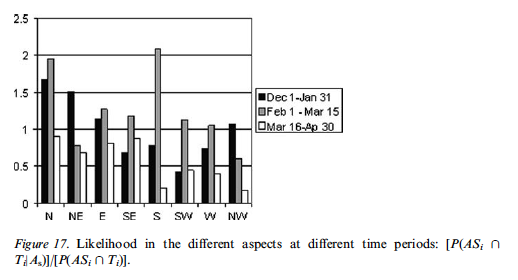
Figure 17 shows that conditioned on time of year, north and south aspects appear to have 1.5-fold higher likelihood of avalanche Feb 1-Mar 15.
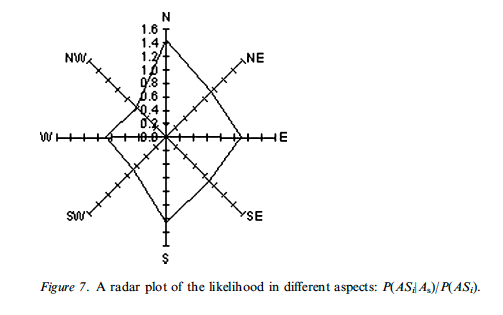
But, finally, as you said at the beginning, figure 7 shows that the marginal likelihood appear equivalent across aspects.
Replied by andyrew on topic Re: 4 November 2010: More Paradise climax avalanches.
Furthermore, they assert that they have integrated out the "info" term there is in the above expression by not conditioning their observations on "info", so are just finding P(avalanche | skied) for each aspect and comparing these probabilities. I'm not sure if I think that the integration assumption is a good one or not, but would lean towards not.
You'll have to take this up with Dave McClung and Harpa Grimsdottir. I didn't participate in the research.
But it seems like the main warrant to your assertion that aspect, alone, is not a significant predictor of avalanches is their research?
I find myself agnostic on this question, although certainly more aware of how important additional covariates are important on making inferences related to aspect.
Trumpetsailor and you are still talking past each other. He posted bunch of citations that showed that aspect, conditioned on other information, makes a very good predictor of avalanches, and I think that's the whole point behind this thread. You said "aspect is a poor predictor of avalanches" and that got everyone riled up, because aspect, conditioned on other covariates, can be a very good predictor. For example, I reproduce for you figures 13 and 17 from Grismdottir McClung [2006]. Figure 13 shows that conditioned on elevation band, in the alpine, SE aspects have 2.5-fold higher likelihood of avalanche than westerly aspects.
Figure 17 shows that conditioned on time of year, north and south aspects appear to have 1.5-fold higher likelihood of avalanche Feb 1-Mar 15.
But, finally, as you said at the beginning, figure 7 shows that the marginal likelihood appear equivalent across aspects.
Please Log in or Create an account to join the conversation.
- CookieMonster
-
- User
-
Less
More
- Posts: 392
- Thank you received: 0
15 years 7 months ago #194677
by CookieMonster
I don't want to be sharp, but is your toaster plugged in?
You talk about "my assertion" as if I was the one who conducted the research, when clearly I was not. This assertion was made by research conducted by Dave McClung and Harpa Grimsdottir. Are we clear on this point?
Throughout this thread, including in my original remarks, I repeated conclusions by one of the best researchers in the field, I cited an unimpeachable source, and provided additional facts.
Please take a few minutes and think about this before you write another post.
Let me revise your statement:
"But, finally, as you said at the beginning when you cited work by Dave McClung and Harpa Grimsdottir, figure 7 shows that the marginal likelihood appear equivalent across aspects."
***
As to the discussion of whether or not the conclusions of the research are supportable. I have already said that you'll have to take this up with Dave McClung and Harpa Grimsdottir. Allow me to repeat myself once again: I didn't participate in their research. Are we finally clear on that point?
Yes, I trust their research. It's peer reviewed and cited by The Avalanche Handbook. Hey, that's good enough for me. That said, the fact that I cite their work doesn't mean I am expected to explain it to you or defend it from any criticism you propose. I would be equally happy to cite any research that you and TrumpetSailer have prepared which proves that aspect is in general a good predictor of avalanches. ( But I suspect you haven't conducted any such research, and I also suspect you won't be able to find any such research elsewhere. )
As always, you're free to reach your own conclusions.
***
Citing a bunch of links does NOT constitute research, and it certainly doesn't prove anything. I asked TrumpetSailer to provide links that prove aspect is in general a good predictor of avalanches. He provided a bunch of links that established avalanches happen on all aspects. What I should have said is "Hey TrumpetSailer, why don't you find a study that proves aspect is in general a good predictor of avalanches".
I'll say it again: TrumpetSailer and Andyrew, please find me a peer reviewed study by a prominent expert that establishes aspect in general as good predictor of avalanches.
( Otherwise, I'm sorry but neither your nor TrumpetSailer's remarks are equivalent to peer reviewed research conducted by one of the best researchers in the field. )
***
Finally, I get to say this because I am arguing in favour of a conclusion that is supported by damn good science. You're just arguing.
Replied by CookieMonster on topic Re: 4 November 2010: More Paradise climax avalanches.
But it seems like the main warrant to your assertion that aspect, alone, is not a significant predictor of avalanches is their research?
I don't want to be sharp, but is your toaster plugged in?
You talk about "my assertion" as if I was the one who conducted the research, when clearly I was not. This assertion was made by research conducted by Dave McClung and Harpa Grimsdottir. Are we clear on this point?
Throughout this thread, including in my original remarks, I repeated conclusions by one of the best researchers in the field, I cited an unimpeachable source, and provided additional facts.
Please take a few minutes and think about this before you write another post.
But, finally, as you said at the beginning, figure 7 shows that the marginal likelihood appear equivalent across aspects.
Let me revise your statement:
"But, finally, as you said at the beginning when you cited work by Dave McClung and Harpa Grimsdottir, figure 7 shows that the marginal likelihood appear equivalent across aspects."
***
As to the discussion of whether or not the conclusions of the research are supportable. I have already said that you'll have to take this up with Dave McClung and Harpa Grimsdottir. Allow me to repeat myself once again: I didn't participate in their research. Are we finally clear on that point?
Yes, I trust their research. It's peer reviewed and cited by The Avalanche Handbook. Hey, that's good enough for me. That said, the fact that I cite their work doesn't mean I am expected to explain it to you or defend it from any criticism you propose. I would be equally happy to cite any research that you and TrumpetSailer have prepared which proves that aspect is in general a good predictor of avalanches. ( But I suspect you haven't conducted any such research, and I also suspect you won't be able to find any such research elsewhere. )
As always, you're free to reach your own conclusions.
***
Citing a bunch of links does NOT constitute research, and it certainly doesn't prove anything. I asked TrumpetSailer to provide links that prove aspect is in general a good predictor of avalanches. He provided a bunch of links that established avalanches happen on all aspects. What I should have said is "Hey TrumpetSailer, why don't you find a study that proves aspect is in general a good predictor of avalanches".
I'll say it again: TrumpetSailer and Andyrew, please find me a peer reviewed study by a prominent expert that establishes aspect in general as good predictor of avalanches.
( Otherwise, I'm sorry but neither your nor TrumpetSailer's remarks are equivalent to peer reviewed research conducted by one of the best researchers in the field. )
***
Finally, I get to say this because I am arguing in favour of a conclusion that is supported by damn good science. You're just arguing.
Please Log in or Create an account to join the conversation.
- andyrew
-
- User
-
Less
More
- Posts: 116
- Thank you received: 0
15 years 7 months ago #194678
by andyrew
I'm sorry I wasn't more clear. When I said your assertion, I referred to your comment
at the very head of the thread. Which you then supported by citing Grimsdottir. So that is why I thought that reading their paper closely and examining their assumptions was germane.
I believe this is fundamentally a misunderstanding on conditional versus unconditional probabilities, and that was what I was trying to clarify.
Did you look at figures 13 and 17? They show that conditioned on other covariates, aspect does appear to be a predictor of likelihood of avalanche. I don't want to put words in TrumpetSailor's mouth, but the links he posted appeared to be trying to emphasize that idea: the likelihood of avalanche, CONDITIONED on other things (the direction of the wind, the time of the year, the elevation, the lattitude, the nature of the instability in the snowpack), is not the same on all aspects.
Or am I misinterpreting figures 13 and 17?
Replied by andyrew on topic Re: 4 November 2010: More Paradise climax avalanches.
I don't want to be sharp, but is your toaster plugged in?
You talk about "my assertion" as if I was the one who conducted the research, when clearly I was not.
I'm sorry I wasn't more clear. When I said your assertion, I referred to your comment
Also, aspect is in general a *very* poor predictor of avalanche activity.
at the very head of the thread. Which you then supported by citing Grimsdottir. So that is why I thought that reading their paper closely and examining their assumptions was germane.
I'm apologize if I came off as using the paper as a strawman to attack you. I was trying to better elucidate how you interpreted their research since that seemed to be the reason that you said that, in general, aspect is a poor predictor of avalanche activity.As to the discussion of whether or not the conclusions of the research are supportable. I have already said that you'll have to take this up with Dave McClung and Harpa Grimsdottir. Allow me to repeat myself once again: I didn't participate in their research. Are we finally clear on that point?
I believe this is fundamentally a misunderstanding on conditional versus unconditional probabilities, and that was what I was trying to clarify.
Citing a bunch of links does NOT constitute research, and it certainly doesn't prove anything. I asked TrumpetSailer to provide links that prove aspect is in general a good predictor of avalanches. He provided a bunch of links that established avalanches happen on all aspects. What I should have said is "Hey TrumpetSailer, why don't you find a study that proves aspect is in general a good predictor of avalanches".
Did you look at figures 13 and 17? They show that conditioned on other covariates, aspect does appear to be a predictor of likelihood of avalanche. I don't want to put words in TrumpetSailor's mouth, but the links he posted appeared to be trying to emphasize that idea: the likelihood of avalanche, CONDITIONED on other things (the direction of the wind, the time of the year, the elevation, the lattitude, the nature of the instability in the snowpack), is not the same on all aspects.
Or am I misinterpreting figures 13 and 17?
Please Log in or Create an account to join the conversation.