
- Posts: 635
- Thank you received: 0
8/7/09, South Cascade Glacier has shrunk by half
- Amar Andalkar
-

- User
-

Less
More
16 years 9 months ago - 16 years 9 months ago #187899
by Amar Andalkar
Replied by Amar Andalkar on topic Re: 8/7/09, South Cascade Glacier has shrunk by ha
Thanks for the link, Lowell. But the newspaper story has a major error in that sentence (sadly enough, I feel compelled to add "as usual"). By late summer when glacier net mass-balances are calculated, essentially all of the mass and volume of the glacier is in the form of glacial ice, with firn and seasonal snow contributing a very small amount to either quantity (a few percent in fat years, almost nothing in lean years). Since all of the glacial ice has roughly the same density to within a few %, about 0.85 to 0.90, a decrease in glacier volume by one-half is pretty much equivalent to a decrease in glacier mass by one-half. Glacial mass-balance studies are a very inexact science, with much careful estimation involved, so a few percent doesn't matter and is much less than the margin of error in the measurements (so much so that scientific papers in the field usually don't even include error bars on graphs or tables of data, which seems like heresy to a physicist).
The original study can be found at the USGS Benchmark Glaciers website, including a link to the recently released USGS Fact Sheet 2009-3046 which I assume the story is referring to in its first sentence. The underlying data can be found in the last 2 refs, Annals of Glaciology, V. 46, p.291-6 (2007) and USGS Scientific Investigations Report 2007-5055 . Interesting reading. The Annals of Glaciology article has a table of volumes for South Cascade Glacier through 2001.
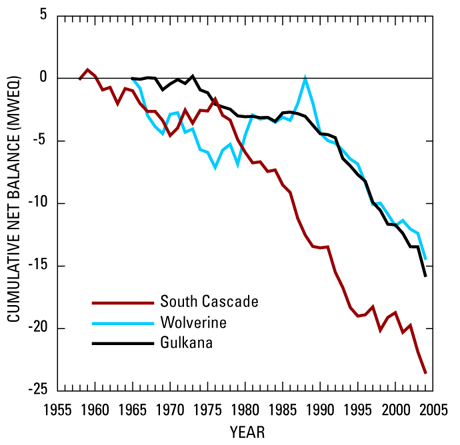
So how did the reporter make the error? Well, he quotes Josberger as stating that the volume decreased by a half from 0.25 to 0.13 cubic km, providing the first portion of his statement. I suspect that he then looked at this plot from the fact sheet,
 ,
,
but ignored the scale and caption completely and assumed that it shows a 25% decrease in mass. Thus providing the second part of his statement, "the South Cascade Glacier in Washington, has lost nearly half its volume and a quarter of its mass since 1958." LOL! However, the graph actually shows a cumulative loss of 25 meters of water equivalent, which is very different.
Regarding Wikipedia: someone else has already fixed the nonsense, so the wiki is working well and as it should. Someone else should probably delete the reference to Tankersley's article, too, and change it to refer to the USGS fact sheet and the scientific papers.
The original study can be found at the USGS Benchmark Glaciers website, including a link to the recently released USGS Fact Sheet 2009-3046 which I assume the story is referring to in its first sentence. The underlying data can be found in the last 2 refs, Annals of Glaciology, V. 46, p.291-6 (2007) and USGS Scientific Investigations Report 2007-5055 . Interesting reading. The Annals of Glaciology article has a table of volumes for South Cascade Glacier through 2001.
So how did the reporter make the error? Well, he quotes Josberger as stating that the volume decreased by a half from 0.25 to 0.13 cubic km, providing the first portion of his statement. I suspect that he then looked at this plot from the fact sheet,
but ignored the scale and caption completely and assumed that it shows a 25% decrease in mass. Thus providing the second part of his statement, "the South Cascade Glacier in Washington, has lost nearly half its volume and a quarter of its mass since 1958." LOL! However, the graph actually shows a cumulative loss of 25 meters of water equivalent, which is very different.
Regarding Wikipedia: someone else has already fixed the nonsense, so the wiki is working well and as it should. Someone else should probably delete the reference to Tankersley's article, too, and change it to refer to the USGS fact sheet and the scientific papers.
Please Log in or Create an account to join the conversation.
- James Wells
-
- User
-
Less
More
- Posts: 217
- Thank you received: 0
16 years 9 months ago #187900
by James Wells
Replied by James Wells on topic Re: 8/7/09, South Cascade Glacier has shrunk by half
I updated Wikipedia, I will change the reference as well.
Please Log in or Create an account to join the conversation.
- James Wells
-
- User
-
Less
More
- Posts: 217
- Thank you received: 0
16 years 9 months ago #187901
by James Wells
Replied by James Wells on topic Re: 8/7/09, South Cascade Glacier has shrunk by half
Amar, can you tell if the "almost 50%" statement about lost volume is accurate? It does not seem to be directly in the paper (nor are the .25 to .13 cu km numbers) , although it might be possible to derive based on the other info. While the report shows the deltas, it does not appear to show the starting mass quantities of each glacier.
Please Log in or Create an account to join the conversation.
- Amar Andalkar
-
- User
-
Less
More
- Posts: 635
- Thank you received: 0
16 years 9 months ago #187902
by Amar Andalkar
Replied by Amar Andalkar on topic Re: 8/7/09, South Cascade Glacier has shrunk by ha
Right, the 2007 paper only has the volumes through 2001 (0.16 cu km), so the 0.13 cu km number for 2008 is only quoted in Tankersley's article. And the 0.25 number he quotes for 1958 differs from the 0.24 shown in the 2007 paper.
And oddly enough, the Fact Sheet doesn't even have the word "volume" anywhere in it, talking exclusively about mass balance. So it's hard to support the statement about volume change without referencing both sources.
Even more interesting to me seems to be the HUGE volume loss from 1890 to 1958. Here's the South Cascade Glacier volume data from the 2007 paper, just so other readers can see it without finding the original PDF:
About 1890: 0.49 km3
1928: 0.32 km3
1958: 0.24 km3
1970: 0.22 km3
1985: 0.19 km3
2001: 0.16 km3
And oddly enough, the Fact Sheet doesn't even have the word "volume" anywhere in it, talking exclusively about mass balance. So it's hard to support the statement about volume change without referencing both sources.
Even more interesting to me seems to be the HUGE volume loss from 1890 to 1958. Here's the South Cascade Glacier volume data from the 2007 paper, just so other readers can see it without finding the original PDF:
About 1890: 0.49 km3
1928: 0.32 km3
1958: 0.24 km3
1970: 0.22 km3
1985: 0.19 km3
2001: 0.16 km3
Please Log in or Create an account to join the conversation.
- skimtner
-
- User
-
Less
More
- Posts: 23
- Thank you received: 0
16 years 9 months ago #187903
by skimtner
Replied by skimtner on topic Re: 8/7/09, South Cascade Glacier has shrunk by half
- down here in the Sierra, I've heard the Palisade Glacier is similar.
Please Log in or Create an account to join the conversation.
- JimH
-
- User
-
Less
More
- Posts: 104
- Thank you received: 0
16 years 9 months ago #187904
by JimH
Replied by JimH on topic Re: 8/7/09, South Cascade Glacier has shrunk by half
A glaciologist I was lucky enough to ski with said that most of the glaciers in the N Cascades aren't much more than 300 years old, having formed near the time of the the Little Ice Age' of the 1700s. That finding is apparently based on studies that used glacial silt in downstream lakes to estimate the age of several glaciers in the NC, which is apparently a pretty reliable technique.
Where would I look to find that data? I've no idea which journals to look at, but I'm suddenly interested in finding out. It would be nice to have some real data to back up my little anecdote.
If the glaciers are really only a few hundred years old, then that would make the loss of glacial mass seem a little less dramatic - it could still have a lot to do with larger climate issues, but maybe it also reflects a more dynamic system.
Amar - thanks for your relentless contributions on issues like this.
Where would I look to find that data? I've no idea which journals to look at, but I'm suddenly interested in finding out. It would be nice to have some real data to back up my little anecdote.
If the glaciers are really only a few hundred years old, then that would make the loss of glacial mass seem a little less dramatic - it could still have a lot to do with larger climate issues, but maybe it also reflects a more dynamic system.
Amar - thanks for your relentless contributions on issues like this.
Please Log in or Create an account to join the conversation.