
- Posts: 217
- Thank you received: 0
Lake hazard?
- James Wells
-
 Topic Author
- User
-

Less
More
17 years 4 months ago #185664
by James Wells
Lake hazard? was created by James Wells
So on Friday's tour we found ourselves going around rather than across several frozen lakes, seeing open water at several of the inlets. Normally that's crazy to worry about on January 30th, bit I couldn't get away from thinking of how warm it may have been for days on end during the inversion. Finally at the end we gave in and followed the track right across Bagely Lake.
So, is there either a useful seasonal chart or a good method based on observable evidence to determine if it is reasonable to cross a lake? If you start skiing across and it turns out to be a bad idea, do you get any feedback before catastrophe strikes?
So, is there either a useful seasonal chart or a good method based on observable evidence to determine if it is reasonable to cross a lake? If you start skiing across and it turns out to be a bad idea, do you get any feedback before catastrophe strikes?
Please Log in or Create an account to join the conversation.
- Stugie
-
- User
-
Less
More
- Posts: 291
- Thank you received: 0
17 years 4 months ago #185666
by Stugie
Replied by Stugie on topic Re: Lake hazard?
We used to play hockey on lakes back home. The question was whether we could bring a snowblower onto the ice or not. Out here, I guess I've got a few rules of thumb I've come up with, but there's always exceptions.
If it's cold (below freezing) and has been for a while, I'll cross it. Obviously, space yourselves out, maybe 20 ft or so. If the lake is small (like a tarn), you're usually good December - April, even with inversion. On a larger lake, (such as Mowich) it somewhat depends on the depth and elevation. Shallow and high up is usually a safe bet. During inversions or small periods of warmth, it's probably a good idea to avoid a lake crossing though. Another thing, which I haven't seen out in the PNW yet, but if there is an airation hole on the lake, don't cross it. My brother fell in this way once. It makes the ice weak, and it never gets thick, even in dead of winter.
So, I guess as far as a seasonal chart, I will usually cross a lake after the first good month of cold weather (usually November). Once the warming trend begins (May?), no more lake crossings for me.
If it's cold (below freezing) and has been for a while, I'll cross it. Obviously, space yourselves out, maybe 20 ft or so. If the lake is small (like a tarn), you're usually good December - April, even with inversion. On a larger lake, (such as Mowich) it somewhat depends on the depth and elevation. Shallow and high up is usually a safe bet. During inversions or small periods of warmth, it's probably a good idea to avoid a lake crossing though. Another thing, which I haven't seen out in the PNW yet, but if there is an airation hole on the lake, don't cross it. My brother fell in this way once. It makes the ice weak, and it never gets thick, even in dead of winter.
So, I guess as far as a seasonal chart, I will usually cross a lake after the first good month of cold weather (usually November). Once the warming trend begins (May?), no more lake crossings for me.
Please Log in or Create an account to join the conversation.
- Joedabaker
-
- User
-
Less
More
- Posts: 1012
- Thank you received: 0
17 years 4 months ago #185669
by Joedabaker
I tried to research this, but can you explain airation hole in frozen lake to me?
Replied by Joedabaker on topic Re: Lake hazard?
Another thing, which I haven't seen out in the PNW yet, but if there is an airation hole on the lake, don't cross it. My brother fell in this way once. It makes the ice weak, and it never gets thick, even in dead of winter.
I tried to research this, but can you explain airation hole in frozen lake to me?
Please Log in or Create an account to join the conversation.
- Scotsman
-
- User
-
Less
More
- Posts: 2432
- Thank you received: 0
17 years 4 months ago #185670
by Scotsman
Replied by Scotsman on topic Re: Lake hazard?
I am currently working on an estimate for a project in AK where we are going to demolish the old bridge by building an ice-road, exploding the bridge onto the ice using shaped charges and then cutting the bridge up with excavators with shears.
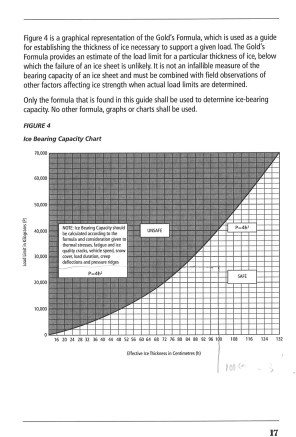
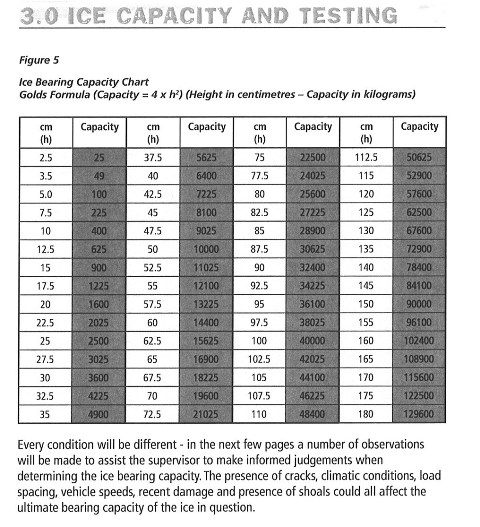
To determine the ice-thickness we require I am using " A field Guide to Ice Construction Safety" published by the Northwest Territories Transportation.
Attached are two charts from that publication showing ice thickness and safe load. It's metric!!!!
See, I am a geek too!
To determine the ice-thickness we require I am using " A field Guide to Ice Construction Safety" published by the Northwest Territories Transportation.
Attached are two charts from that publication showing ice thickness and safe load. It's metric!!!!
See, I am a geek too!
Please Log in or Create an account to join the conversation.
- James Wells
-
Topic Author
- User
-
Less
More
- Posts: 217
- Thank you received: 0
17 years 4 months ago #185671
by James Wells
Replied by James Wells on topic Re: Lake hazard?
If I am reading it right, the bottom chart shows pretty amazing strength of 4" thick ice (=10 cm) of 400 kilograms.
But doesn't it also matter a lot how widely the weight is distributed? I would picture that being on skis would have the effect of strongly reducing the hazard by distributing weight. It could be that the chart assumes some average degree of weight concentration such as you would commonly see with a vehicle.
There is of course money to be made if you understand the dynamics of this question very well:
www.nenanaakiceclassic.com/TicketsBrochures.html
But doesn't it also matter a lot how widely the weight is distributed? I would picture that being on skis would have the effect of strongly reducing the hazard by distributing weight. It could be that the chart assumes some average degree of weight concentration such as you would commonly see with a vehicle.
There is of course money to be made if you understand the dynamics of this question very well:
www.nenanaakiceclassic.com/TicketsBrochures.html
Please Log in or Create an account to join the conversation.
- Scotsman
-
- User
-
Less
More
- Posts: 2432
- Thank you received: 0
17 years 4 months ago #185672
by Scotsman
Yep, it's for vehicle loads and interestingly enough, the link you provided is for the actual river. Project is to rebuild a new bridge over the Tanana River near Tok, AK and demolish old bridge.
Replied by Scotsman on topic Re: Lake hazard?
If I am reading it right, the bottom chart shows pretty amazing strength of 4" thick ice (=10 cm) of 400 kilograms.
But doesn't it also matter a lot how widely the weight is distributed? I would picture that being on skis would have the effect of strongly reducing the hazard by distributing weight. It could be that the chart assumes some average degree of weight concentration such as you would commonly see with a vehicle.
There is of course money to be made if you understand the dynamics of this question very well:
www.nenanaakiceclassic.com/TicketsBrochures.html
Yep, it's for vehicle loads and interestingly enough, the link you provided is for the actual river. Project is to rebuild a new bridge over the Tanana River near Tok, AK and demolish old bridge.
Please Log in or Create an account to join the conversation.