
- Posts: 1460
- Thank you received: 16
Dwight Watson's skis
- Lowell_Skoog
-
 Topic Author
- User
-

Less
More
18 years 8 months ago - 18 years 8 months ago #179187
by Lowell_Skoog
Dwight Watson's skis was created by Lowell_Skoog
www.alpenglow.org/people/dwight-watson-skis/index.html
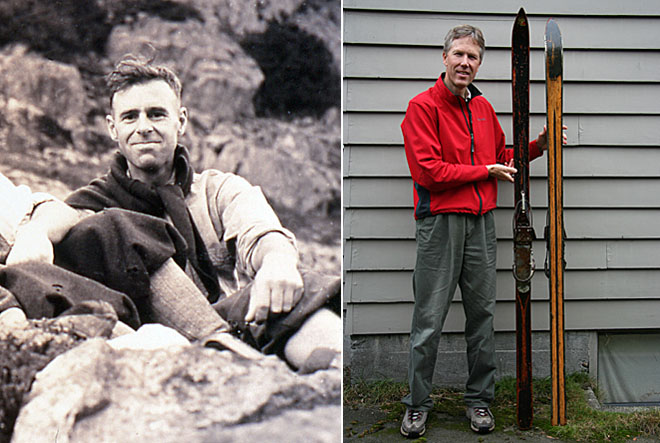
Left: Dwight Alvin Watson, circa 1939. Right: The author with the only known pair of Watson's skis in 2007.
[hr]
Dwight Watson, born December 22, 1900, can justifiably be called the father of backcountry skiing in Washington state. From the mid-1930s through mid-1940s, Watson and a small group of friends explored many areas of the Cascade and Olympic Mountains that had never been skied before.
Watson's first ski ascents in the Cascades include Ruth Mountain, Glacier Peak, White Mountain, North Star Mountain, Mount Daniel, Mount Hinman, and Old Desolate. He made early ascents or scouting trips to Eldorado Peak, Buck Pass, the Monte Cristo area, Mount Stuart, Governors Ridge, the NE Olympics, Mount Bretherton, Mount Adams, Mount St. Helens, the Goat Rocks, Mount Hood, and all sides of Mount Rainier. Perhaps his finest ski mountaineering achievement was the first ski traverse over the summit of Mount Baker from the Kulshan Cabin to the Mount Baker Lodge in May 1939. Watson was a prolific and talented photographer and a pioneering movie maker. His knowledge of skiable terrain in the Cascades was unmatched in the years before World War II.
Dwight Watson died on February 29, 1996, at age 95. Before his death he donated his mountain scrapbook , papers , and still photographs to the University of Washington . He donated his movies and miscellaneous shoeboxes to The Mountaineers . Following his death, a mutual friend transferred Watson's skis, camera equipment, and camping gear to his longtime friend Othello Phil Dickert in Seattle. During phone conversations with Dickert in the early 2000s, I learned that he had Dwight Watson's skis. Due to his health problems, I was never able to visit Dickert at his home. Dickert, himself a mountaineer and photographer of great accomplishment, passed away in 2004 at age 95. Following his death, his daughters, especially Judi Lemp, began going through his belongings to decide what to do with them.
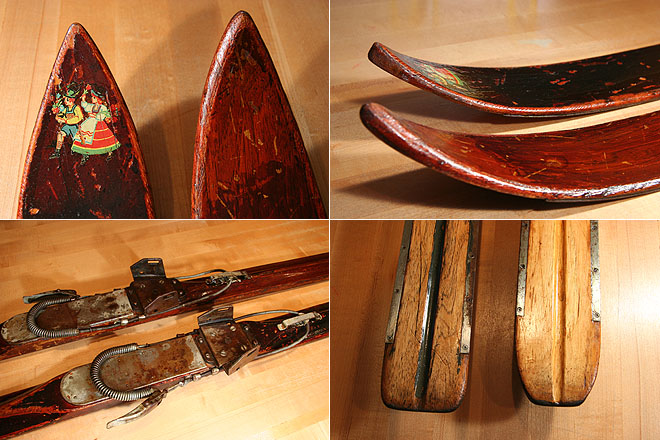
Upper left: Unmatched ski tips, Northland ski on the left. Upper right: Ski tip profile. Lower left: Anderson & Thompson (A&T) cable bindings. Lower right: Unmatched ski tails, Northland ski on the right.
[hr]
In autumn 2007, a friend of mine met Judi Lemp at the annual gear sale of The Mountaineers in Seattle. She sold him a pair of her father's nailed mountaineering boots. I called Judi shortly thereafter to inquire about Dwight Watson's skis. Judi told me that she still had them. A few days later I visited her at her father's home and bought the skis. The photos on this page document my observations about these skis.
Like any veteran skier, Dwight Watson owned several pairs of skis during his lifetime. I believe that the skis shown in these photos date from the 1940s, probably after World War II, following Watson's most active pioneering period. Watson's photographs and movies from the 1930s and early 1940s show that he and his friends used skis with the distinctive "sugar cube" tip that was common during that period. The skis held by O.P. Dickert do not have this tip style. They are 200cm in length, ridge-topped, with segmented, screwed-on steel edges. They appear to be solid rather than laminated wood. On a cheap bathroom scale, they weigh about twelve pounds.
The skis are mounted with simple toe irons and cable bindings. The toe irons are of the "Ski Sport" model. The cables are made by Anderson & Thompson (A&T). The cables have a latch at the toe to adjust the binding for boot length. The latch is stamped "Zephyr". A toggle installed in the binding near the heel tightens the cable after you step into the binding.
Although the skis are roughly the same length, they are not a matched pair. The right ski (the one mounted with the right binding) is more decorative, with a Scandinavian-style painting on the tip. This ski has a legend burned on the under-side of the tip, which I believe says, "FIS Model, Slalom/Downhill, by Northland." (The word "Downhill" is almost illegible and I have inferred it from context.) The Northland ski has a more tapered tail than the other one and the edges end at different points on the skis. The ski profiles are also different. In millimeters, the Northland ski measures 86/70/79 (shovel/waist/tail) while the other, unmarked ski is 87/70/77.
Today's backcountry skier may think it odd to use an unmatched pair of skis. Modern skis are nearly unbreakable and backcountry skiers today have more disposable income than they did in the 1930s and 1940s. In the days of wooden skis, it was not unusual to break a ski and replace it with a mate that was only a crude match.
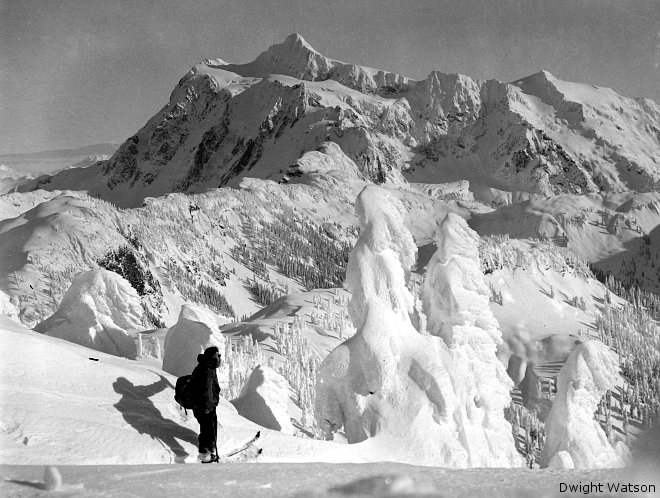
A skier pauses on Table Mountain with Mount Shuksan in the distance, 1930s. Photo by Dwight Watson, The Mountaineers collection.
[hr]
Left: Dwight Alvin Watson, circa 1939. Right: The author with the only known pair of Watson's skis in 2007.
[hr]
Dwight Watson, born December 22, 1900, can justifiably be called the father of backcountry skiing in Washington state. From the mid-1930s through mid-1940s, Watson and a small group of friends explored many areas of the Cascade and Olympic Mountains that had never been skied before.
Watson's first ski ascents in the Cascades include Ruth Mountain, Glacier Peak, White Mountain, North Star Mountain, Mount Daniel, Mount Hinman, and Old Desolate. He made early ascents or scouting trips to Eldorado Peak, Buck Pass, the Monte Cristo area, Mount Stuart, Governors Ridge, the NE Olympics, Mount Bretherton, Mount Adams, Mount St. Helens, the Goat Rocks, Mount Hood, and all sides of Mount Rainier. Perhaps his finest ski mountaineering achievement was the first ski traverse over the summit of Mount Baker from the Kulshan Cabin to the Mount Baker Lodge in May 1939. Watson was a prolific and talented photographer and a pioneering movie maker. His knowledge of skiable terrain in the Cascades was unmatched in the years before World War II.
Dwight Watson died on February 29, 1996, at age 95. Before his death he donated his mountain scrapbook , papers , and still photographs to the University of Washington . He donated his movies and miscellaneous shoeboxes to The Mountaineers . Following his death, a mutual friend transferred Watson's skis, camera equipment, and camping gear to his longtime friend Othello Phil Dickert in Seattle. During phone conversations with Dickert in the early 2000s, I learned that he had Dwight Watson's skis. Due to his health problems, I was never able to visit Dickert at his home. Dickert, himself a mountaineer and photographer of great accomplishment, passed away in 2004 at age 95. Following his death, his daughters, especially Judi Lemp, began going through his belongings to decide what to do with them.
Upper left: Unmatched ski tips, Northland ski on the left. Upper right: Ski tip profile. Lower left: Anderson & Thompson (A&T) cable bindings. Lower right: Unmatched ski tails, Northland ski on the right.
[hr]
In autumn 2007, a friend of mine met Judi Lemp at the annual gear sale of The Mountaineers in Seattle. She sold him a pair of her father's nailed mountaineering boots. I called Judi shortly thereafter to inquire about Dwight Watson's skis. Judi told me that she still had them. A few days later I visited her at her father's home and bought the skis. The photos on this page document my observations about these skis.
Like any veteran skier, Dwight Watson owned several pairs of skis during his lifetime. I believe that the skis shown in these photos date from the 1940s, probably after World War II, following Watson's most active pioneering period. Watson's photographs and movies from the 1930s and early 1940s show that he and his friends used skis with the distinctive "sugar cube" tip that was common during that period. The skis held by O.P. Dickert do not have this tip style. They are 200cm in length, ridge-topped, with segmented, screwed-on steel edges. They appear to be solid rather than laminated wood. On a cheap bathroom scale, they weigh about twelve pounds.
The skis are mounted with simple toe irons and cable bindings. The toe irons are of the "Ski Sport" model. The cables are made by Anderson & Thompson (A&T). The cables have a latch at the toe to adjust the binding for boot length. The latch is stamped "Zephyr". A toggle installed in the binding near the heel tightens the cable after you step into the binding.
Although the skis are roughly the same length, they are not a matched pair. The right ski (the one mounted with the right binding) is more decorative, with a Scandinavian-style painting on the tip. This ski has a legend burned on the under-side of the tip, which I believe says, "FIS Model, Slalom/Downhill, by Northland." (The word "Downhill" is almost illegible and I have inferred it from context.) The Northland ski has a more tapered tail than the other one and the edges end at different points on the skis. The ski profiles are also different. In millimeters, the Northland ski measures 86/70/79 (shovel/waist/tail) while the other, unmarked ski is 87/70/77.
Today's backcountry skier may think it odd to use an unmatched pair of skis. Modern skis are nearly unbreakable and backcountry skiers today have more disposable income than they did in the 1930s and 1940s. In the days of wooden skis, it was not unusual to break a ski and replace it with a mate that was only a crude match.
A skier pauses on Table Mountain with Mount Shuksan in the distance, 1930s. Photo by Dwight Watson, The Mountaineers collection.
[hr]
Please Log in or Create an account to join the conversation.
- Joedabaker
-

- User
-
Less
More
- Posts: 1012
- Thank you received: 0
18 years 8 months ago #179195
by Joedabaker
Replied by Joedabaker on topic Re: Dwight Watson's skis
Nice story Lowell,
It is interesting that his boards are relatively wide 87 shovel and 70mm in the waist.
I wonder when the skis started the trend back to narrower skis?
He traveled some pretty rugged terrain on those sticks, knowing what we know about avalanche hazards he must have been pretty versed in snow conditions.
Good stuff, remarkable for any day!
It is interesting that his boards are relatively wide 87 shovel and 70mm in the waist.
I wonder when the skis started the trend back to narrower skis?
He traveled some pretty rugged terrain on those sticks, knowing what we know about avalanche hazards he must have been pretty versed in snow conditions.
Good stuff, remarkable for any day!
Please Log in or Create an account to join the conversation.
- Lowell_Skoog
-
Topic Author
- User
-
Less
More
- Posts: 1460
- Thank you received: 16
18 years 8 months ago - 18 years 8 months ago #179198
by Lowell_Skoog
Those dimensions seem pretty typical to me for a traditional alpine ski. That is to say, what alpine skis looked like from the 1930s until 10 to 15 years ago, when fatter skis appeared. I agree that those dimensions are wide compared to the nordic skis that were used in the 1970s and 1980s. But almost nobody skied on what we now think of as nordic skis before the 1960s. Before World War II, "alpine" skis worked for everything, and you could do both parallel turns and telemark turns, because the cable bindings allowed some heel lift. Most people did parallel turns, but I've seen skiers like Sigurd Hall and Otto Trott throw in telemark turns now and then in Dwight Watson's films from the 1930s and 1940s.
I'm not sure what skis you're referring to when you mention narrower dimensions. Do you mean telemark skis ala 1980?
Replied by Lowell_Skoog on topic Re: Dwight Watson's skis
It is interesting that his boards are relatively wide 87 shovel and 70mm in the waist.
I wonder when the skis started the trend back to narrower skis?
Those dimensions seem pretty typical to me for a traditional alpine ski. That is to say, what alpine skis looked like from the 1930s until 10 to 15 years ago, when fatter skis appeared. I agree that those dimensions are wide compared to the nordic skis that were used in the 1970s and 1980s. But almost nobody skied on what we now think of as nordic skis before the 1960s. Before World War II, "alpine" skis worked for everything, and you could do both parallel turns and telemark turns, because the cable bindings allowed some heel lift. Most people did parallel turns, but I've seen skiers like Sigurd Hall and Otto Trott throw in telemark turns now and then in Dwight Watson's films from the 1930s and 1940s.
I'm not sure what skis you're referring to when you mention narrower dimensions. Do you mean telemark skis ala 1980?
Please Log in or Create an account to join the conversation.
- Joedabaker
-
- User
-
Less
More
- Posts: 1012
- Thank you received: 0
18 years 8 months ago #179201
by Joedabaker
Replied by Joedabaker on topic Re: Dwight Watson's skis
I suppose I was referring to the Alpine skis of the 70's and 80's where it seemed to me that the waist and shovels were substantially narrower.
There were a couple private ski companies that were ahead of their time making wider skis, but a 70mm waist on a ski in 70's and 80's era would have been a pretty wide ski. It seems that the ski waist was more in the mid 50-55mm range.
Other than the short ski craze in the early 70's, I can't remember much focus on the width of a ski as it is now days, it really was cooler to ski longer skis well over 200cm.
The nordic skis that I learned to telemark on were super narrow. They must have been 45 in the waist.
I digress your awesome thread...but some more history
When I grew up skiing in the 70's and early 80's, There were very few people really skiing the BC maybe due to the expansion of ski areas.
I did work in a bakery when I was very young to make enough money to buy ski gear and worked with a baker named Karl Ritchie who lived at the base of Nason Ridge. He would tell me stories of skiing Stevens Pass before the lifts were placed and skiing all over Nason Ridge area including the high camp.
I wish I could remember all his stories since he is now passed on, but it inspired me to be adventurous in the outdoors as a youth on skis.
Karl was a big strong man, he would have broken a heck of a trail.
His stories remind me of what Dwight Watson's adventures may have been like.
There were a couple private ski companies that were ahead of their time making wider skis, but a 70mm waist on a ski in 70's and 80's era would have been a pretty wide ski. It seems that the ski waist was more in the mid 50-55mm range.
Other than the short ski craze in the early 70's, I can't remember much focus on the width of a ski as it is now days, it really was cooler to ski longer skis well over 200cm.
The nordic skis that I learned to telemark on were super narrow. They must have been 45 in the waist.
I digress your awesome thread...but some more history
When I grew up skiing in the 70's and early 80's, There were very few people really skiing the BC maybe due to the expansion of ski areas.
I did work in a bakery when I was very young to make enough money to buy ski gear and worked with a baker named Karl Ritchie who lived at the base of Nason Ridge. He would tell me stories of skiing Stevens Pass before the lifts were placed and skiing all over Nason Ridge area including the high camp.
I wish I could remember all his stories since he is now passed on, but it inspired me to be adventurous in the outdoors as a youth on skis.
Karl was a big strong man, he would have broken a heck of a trail.
His stories remind me of what Dwight Watson's adventures may have been like.
Please Log in or Create an account to join the conversation.
- JibberD
-
- User
-
Less
More
- Posts: 267
- Thank you received: 0
18 years 8 months ago #179211
by JibberD
Replied by JibberD on topic Re: Dwight Watson's skis
Good stuff Lowell!
The euro couple on the ski tip resemble my neighbors here in Trier, Germany
Has any attempt been made to record (restore) Mr. Watson's movies onto another medium? They would be great to see, but they must be fragile?
The euro couple on the ski tip resemble my neighbors here in Trier, Germany
Has any attempt been made to record (restore) Mr. Watson's movies onto another medium? They would be great to see, but they must be fragile?
Please Log in or Create an account to join the conversation.
- Larry_R
-
- User
-
Less
More
- Posts: 128
- Thank you received: 0
18 years 8 months ago - 18 years 8 months ago #179212
by Larry_R
Replied by Larry_R on topic Re: Dwight Watson's skis
Lowell,
Thanks much for these pics! Wow, they brought back memories of long ago. The skis and bindings look like my first pair, except mine did not have the steel plate under the foot, and they had a front throw lever instead of the side throw. But at that time, my dad's bindings looked exactly like the ones in the pics. I'm not sure where dad bought my skis, but we got the boots (always used) and a lot of other stuff at Allund's Sport Shop. Not sure of the spelling. It was just south of the Montlake bridge, near where Gillys was, or maybe still is.
Oh, by the way, it looks like the bindings shown are missing the leather strap across the toe. The ones we used were a simple leather strap about maybe 8 inches long with a buckle at one end. The strap went through the slots in the wings of the toe piece and was adjusted with the buckle. I may still have one in my junk box.
Larry
Thanks much for these pics! Wow, they brought back memories of long ago. The skis and bindings look like my first pair, except mine did not have the steel plate under the foot, and they had a front throw lever instead of the side throw. But at that time, my dad's bindings looked exactly like the ones in the pics. I'm not sure where dad bought my skis, but we got the boots (always used) and a lot of other stuff at Allund's Sport Shop. Not sure of the spelling. It was just south of the Montlake bridge, near where Gillys was, or maybe still is.
Oh, by the way, it looks like the bindings shown are missing the leather strap across the toe. The ones we used were a simple leather strap about maybe 8 inches long with a buckle at one end. The strap went through the slots in the wings of the toe piece and was adjusted with the buckle. I may still have one in my junk box.
Larry
Please Log in or Create an account to join the conversation.