
Dec 31, 08 - Jan 1, 2009, French Cabin Creek
1/15/09
WA Snoqualmie Pass
2091
4
I finally got out ski camping this season. Jane and I were not sure where we would go, but Nancy at the Cle Elum RD front desk told us that they finally got the road plowed to Salmon La Sac on Tuesday, and that French Cabin Creek had been groomed (I think Tuesday night).
By the time we got to French Cabin Creek Rd, there were 7 to 8 inches new on the road, and in view of the forecast, and what my snowpack model said, ( http://www.larryscascaderesource.com/SasseWinter/current.html ) we decided not to press our luck. My gut feel was that by Wed, anything off RD 4315 that would make for good turns might slide, so at that point, one place is as good as another. By comparison, FCC below ~3000 feet is quite safe, no matter what the conditions. Still, note the last pic below!
We started up the road with about 8 inches new over the groomed surface. Not a sound in the whole valley, which was nice because we were expecting the holiday snomo crowds. We ended up not seeing anyone the whole trip, other than by the road after we came down. We shortcut the road in a few places to make it seem less like road skiing, and then left the road at about 2900 feet. From there to where we camped, the pole depth was 2 feet. Not the time to fall down.
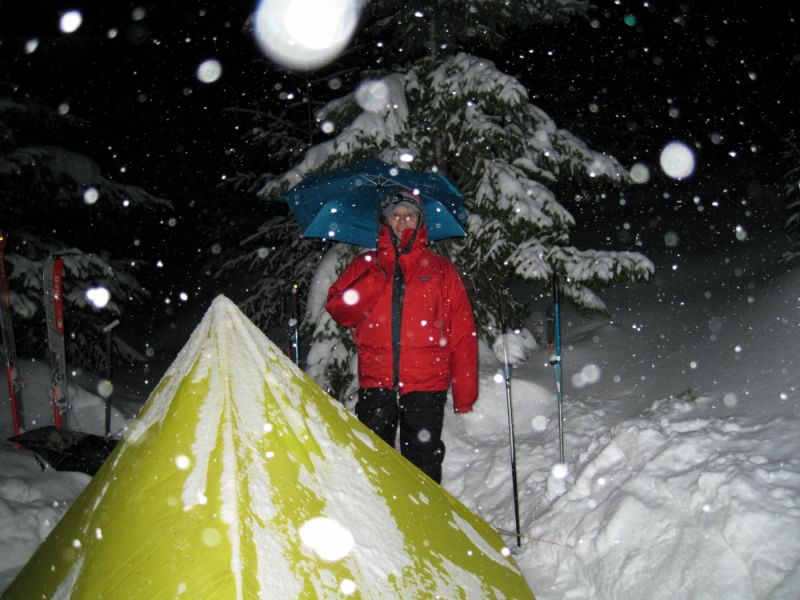
Relatively speaking, we did not go that far, because we wanted to allow plenty of time to pack out our campsites, get in the tents and dry things out, and then relax before the mandatory evening out of the tents watching the snow fall. See the first pic, and note the two umbrellas. An absolute must for every ski camper. :)
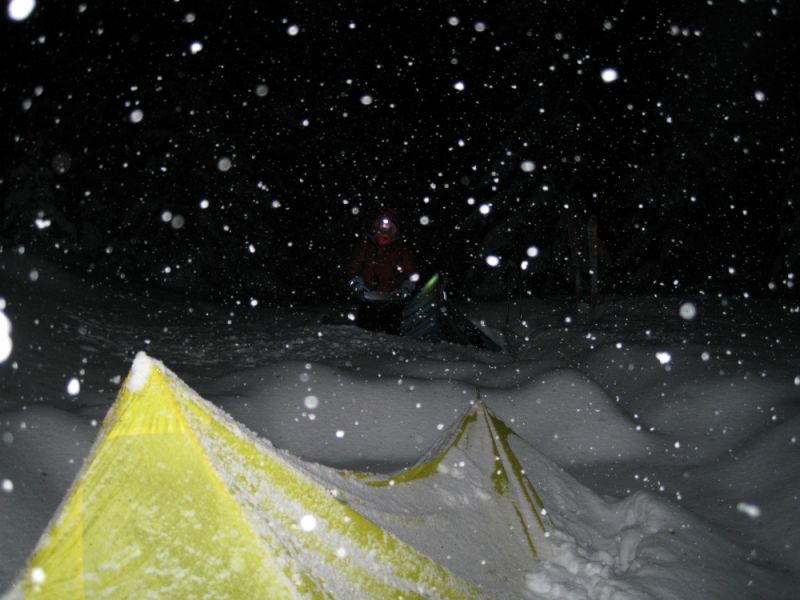
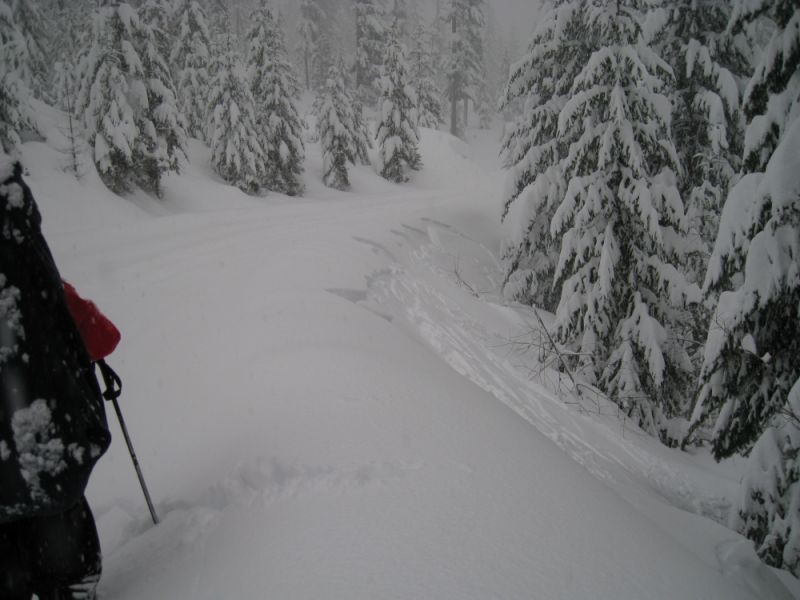
By the next morning, there was an additional 8 inches or more of new. See the second pic. We decided that the big chore for the day was just getting out, so we shoveled out, watched the dawn come, then slowly packed up. I must be getting old; just breaking trail down to the car pooped me out, less so Jane I think. We really started wondering about what was happening on the pass when we saw what's shown in the last pic. These little slides were everywhere. Every little road embankment. In this case the bed surface was a layer of graupel that fell about dawn for an hour or so. Before and after the snow was mostly fine needles.
When we got to the car about 11:30, the plow had been by going in, and by the time we had most of the stuff in the car, it came back down the road, making the drive out easy. Otherwise....
Because the pass was closed, we ended up staying at John's in Roslyn last night (thanks John!) and driving home early this morning. I 90 was in great shape by then, but we saw evidence of significant slides, even in the dark.
Larry
By the time we got to French Cabin Creek Rd, there were 7 to 8 inches new on the road, and in view of the forecast, and what my snowpack model said, ( http://www.larryscascaderesource.com/SasseWinter/current.html ) we decided not to press our luck. My gut feel was that by Wed, anything off RD 4315 that would make for good turns might slide, so at that point, one place is as good as another. By comparison, FCC below ~3000 feet is quite safe, no matter what the conditions. Still, note the last pic below!
We started up the road with about 8 inches new over the groomed surface. Not a sound in the whole valley, which was nice because we were expecting the holiday snomo crowds. We ended up not seeing anyone the whole trip, other than by the road after we came down. We shortcut the road in a few places to make it seem less like road skiing, and then left the road at about 2900 feet. From there to where we camped, the pole depth was 2 feet. Not the time to fall down.
Relatively speaking, we did not go that far, because we wanted to allow plenty of time to pack out our campsites, get in the tents and dry things out, and then relax before the mandatory evening out of the tents watching the snow fall. See the first pic, and note the two umbrellas. An absolute must for every ski camper. :)
By the next morning, there was an additional 8 inches or more of new. See the second pic. We decided that the big chore for the day was just getting out, so we shoveled out, watched the dawn come, then slowly packed up. I must be getting old; just breaking trail down to the car pooped me out, less so Jane I think. We really started wondering about what was happening on the pass when we saw what's shown in the last pic. These little slides were everywhere. Every little road embankment. In this case the bed surface was a layer of graupel that fell about dawn for an hour or so. Before and after the snow was mostly fine needles.
When we got to the car about 11:30, the plow had been by going in, and by the time we had most of the stuff in the car, it came back down the road, making the drive out easy. Otherwise....
Because the pass was closed, we ended up staying at John's in Roslyn last night (thanks John!) and driving home early this morning. I 90 was in great shape by then, but we saw evidence of significant slides, even in the dark.
Larry
So you think you might be getting old? Skiing down for the lead person in lots of unconsolidated snow is work. The following person just stands there, which I, as little sister, was happy to do more than my half of the time. I was comparing the aerobic work of uphill travel v.s anaerobic lifting/pushing of piles of snow with each step on the descent. Going uphill, the skis tips on the Trabs float with each step. Nice. Not much weight to strain hip flexors. Downhill was not the same, ski tips remained buried and the choice was to lift and kick free with each step or plow forward with all the weight of the snow against your leg. I decided to let you figure it out Lar. ;D
One age related tidbit of trivia: one should spend their first social security check on new Trab Free Rando lights. I cheated, I got mine 4 months early since I finally felt too old in the knees for tele anymore. Now if we can keep skiing until we are 90 something like Dad.
Jane
One age related tidbit of trivia: one should spend their first social security check on new Trab Free Rando lights. I cheated, I got mine 4 months early since I finally felt too old in the knees for tele anymore. Now if we can keep skiing until we are 90 something like Dad.
Jane
Nice report. You guys seem to have the winter camping systems totally wired.
Yeah, I'm very willing to trade a bit of downhill performance for uphill (and downhill trailbreaking :'() ease.
Yeah, I'm very willing to trade a bit of downhill performance for uphill (and downhill trailbreaking :'() ease.
Thanks Jim,
I thought I might add a bit about tent lights. A number of people have told me that they don't enjoy winter ski camping even though they have all the gear, because of the long period of darkness. For me, the trick is a good tent light that puts out plenty of lumens. For winter, I'm still using the one I described here several years ago; A Coleman folding florescent light with a minor modification so it can use two rechargeable lithium ion camcorder batteries (RCR-V3). I think lithium batteries are a must, and if you go out a lot rechargeable batteries are nice because otherwise you can go through $10 worth of disposable cells per overnight trip. That is, if you want enough light so that you don't feel like your whole world is a 3 foot area of light. (For summer I use a lighter weight LED lamp that runs on AA lithium batts, which usually last from late spring to early fall.)
The rechargeable camcorder batteries last about 2 1/2 hours per set in my light, even in the coldest weather, so in mid-winter I carry a second set of two. I used to get annoyed by having the tent light suddenly run out of juice at the wrong time, so those who know me will have guessed my solution. :) I generated an Excel spreadsheet prints out a little trip notes sheet that will tell me when it's time to change the batteries. It's here: http://www.larryscascaderesource.com/weird/weird.html
OK, I'll admit it; it's over the top, but the Excel workbook has several worksheets that may be of use for others. It has a table of the time when the tent light will be needed, by date. This turns out to be about 10 minutes before civil twilight in the evening, and 10 minutes after civil twilight in the morning. It's easy to work back to civil twilight if you wish, which is handy because this is the time when it is just light enough to carry on common activities outside without a light. The times listed are for the central Cascades, which are about 5 minutes earlier than those for the Puget Sound area.
There are also tables for sun rise and set, moon rise and set, and phase of the moon, reformatted so they are a bit easier to read than the raw US Naval Observatory ones. The table for moon rise and set is particularly handy for winter stargazing.
It's not necessary to look all these values up for a trip planned for a given day. In the 'printing' worksheet, you can enter the month and day and the values will be displayed in a form suitable for printing (should you have the memory deficit I have).
I've posted the Excel file for 2009, but I've not yet checked it carefully for errors. From past experience, if there are no errors, something's wrong. :)
Larry
I thought I might add a bit about tent lights. A number of people have told me that they don't enjoy winter ski camping even though they have all the gear, because of the long period of darkness. For me, the trick is a good tent light that puts out plenty of lumens. For winter, I'm still using the one I described here several years ago; A Coleman folding florescent light with a minor modification so it can use two rechargeable lithium ion camcorder batteries (RCR-V3). I think lithium batteries are a must, and if you go out a lot rechargeable batteries are nice because otherwise you can go through $10 worth of disposable cells per overnight trip. That is, if you want enough light so that you don't feel like your whole world is a 3 foot area of light. (For summer I use a lighter weight LED lamp that runs on AA lithium batts, which usually last from late spring to early fall.)
The rechargeable camcorder batteries last about 2 1/2 hours per set in my light, even in the coldest weather, so in mid-winter I carry a second set of two. I used to get annoyed by having the tent light suddenly run out of juice at the wrong time, so those who know me will have guessed my solution. :) I generated an Excel spreadsheet prints out a little trip notes sheet that will tell me when it's time to change the batteries. It's here: http://www.larryscascaderesource.com/weird/weird.html
OK, I'll admit it; it's over the top, but the Excel workbook has several worksheets that may be of use for others. It has a table of the time when the tent light will be needed, by date. This turns out to be about 10 minutes before civil twilight in the evening, and 10 minutes after civil twilight in the morning. It's easy to work back to civil twilight if you wish, which is handy because this is the time when it is just light enough to carry on common activities outside without a light. The times listed are for the central Cascades, which are about 5 minutes earlier than those for the Puget Sound area.
There are also tables for sun rise and set, moon rise and set, and phase of the moon, reformatted so they are a bit easier to read than the raw US Naval Observatory ones. The table for moon rise and set is particularly handy for winter stargazing.
It's not necessary to look all these values up for a trip planned for a given day. In the 'printing' worksheet, you can enter the month and day and the values will be displayed in a form suitable for printing (should you have the memory deficit I have).
I've posted the Excel file for 2009, but I've not yet checked it carefully for errors. From past experience, if there are no errors, something's wrong. :)
Larry
Thanks Larry! Your resources and documentation are great. The USFS is lucky to have your help. I especially enjoyed your Scatter Creek video.
Reply to this TR
Please login first: