
Bailey Range Traverse
Kevin Peterson and I completed a ski traverse of the Bailey Range this spring, finally completing a goal inspired by Chris Morgan in 2021. I’m not the first skier to have done this… but I’m almost certainly the worst skier to have done it.
The plan was to enter and exit via the Sol Duc, as the Hoh river road was closed with the washout. We went pretty light when possible - My tiniest “skis” (Hagan Off Limits, 130cm), a lot of calories, and a warm bag for me (a bit over 40 pounds); Very heavy splitboard setup, minimum food, and a tiny quilt for Kevin (just over 50 pounds). We took crampons, skrampons, and one whippet each beyond the usual snow camping setup.
We left on April 1st with great avalanche conditions (post heat-wave) and a good weather window arriving (some sun, not too warm, no new snow), hoping to be out to beat another round of warm rain falling the following Sunday.
Day 1: Wore shoes through intermittent snow until the Sol Duc bridge crossing. I chose to leave my shoes at the bridge, committing to my ski boots for the next six days. Kevin packed his shoes. The crossing felt treacherous with hard snow and ice covering the bridge. The snow wasn’t too deep, though, so it just required a patient straddle-walk.
The first real obstacle I had in mind was the ascending S facing contour to the summit of Mt. Carrie. Having been caught there in the afternoon sun once, I wanted to make sure to get there earlier in the day, which meant pushing as far as we could on Day 1. We made good time up to Heart lake and the high divide, managed a short skin-ski down to the swimming bear junction, and finally set up camp in a clearing just north of the ridge, less than a mile before the ridge began angling up towards Cat Peak.
Day 2: My hope for getting over Carrie by early afternoon was quickly extinguished by the slog up Cat peak. The summer trail is cut out of a steep sidehill, not where I would want to be with snow. Unfortunately, the ridge is narrow, too steep to skin effectively, but too deep to walk without constant postholing. The 1000ft ascent took us about two frustrating hours, some of our slowest movement of the entire trip. From the socked-in summit of Cat we skied down to the bottom of the basin N of the catwalk, the first of many descents on impeccably nonreactive but otherwise fairly miserable snow.
Our second ascent of the day was to regain the ridge on the far side of the catwalk. We put on our crampons and started making our way up a steep snow chute. With the assist of a green belay at the top and Kevin’s zen calm through a poorly timed crampon malfunction, we made it to the far side of the catwalk and proceeded on to the ascent of Carrie. Miraculously, while the sun was poking through, the top of Carrie remained fully shrouded, and the firm snow made for smooth travel to the summit of Carrie. Descending, the half-pipe feature visible from Hurricane Ridge melded with the clouds to make a full whiteout. I couldn’t tell if I was moving at all, or how fast, or in what direction. Kevin led with a strong sense of vibes and I followed him blindly, hugging skier’s right to try to stay as high as possible for our final ascent of the shoulder of Ruth.
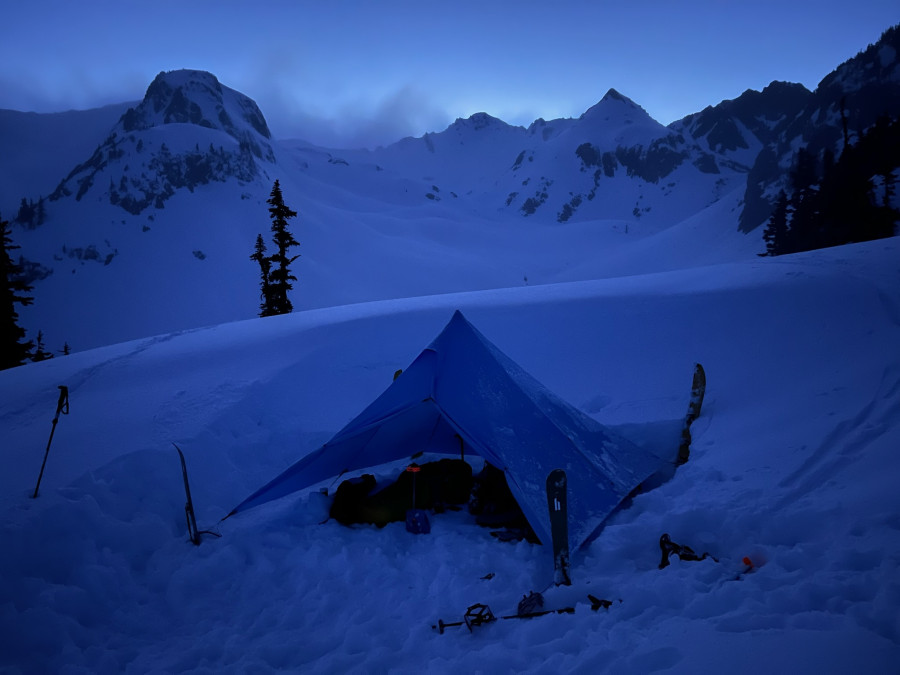
In our effort to maintain elevation we eventually took off our skis and started side-stepping through steep sluffing snow. I think descending further into the basin and taking a more direct route up would be worth trying. By this point in the day I was extremely done with challenging ascents. The slope’s slight convexity made for a receding horizon. Looking ahead I would tell myself: 50 more steps. 50 steps later, the top seemed just as far away. After a few iterations of this and some moderate screaming into the void we made it to the top for another icy and debris-filled ski down to Stephen Lake, where we finally set up camp behind a snowdrift. Writing this summary made me tired.
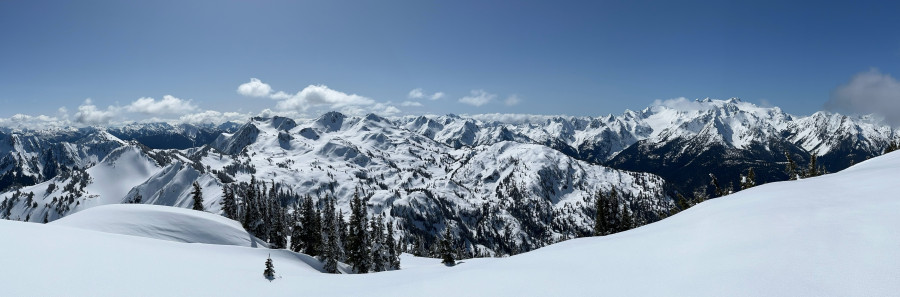
Day 3: The sun was out for the morning in Stephen basin. We found some free water (no melting!) flowing at the outlet, and then started skinning up. We more-or-less followed the summer route here with little to report except a challenging initial skin to gain the bench with an inch of new snow covering the hard melt surface. We got a beautiful view from the shoulder as we crested the ridge - our first clear view of the Bailey range and Olympus massif.
We skied down to the bottom of Ferry basin, proceeded up through Ferry lake, straight across the old glacier lake, up and down pulitzer, and started making our way to the crest just as clouds started to blow in. Large cornices lined the narrow ridge, and we struggled to decide how to approach it. I wanted to go up and over with the promise of easier travel just past the (dull) knife edge but Kevin wisely talked me out of going for it as the winds picked up and clouds started significantly affecting visibility. This was the only time I thought having an ice axe might have changed our path, but ice axe or not I think descending was the correct call in poor conditions. We skied down to the E of the crest and set up camp a bit early for the evening, on top of a summertime tarn. It looked like we would be able to regain the ridge on the other side of the narrow crest, but that would wait for morning.
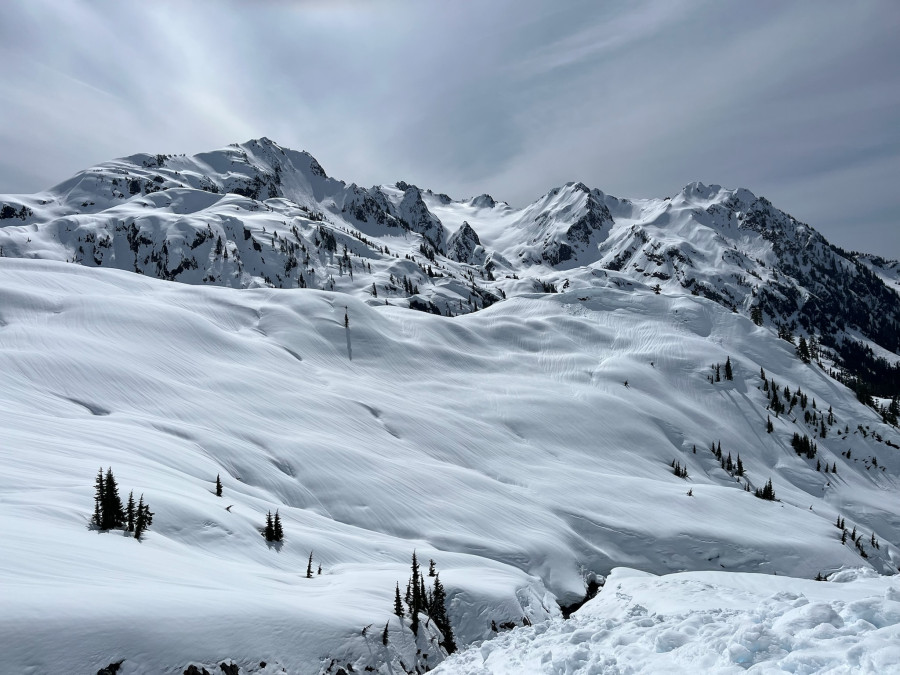
Day 4. Our morning began with our new daily ritual: Pouring boiling water into a small nalgene to put in Kevin’s frozen boots until they thawed enough to put on, welcoming us into the new day with aromatherapeutic steam. Boots on foot, we scouted out our path back to the ridge. Sure enough, it worked, and we continued on. We were approaching a commitment point. Due to some inreach communication errors (test at home…) we hadn’t gotten an updated forecast, and we were starting to feel good about ourselves anyway, so I’m not sure it would’ve mattered. But we approached the descent into Queets basin and our last reasonable escape to low ground down the snowfinger without much discussion - we were going for it. I was interested in attempting to follow the N side of the ridge as far as camp pan (per Steph Abegg), or just far enough to meet the S facing bowl where we could cross the Queets gully, but as there was chance that wouldn’t work and we couldn’t afford to lose half a day we chose the tedious-but-relatively-certain approach. We descended right, picking through bands of refrozen avalanche debris, and took the climber’s guide high route up to the basin over the gully. I didn’t consider dropping to cross at 3400, which may have been a mistake - but the risk of running out of snow, or having too much snow to cross easily, or a hard time getting back up in snow…etc… made dropping seem risky. Regardless, from the high basin Kevin found the line descending skier’s right through debris fields to get us to the bottom of the Humes.
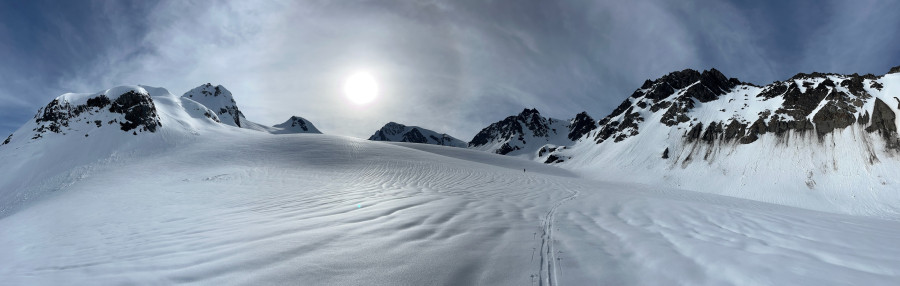
Ascending the headwall was straightforward. We lucked into some free water in a depression in the glacial recession lake, ate some food, threw some baling wire on Kevin’s cracked binding, and proceeded up the glacier. The gentle incline was a welcome respite from the constant up and down. In a world of dying glaciers I forget they are still quite large, and a full mile skinning up the glacier was a good reminder. The skin up blizzard pass was steep but workable. I had been a bit concerned about climbing the pass late in the day but the late-day snow was malleable enough for easy travel. We found our only decent ski descent of the trip on the other side down to camp pan, where we set up camp.
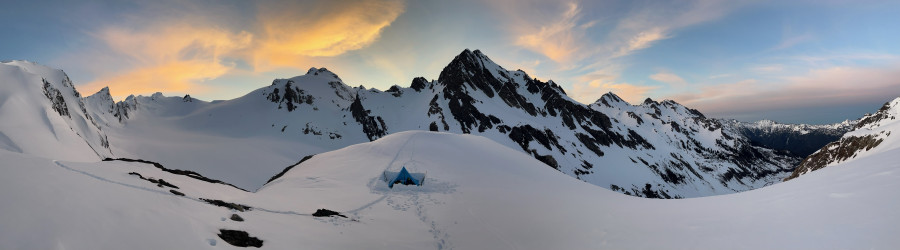
I finally asked for an inreach forecast. The good news was a forecast calling for a maximum overnight wind speed of 3mph. The bad news was that the rain looked to be starting sooner, around 10pm on Saturday night. Hoping to get back to safe avalanche terrain on the high divide before the rain, we had a long day ahead, and we set aside the dream of ascending the Hoh to East/Middle peak for a top-to-bottom descent of the Blue for next year. In the calm wind we decided to set up right on top. After settling in and taking many pictures the wind started to pick up just before sunset. We convinced ourselves it would die down with the evening. It did not. As the tent flapped loudly I put my things in my backpack, and put my pants and jacket back on over my pajamas in preparation for a crisis. With the exception of a single corner around 2am the tent held, and I even managed some sleep.
Day 5. We woke up before first light, ready to get the fuck out of our windy camp. I was nervous for a steep and icy morning ski and again let Kevin lead the descent, forgetting to mention that the line was skier’s left. I caught up to him perched above the steep bottom portion, and I did my best calm breathing routine as we started our day with a precarious transition to boot back up the icy slope. From there the descent was routine and we made our way across the Hoh, stopping for a quick “breakfast” at the base of crystal pass. We again ascended the normal summer route, using skrampons to climb the hard morning snow. The snow descending the blue glacier was cold and very hard, which was perfect for relaxing into the 2-mile, low angle ski. We were now entering the part of the trip I’d taken for granted in planning. We were on trail - how hard could it be?
Looking at old maps I’d hoped we could cross back over from the base to the terminus trail, optimistically ignoring 100 years of glacial recession. We backtracked to the moraine and climbed up, losing precious time. We stopped for second breakfast at the top of the moraine and picked our way through trees down to glacier meadows, ready for fast trail travel just ahead.
As anyone with a topo map could tell you, the top of the hoh trail was heinously steep, seemingly blasted out of near-vertical rock faces. Intermittent drifts and dirt called for frequent transitions. Each gully required focused movement (“walk with intention”, Kevin says) as my skins began to fail and Kevin’s boot crampons still didn’t fit. Finally, though, we made it to Elk Lake, Kevin put on his shoes, we had a third Breakfast of Champions (ibuprofen and adderall…) and started walking down the trail as a growing sense of concern settled in. We reached the junction with the Hoh Lake trail around 5pm and started working our way up the 5000 foot ascent.
In retrospect, walking out the Hoh and asking the park to let us through via inreach would have been well worth some shame. As daylight started to fade we found ourselves back in intermittent snow on the north side of the ridge and our pace fell. As I transitioned back and forth I found myself constantly in the wrong mode of travel. I finally started to lose my grip on attitude along with my skin adhesion and the trail through the woods. Kevin took the lead and kept it together. Our goal of clearing avalanche terrain was obviously out of the question. We decided to call it at the group camp zone at about 4000 feet around 9pm. We set up in the dark and made it into our tent before it began to drizzle around 1030. Kevin poured out our remaining whiskey (truly desperate times) and we tried to sleep.
Day 6. The drizzle persisted through the night and into the morning. We made our way through steep and deep snowy forest to Hoh lake, and then ascended the ridge, sticking mostly to the top or climber’s left when necessary. We quickly found ourselves soaked to the skin, barely staying warm with movement. Even a short pause to check the map left us shivering. The snow was quite wet, the top layer frequently sliding out from under us as we traversed climber’s left of the ridge. I’d hoped to follow the top, but I scouted a rock outcrop and found a vertical drop on the other side, so we backtracked as Kevin made the call to skirt it skier’s left. Kevin took a short slide as the wet snow slid out under a steep step. In a moment of hubris I took the same step and took a slightly longer slide through his slide path, adding a coating of snow to my soaked clothes. Now below the ridge, we ascended to the left of Bogachiel peak to finally reach the high divide.
I had hoped to avoid avalanche terrain by taking the longer heart lake exit, but we were cold enough to prioritize getting off the ridge. We dropped into the seven lakes basin whiteout. Kevin took a gentle ride down in a wet loose slide, and I fell as I skied into the debris pile, ejecting from my skis, incredibly thankful for intact knees. This was the crux risk moment of the trip, where any injury significant enough to slow us down would have left us very cold and very difficult to access in deteriorating weather, begetting of some significant post-trip reflection. We were too cold to stop and ponder, so we skinned through the basin, slowed by the quartet of ski straps keeping my skins attached to reach the WNW side of Round Lake.
Ascending to the notch in the ridge from climber’s right, we were again slowed by a thick layer wet sliding snow. The correct notch does not match the map, but the obvious notch is the correct one. We finally reached the top to begin the ski down to Deer Lake. Kevin chose the gully and I followed, gracelessly picking my way around large open holes with running water below while Kevin shivered patiently. Snow became scarcer as we navigated the intersecting streams, finally reaching the open field just SE of the lake, which was somehow criss-crossed by yet more intersecting streams. Sticking to our-left side of the creek, we crested over a small hill to finally reach trail with some relief. I paused to eat, but Kevin was too cold to take a break and began the march down. After yet another Breakfast of Champions I followed. My last note is that the Deer Lake trail is quite rocky and thus extremely uncomfortable to walk down in ski boots. Anyway: we lived.
Approaching Carrie Summit
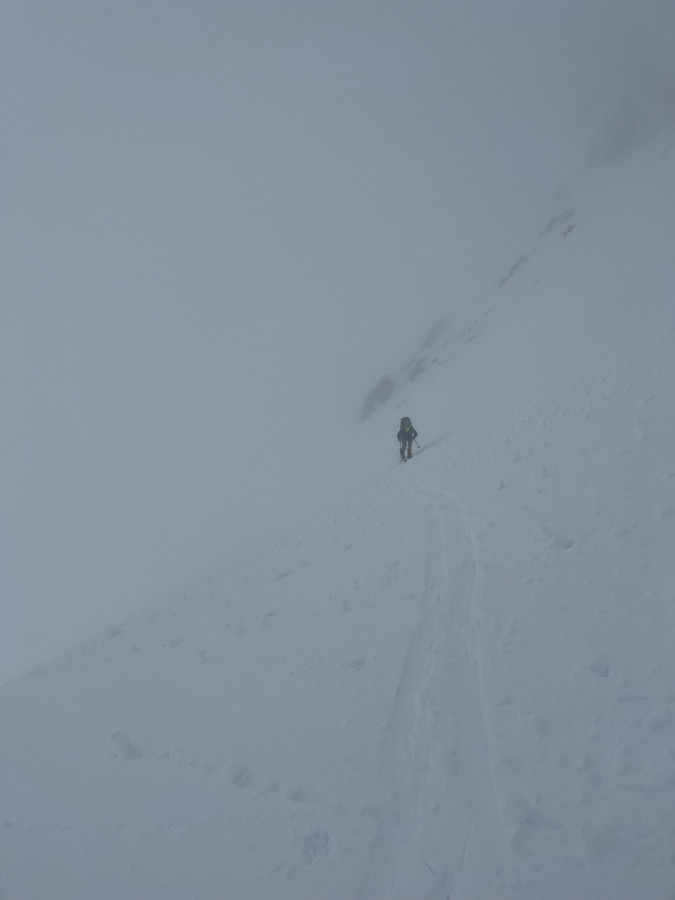
Looking back from Ruth shoulder
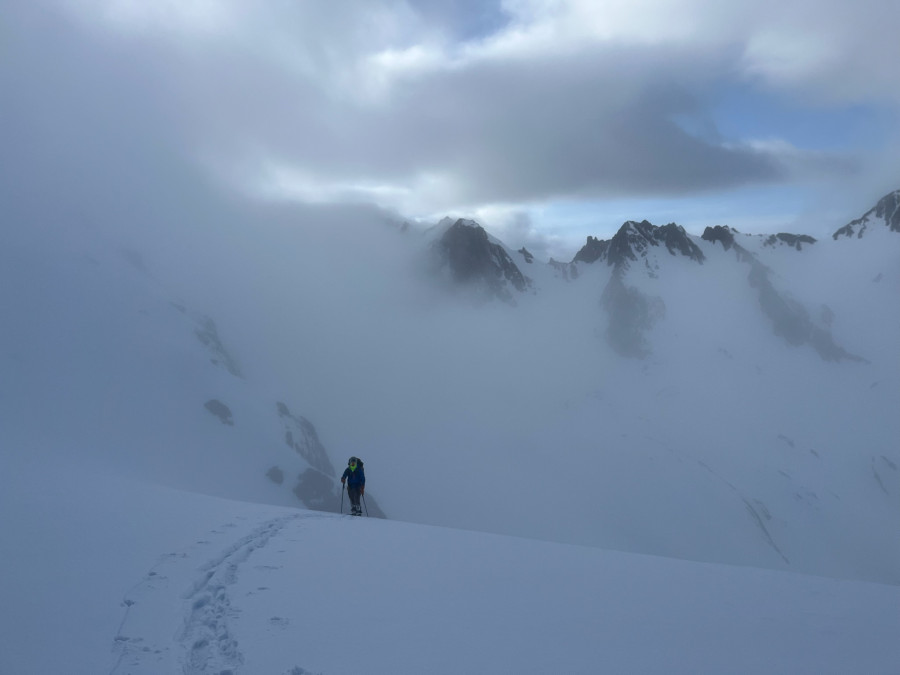
Looking back from Ruth Shoulder
Camp near Stephen Lake
View from Stephen Shoulder
Track across Ferry Glacier Lake
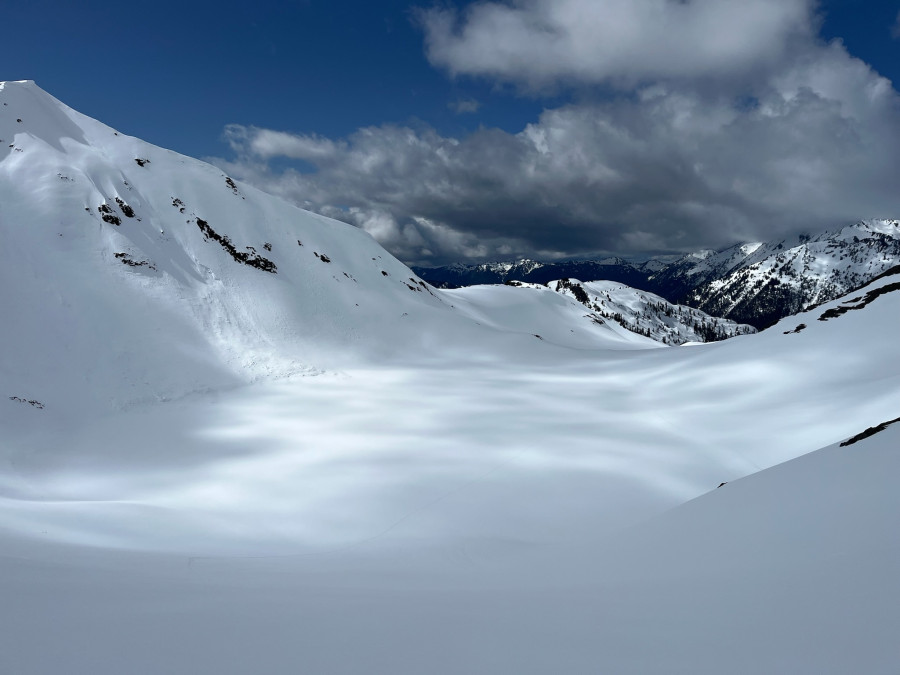
Queets Basin runnels
Ascending Humes Glacier
Camp Pan
Reply to this TR
Please login first: