
- Posts: 1460
- Thank you received: 16
Rando-rhythms: Thoughts on fast skinning
- Lowell_Skoog
-
 Topic Author
- User
-

Less
More
17 years 1 month ago - 17 years 1 month ago #186857
by Lowell_Skoog
Rando-rhythms: Thoughts on fast skinning was created by Lowell_Skoog
Most of my ski touring this winter has been rally-style workouts. While others enjoyed epic days of corn in January and powder in March I’ve been mostly constrained to two-hour sessions, usually at night, around the margins of local ski areas. It’s a way to stretch my backcountry ski muscles that fits my current obligations, and I have no complaints. Next winter will probably be different.
I’ve been lucky to share these sessions with friends, and it’s been fun to push each other in practice and then sign up for Vertfest to see if our workouts have done us any good. At both the Crystal and Alpental rallies, I was impressed by Ben Parsons of Montana, who won both races and is probably the fastest racer in the U.S. this year. I remember watching Parsons pull away during the first climb at Alpental, and noting how much quicker his stride cadence was than anyone else in the race. Like bike racers, I think the top rando racers try to “spin,” working their legs in relatively short, quick strides, shifting much of the work from their quads to their lungs.
After the Alpental event I decided to experiment with this idea during my weekly workouts. During my first post-Alpental session, I simply climbed like usual, but with the cadence dialed up a bit. I quickly realized why the top racers go for really light boots and skis, but I also found that by the end of the session my upper body was getting tired trying to keep up with my legs, without a clear benefit. I was doing the basic stride that anybody who’s ever strapped on a pair of skins knows how to do. For the sake of discussion, call it the one-for-one stride (below).

In the one-for-one stride, every movement of your legs is matched by a corresponding movement of your arms. When a foot moves forward, so does the opposite hand. This is indicated in the diagram above by matching numbers. At step 1, the left ski and right pole move forward. At step 2, the opposite ski and pole move forward. I discovered that it was less tiring (and just as quick) to de-couple my arms and legs so that I sometimes took more than one step between pole plants.
The next time I went out, I decided to explore this idea further. Moving the poles at random times seemed inefficient, so I played around with movements that were synchronized with my strides, but not one-for-one. The rhythm I liked best is what I call the three-by-four stride, shown below.

The three-by-four stride has three pole plants for every four strides. The downhill hand (during a diagonal ascent) moves forward with the opposite foot, just as in the one-for-one stride. But the uphill hand moves only half as fast. At every other step of the uphill foot, both hands swing forward and plant the poles together. My subjective feeling is that this stride makes it easier to keep my stride cadence high without getting winded as badly as the one-for-one stride would do.
During a follow-up session, I shared these ideas with my workout partner and he suggested that it might be good sometimes to simply move both poles together repeatedly. We experimented with timing, and my feeling was that the best rhythm was a two-by-three stride. In this stride, both poles are planted on every third step. (Every two steps seems too quick, while every four steps seems too slow.) This is shown in the diagram below. At step 1 in each cycle, both hands drive forward to plant the poles simultaneously.

When does each stride work best?
All of these ideas are subjective and preliminary. For all I know, the experts may have evaluated and rejected these ideas years ago. Ideally, it should be possible to validate whether these ideas are any good using an altimeter, a stopwatch, and a heart-rate monitor. I’d be curious to know whether anyone has ever done something like that. In any case, it’s fun to experiment with these things to see if rando-racing can teach us techniques that are useful for everyday touring.
I’ve been lucky to share these sessions with friends, and it’s been fun to push each other in practice and then sign up for Vertfest to see if our workouts have done us any good. At both the Crystal and Alpental rallies, I was impressed by Ben Parsons of Montana, who won both races and is probably the fastest racer in the U.S. this year. I remember watching Parsons pull away during the first climb at Alpental, and noting how much quicker his stride cadence was than anyone else in the race. Like bike racers, I think the top rando racers try to “spin,” working their legs in relatively short, quick strides, shifting much of the work from their quads to their lungs.
After the Alpental event I decided to experiment with this idea during my weekly workouts. During my first post-Alpental session, I simply climbed like usual, but with the cadence dialed up a bit. I quickly realized why the top racers go for really light boots and skis, but I also found that by the end of the session my upper body was getting tired trying to keep up with my legs, without a clear benefit. I was doing the basic stride that anybody who’s ever strapped on a pair of skins knows how to do. For the sake of discussion, call it the one-for-one stride (below).
In the one-for-one stride, every movement of your legs is matched by a corresponding movement of your arms. When a foot moves forward, so does the opposite hand. This is indicated in the diagram above by matching numbers. At step 1, the left ski and right pole move forward. At step 2, the opposite ski and pole move forward. I discovered that it was less tiring (and just as quick) to de-couple my arms and legs so that I sometimes took more than one step between pole plants.
The next time I went out, I decided to explore this idea further. Moving the poles at random times seemed inefficient, so I played around with movements that were synchronized with my strides, but not one-for-one. The rhythm I liked best is what I call the three-by-four stride, shown below.
The three-by-four stride has three pole plants for every four strides. The downhill hand (during a diagonal ascent) moves forward with the opposite foot, just as in the one-for-one stride. But the uphill hand moves only half as fast. At every other step of the uphill foot, both hands swing forward and plant the poles together. My subjective feeling is that this stride makes it easier to keep my stride cadence high without getting winded as badly as the one-for-one stride would do.
During a follow-up session, I shared these ideas with my workout partner and he suggested that it might be good sometimes to simply move both poles together repeatedly. We experimented with timing, and my feeling was that the best rhythm was a two-by-three stride. In this stride, both poles are planted on every third step. (Every two steps seems too quick, while every four steps seems too slow.) This is shown in the diagram below. At step 1 in each cycle, both hands drive forward to plant the poles simultaneously.
When does each stride work best?
- The one-for-one stride is the default, bread-and-butter stride. If my skins are slipping out or I’m bogging down for some reason, I revert to this basic stride.
- The three-by-four stride has become my favorite for cruise-control while climbing, especially on switchbacks. The downhill arm is moving faster and working harder in this stride, but it gets a break each time you switch to the other direction.
- The two-by-three stride provides a nice change of pace, and it’s especially good on flats or gentle climbs where skin slippage is not a problem.
All of these ideas are subjective and preliminary. For all I know, the experts may have evaluated and rejected these ideas years ago. Ideally, it should be possible to validate whether these ideas are any good using an altimeter, a stopwatch, and a heart-rate monitor. I’d be curious to know whether anyone has ever done something like that. In any case, it’s fun to experiment with these things to see if rando-racing can teach us techniques that are useful for everyday touring.
Please Log in or Create an account to join the conversation.
- LeeLau
-

- User
-
Less
More
- Posts: 23
- Thank you received: 0
17 years 1 month ago #186859
by LeeLau
Replied by LeeLau on topic Re: Rando-rhythms: Thoughts on fast skinning
I don't rando-race. I did do some skinning with heart-rate monitors when I first got one. I'm among the faster ascenders in most groups but not a rando-racer (I know that because I've skied with the Traslins). Having said that these are things which decreased my heart-rate and improved my efficiency and that worked for me when skinning.
Using just one pole. I stick one pole behind my pack and just use one pole. One arm is pretty much kept stationary.
Using long strides and a pronounced forward motion of the hip. Self-explanatory
Using mohair skins. Better glide. I measured 4% lower heart rate on a particular gentle climb with mohair skins vs synthetic skins.
Of course this is over the course of a normal touring day and not a rando race.
Using just one pole. I stick one pole behind my pack and just use one pole. One arm is pretty much kept stationary.
Using long strides and a pronounced forward motion of the hip. Self-explanatory
Using mohair skins. Better glide. I measured 4% lower heart rate on a particular gentle climb with mohair skins vs synthetic skins.
Of course this is over the course of a normal touring day and not a rando race.
Please Log in or Create an account to join the conversation.
- randosteve
-
- User
-
Less
More
- Posts: 9
- Thank you received: 0
17 years 1 month ago #186878
by randosteve
Replied by randosteve on topic Re: Rando-rhythms: Thoughts on fast skinning
I think the 2X3 stride (double poling) is used when rando racers are tired. Often described as "hanging on your poles"...and usually uses more upper body strength.
Please Log in or Create an account to join the conversation.
- coldiron
-
- User
-
Less
More
- Posts: 12
- Thank you received: 0
17 years 1 month ago #186996
by coldiron
Replied by coldiron on topic Re: Rando-rhythms: Thoughts on fast skinning
Hi Lowell-
Interesting topic, and one that I've been studying a bit this year.
While racing in Europe last year I noticed the high cadence of Euro World Cup racers. Later, I studied a lot of video (way too much time on my hands) and discovered some variance- but very often a cadence that was close to 110 strides per minute. Sometimes it would be as high as 130, but only at the start of a race, or in a very fast race like the relays. Late in the race, turnover rates slow, but rarely to under a stride rate of 100.
This is markedly faster than what is typically seen in a U.S. race. I should note, however, that a slower turnover with a long, powerful stride is used very effectively by some, and Brian Wickenhauser has been known to thoroughly kick my butt while using this very method.
Pete Swenson, who is hands-down the fastest U.S. racer at the moment, was using a nice Euro technique at the A-basin race a couple weeks ago. His opinion is that this technique is most useful as you tire in a race and at higher altitudes, where the long stride and extra poling demand too much oxygen. Pete is in my (somewhat arbitrary) opinion, the most technically sound racer in the US also, with lots of European rando race experience, and many years as a pro mountain biker under his belt.
With a faster turnover, it is common to use a double pole - right plant - double pole - right plant with the poling motions coming on each left step, or vice versa. To see what I mean, check out the '09 Euro Championships video . This pattern is often modified with multiple single plants following each double plant. It feels awkward at first, but if done with a light, quick touch soon feels natural and fast. It is confusing in print but easy to see on video.
I've been using this technique all season and find that it is a great tool, especially on steeper switchbacks. On a low angle fast section the traditional stride still seems to be more efficient, and I switch back and forth often.
Uh-oh, I've exposed my hidden race geek enough... time to shut up.
-scott
one more thing... you should all watch this video just because it's cool!
Interesting topic, and one that I've been studying a bit this year.
While racing in Europe last year I noticed the high cadence of Euro World Cup racers. Later, I studied a lot of video (way too much time on my hands) and discovered some variance- but very often a cadence that was close to 110 strides per minute. Sometimes it would be as high as 130, but only at the start of a race, or in a very fast race like the relays. Late in the race, turnover rates slow, but rarely to under a stride rate of 100.
This is markedly faster than what is typically seen in a U.S. race. I should note, however, that a slower turnover with a long, powerful stride is used very effectively by some, and Brian Wickenhauser has been known to thoroughly kick my butt while using this very method.
Pete Swenson, who is hands-down the fastest U.S. racer at the moment, was using a nice Euro technique at the A-basin race a couple weeks ago. His opinion is that this technique is most useful as you tire in a race and at higher altitudes, where the long stride and extra poling demand too much oxygen. Pete is in my (somewhat arbitrary) opinion, the most technically sound racer in the US also, with lots of European rando race experience, and many years as a pro mountain biker under his belt.
With a faster turnover, it is common to use a double pole - right plant - double pole - right plant with the poling motions coming on each left step, or vice versa. To see what I mean, check out the '09 Euro Championships video . This pattern is often modified with multiple single plants following each double plant. It feels awkward at first, but if done with a light, quick touch soon feels natural and fast. It is confusing in print but easy to see on video.
I've been using this technique all season and find that it is a great tool, especially on steeper switchbacks. On a low angle fast section the traditional stride still seems to be more efficient, and I switch back and forth often.
Uh-oh, I've exposed my hidden race geek enough... time to shut up.
-scott
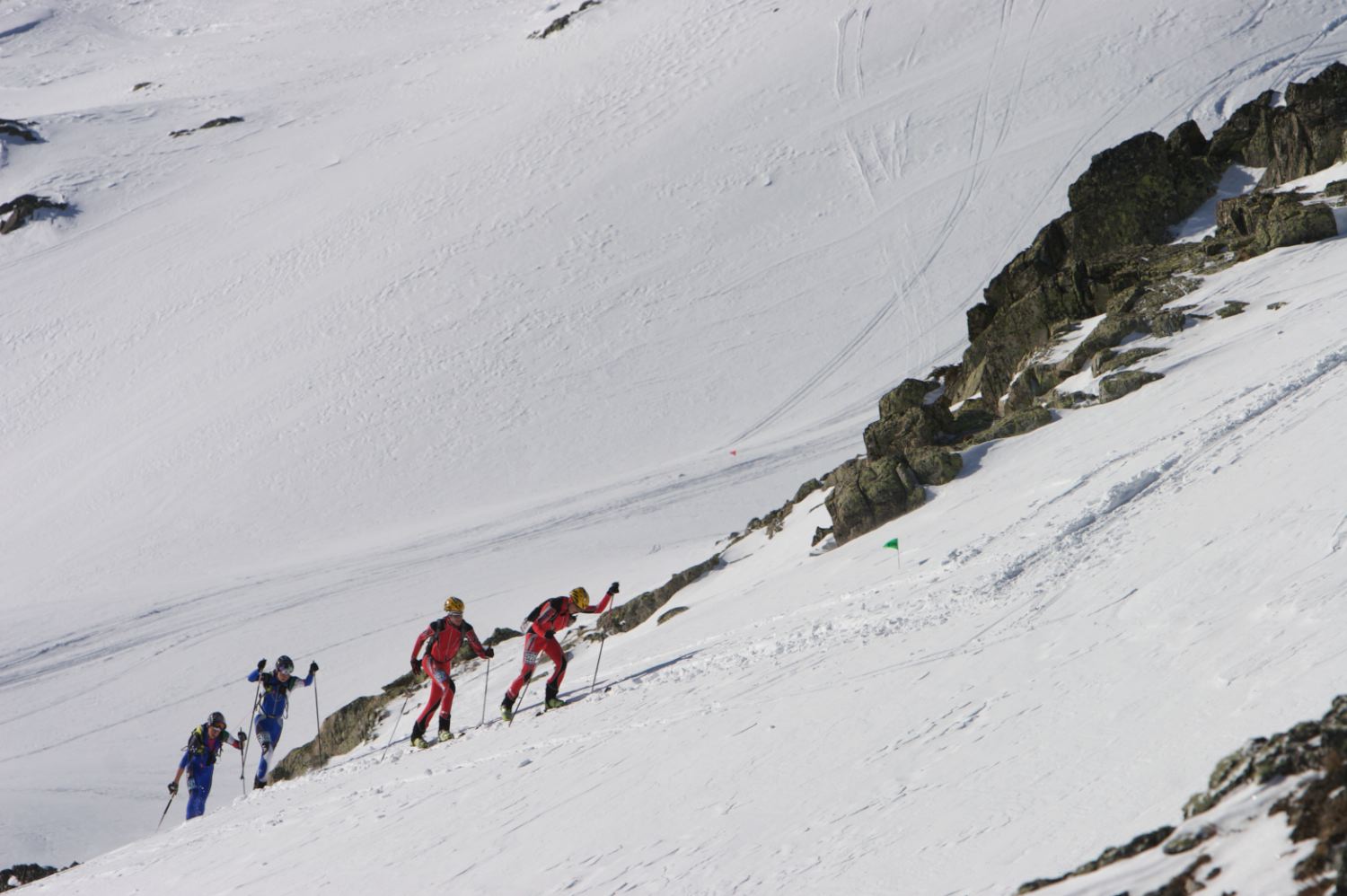
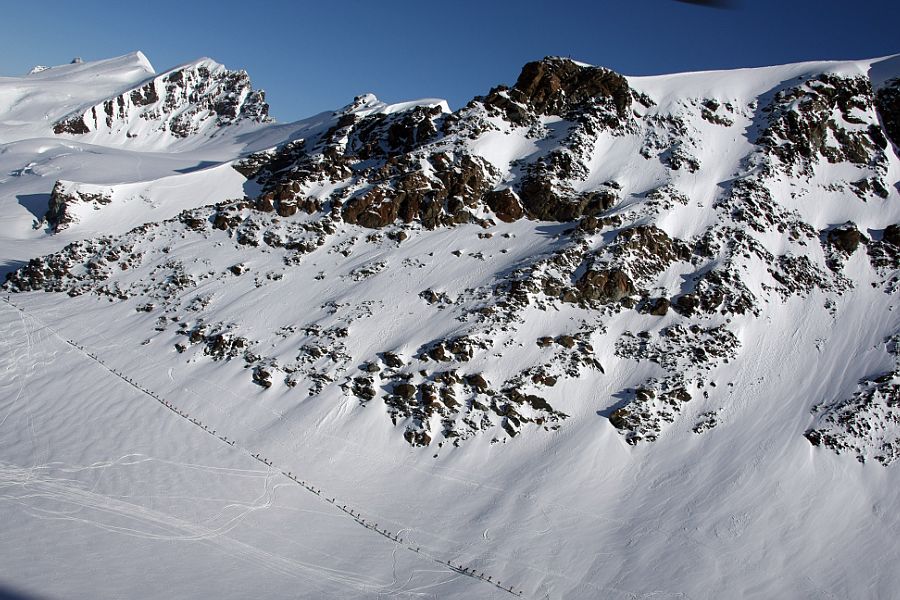
one more thing... you should all watch this video just because it's cool!
Please Log in or Create an account to join the conversation.
- Jonathan_S.
-
- User
-
Less
More
- Posts: 290
- Thank you received: 0
17 years 1 month ago #186997
by Jonathan_S.
Replied by Jonathan_S. on topic Re: Rando-rhythms: Thoughts on fast skinning
Gotta love the soundtrack in that first video and the terrain in the second (e.g., knife-edge ascent and roped descents).
So re stride length, what is the baseline we're talking about here? I mean, assume relatively average leg length, and skis the standard 160-164cm range, then where is the binding toe piece matching up relative to the ski tip?
So re stride length, what is the baseline we're talking about here? I mean, assume relatively average leg length, and skis the standard 160-164cm range, then where is the binding toe piece matching up relative to the ski tip?
Please Log in or Create an account to join the conversation.
- Lowell_Skoog
-
Topic Author
- User
-
Less
More
- Posts: 1460
- Thank you received: 16
17 years 1 month ago - 17 years 1 month ago #186998
by Lowell_Skoog
Thanks Scott!
It's great to hear from somebody who's seen European techniques (and knows where to find the videos).
I'm excited to watch the Alpago video because it confirms that I'm not crazy. If you watch the last team member of the first blue team (at about 1:00 into the video) you see a perfect example of what I called the 3x4 stride. (It's also what you explained above, I think.) I described it like this:
The blue racer at the 1:00 mark does this exactly. I see other racers doing it too, but I also see a lot of variations. I see fluid timing in the video and places where the racers use double-poling strides of various sorts (2x3 or 2x4 strides, for example). My initial post was overly simple, but a good beginning, I think.
Earlier this winter I took my first-ever nordic skating clinic from Don Portman at Sun Mountain Lodge. It was fascinating to see how refined the nordic skating techniques are. It seems logical that skinning techniques should be more refined than the simple 1x1 diagonal stride that everybody knows. Watching the European racers confirms that this is true.
As we start to talk about this stuff, I hope we can come up with better terminology than the nordic skaters use. Even after skiing with Don Portman (one of the best instructors in the country, I'm sure) I still have trouble remembering the difference between V1, V2, V2 alternating, and so on. Those names are terrible! I've tried to apply names that are somewhat meaningful (like the 3x4 stride), that describe the relationship between the arm and leg movements.
Replied by Lowell_Skoog on topic Re: Rando-rhythms: Thoughts on fast skinning
With a faster turnover, it is common to use a double pole - right plant - double pole - right plant with the poling motions coming on each left step, or vice versa. To see what I mean, check out the '09 Euro Championships video . This pattern is often modified with multiple single plants following each double plant. It feels awkward at first, but if done with a light, quick touch soon feels natural and fast. It is confusing in print but easy to see on video.
Thanks Scott!
It's great to hear from somebody who's seen European techniques (and knows where to find the videos).
I'm excited to watch the Alpago video because it confirms that I'm not crazy. If you watch the last team member of the first blue team (at about 1:00 into the video) you see a perfect example of what I called the 3x4 stride. (It's also what you explained above, I think.) I described it like this:
The three-by-four stride has three pole plants for every four strides. The downhill hand (during a diagonal ascent) moves forward with the opposite foot, just as in the one-for-one stride. But the uphill hand moves only half as fast. At every other step of the uphill foot, both hands swing forward and plant the poles together.
The blue racer at the 1:00 mark does this exactly. I see other racers doing it too, but I also see a lot of variations. I see fluid timing in the video and places where the racers use double-poling strides of various sorts (2x3 or 2x4 strides, for example). My initial post was overly simple, but a good beginning, I think.
Earlier this winter I took my first-ever nordic skating clinic from Don Portman at Sun Mountain Lodge. It was fascinating to see how refined the nordic skating techniques are. It seems logical that skinning techniques should be more refined than the simple 1x1 diagonal stride that everybody knows. Watching the European racers confirms that this is true.
As we start to talk about this stuff, I hope we can come up with better terminology than the nordic skaters use. Even after skiing with Don Portman (one of the best instructors in the country, I'm sure) I still have trouble remembering the difference between V1, V2, V2 alternating, and so on. Those names are terrible! I've tried to apply names that are somewhat meaningful (like the 3x4 stride), that describe the relationship between the arm and leg movements.
Please Log in or Create an account to join the conversation.